Get Full Government Meeting Transcripts, Videos, & Alerts Forever!
Get email alerts on the Building Code topic
No spam. Unsubscribe anytime.
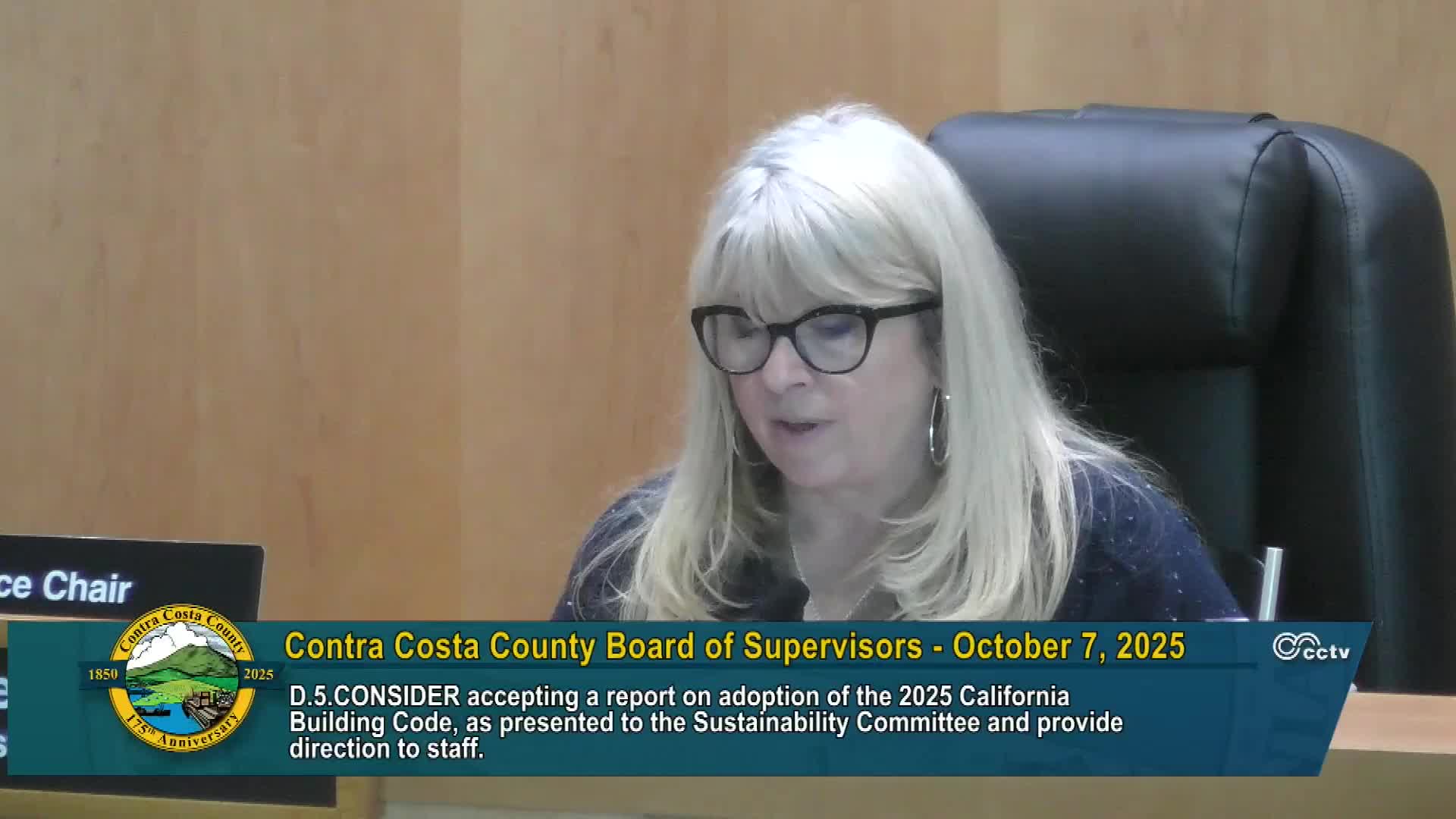
County staff to prepare ordinance adopting 2025 California building code with limited local amendments
Summary
Staff recommended and the board accepted a plan to adopt the 2025 California building code with select local amendments (notably keeping the county'''s stronger EV-parking requirement) and to defer new energy-code amendments pending cost-effectiveness studies; the ordinance is slated for introduction Oct. 21 and a hearing Nov. 4.
Contra Costa County building officials told the Board of Supervisors on Oct. 7 that the statewide 2025 California Building Code becomes effective Jan. 1, 2026, and asked permission to prepare a local ordinance adopting the new code with a small set of local amendments.
Building Director Jason Crapo said state law (including recent budget-related legislation) narrows local authority to create new residential code amendments through June 1, 2031, but county staff recommended continuing a stronger local requirement that at least 10% of parking spaces in new residential and nonresidential developments be equipped with electric vehicle charging. Crapo said energy-efficiency standards in the 2025 state code now exceed the county'''s earlier local amendments, so the county need not keep those local energy provisions. He also noted that any future local energy amendments must be supported by cost-effectiveness findings and approved by the California Energy Commission; such studies are not yet available for the 2025 code.
Crapo recommended the board direct staff to draft an ordinance to adopt the 2025 state code with the specified local amendments, introduce the ordinance on Oct. 21 (consent) and schedule a public hearing Nov. 4 so the adopted code can take effect Jan. 1, 2026.
The board accepted staff'''s recommendation and asked staff to return with the ordinance on the announced schedule.
Why it matters: The building code determines construction standards affecting housing and commercial development; the state code'''s strengthened energy standards (including rooftop solar and electrification measures) shaped staff recommendations.
What'''s next: DCD will prepare the ordinance for an Oct. 21 introduction and a Nov. 4 public hearing; staff will monitor cost-effectiveness studies if future local energy amendments are considered.