
EPA says it will bring federal researchers to probe PCBs in Clark Fork River after Smurfit site visit
Get AI-powered insights, summaries, and transcripts
Subscribe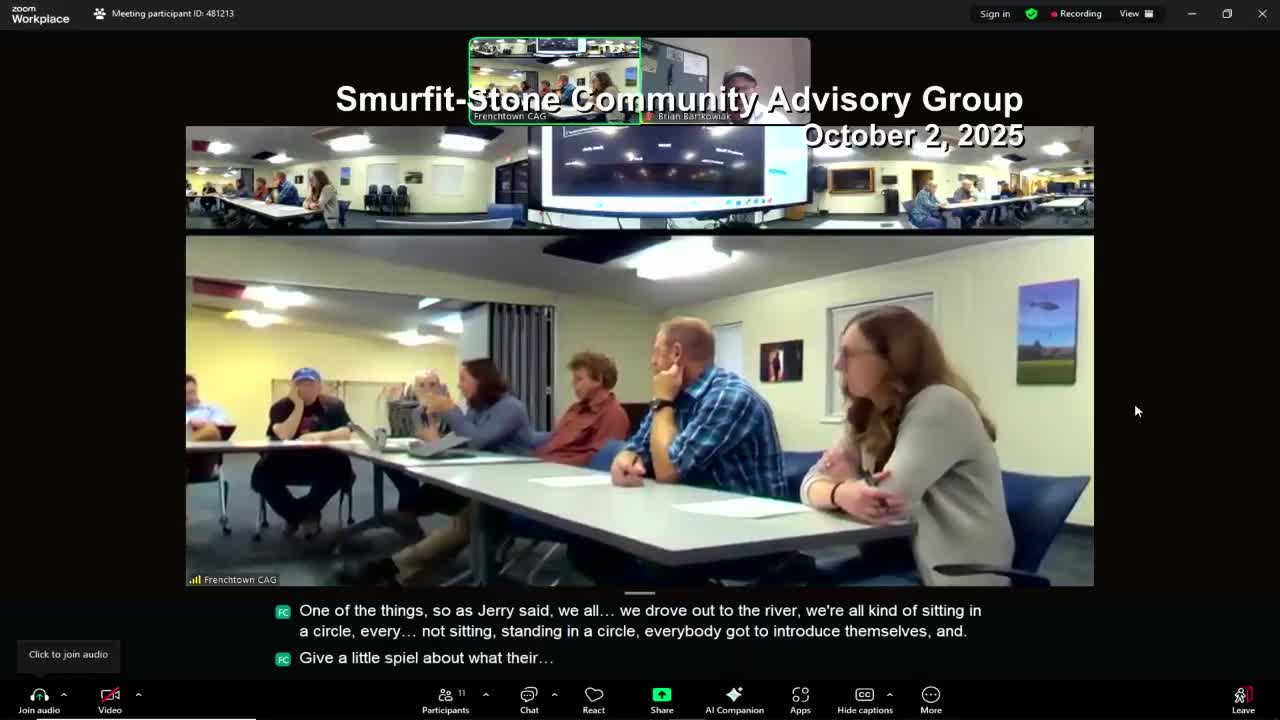
Summary
At an Oct. 2 meeting of the Smurfit community advisory group (KAG), participants said EPA Region staff committed federal research resources to investigate whether PCBs found in local fish originate from the Smurfit (Smurfit-Stone) mill site or from other sources up- and downstream.
EPA officials and community members said federal researchers will be brought to the Clark Fork River to help determine whether polychlorinated biphenyls (PCBs) found in fish tissue are linked to the Smurfit mill site.
The announcement came after a Sept. 24 site visit with Congressman Zinke’s staff and EPA and state officials. Brian Chapman, executive director of the Global Coalition and meeting facilitator, described the trip and repeated that EPA staff told the group they planned to bring Office of Research and Development staff to analyze broader sources of PCBs in the Clark Fork River.
Why it matters: Residents and resource managers have flagged high PCB concentrations in fish and asked whether those toxins originate from the mill or multiple upstream sources. Determining sources affects cleanup priorities and whether further sampling and remedies should focus narrowly on the Smurfit property or on a broader stretch of the river.
Community members at the meeting credited the EPA’s stated commitment to add research capacity. “I was glad to hear that,” said a participant summarizing the agency’s response; meeting notes record that Aaron, identified as the director of Superfund and Emergency Management for EPA Region 8, said he would bring researchers to examine where PCBs in the Clark Fork River are coming from, using fish-tissue and passive-sampling data collected by state and federal partners.
Speakers and local agencies said the planned federal research would draw on existing datasets: state fish-tissue sampling from 2018–2019, EPA passive sampling, and more recent data collected by Fish, Wildlife & Parks under a toxins grant. Meeting participants said those data have not previously supported a clear source attribution.
Several participants emphasized the scale of historic industrial activity along the river and the difficulty of assigning a single source. Chris Stark, staff scientist for the Confederated Salish and Kootenai Tribes (CSKT) legal department, warned that tribes view incomplete data handling and discarded studies as eroding trust: “Throwing away data and not allowing the trustees of all people to come look at these sites…that’s gotta stop,” he said.
EPA and state staff present described next steps in the Superfund process: compiling data into the site’s remedial investigation (RI) and moving toward a feasibility study. At the meeting, DEQ staff said data-summary reports from recent sampling events were under agency review and could be finalized in the coming weeks; those finalized summaries, participants said, will be brought into the RI.
What was not decided: The meeting did not record a formal EPA commitment in the form of a signed plan or timetable; participants recorded agency statements of intent and steps in the RI/feasibility-study sequence, but no formal local vote or binding schedule.
The discussion closed with calls for transparent handling of existing data, and for EPA to explain how the incoming research team will integrate previously collected fish-tissue and passive-sampling datasets.