
Port Richey council continues rewrite of city sign code; digital signs, abandoned-sign rules debated
Get AI-powered insights, summaries, and transcripts
Subscribe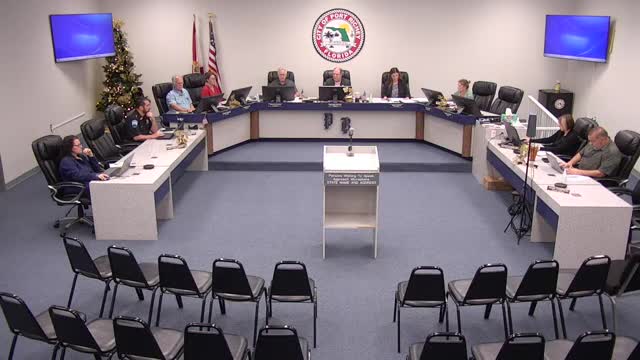
Summary
Council members and staff reviewed a proposed rewrite of Port Richey's sign regulations, discussing temporary signs, nonconforming/abandoned signs, drive-through menu boards, illuminated address numbers and new rules for digital displays. Staff was directed to revise language and return with clarified draft.
Port Richey City Council members and city staff spent a workshop session reviewing a near-complete rewrite of the city's sign regulations, focusing on when signs should need permits, how long abandoned signs stay up, how drive-through menu boards are counted, and new standards for digital and illuminated signs.
The discussion matters because the rewrite would set citywide limits on political and temporary signage, establish rules for nonconforming signs, and create the first comprehensive standards for digital displays and interactive signs. Those rules affect businesses, developers and residents'visibility and how the city enforces signs on public rights-of-way.
Council and staff worked section-by-section through the draft. City Attorney Nancy Meyer, who repeatedly explained draft language and legal limits, said the proposal retains the longstanding option to allow some existing signs to remain but warned that code language must not inadvertently require businesses to change lawful signage immediately. "You can't grandfather anything in as well," Meyer said when explaining which signs could remain under prior approvals. City Manager Andrew Butterfield and Planning staff (identified in the meeting as Veronica) answered technical and implementation questions about setbacks, illumination and permitting procedures.
On temporary and abandoned signs council members debated enforcement time frames. The draft set a 6-month standard before a permanent on-site sign could be classified as "abandoned"; several members said that was too long. Vice Mayor Chris Mayer and Councilman Robert Hubbard favored shortening the time frame, and Council consensus leaned toward a shorter period (council members suggested 90 days or three months as a workable compromise). "Six months seems reasonable if somebody closed the business to to take care of their sign," Mayer said, but later added, "I don't think six months. I think three months is reasonable."
Members also discussed nonconforming signs (signs that were legal when installed but later made noncompliant by code changes). The draft would require some nonconforming signs to be removed or brought into compliance within 90 days of the code's effective date; staff and attorneys agreed the language should be clarified to reflect whether that 90-day clock should apply to signs made temporarily nonconforming or to all nonconforming signs. Nancy Meyer said she would verify whether the proposed language matched state law and the city's existing nonconforming provisions.
Drive-through restaurant signage drew detailed attention. The draft said one menu sign is permitted "in proximity to the drive-through lane for the purpose of ordering." Council members noted modern restaurants often have multiple lanes and multiple ordering points. "I think we probably we're worded to be up to 2 per drive-through lane," one council member said in the discussion; members asked staff to reword the provision to allow one menu sign per drive-through lane (or otherwise clarify a per-lane approach) rather than limiting all restaurants to a single sign.
The rewrite also proposes a new digital-sign section. Staff explained proposed technical limits: a minimum display time for one message, automatic dimming for nighttime, and measures to keep malfunctioning displays dark. Planning staff said the draft borrowed heavily from Pasco County language but P&Z had already edited that passage. Council members struck an early draft sentence that would have required property owners to remove other temporary or nonconforming signs when they installed a digital display; members felt that was unfair and could be interpreted as favoritism. The council directed staff to remove or reword that sentence.
After extended discussion the group settled on two practical points about digital displays: (1) a minimum message dwell time should be required so messages are readable from the roadway, and (2) interactive displays should be limited to pedestrian, touch-enabled installations rather than anything that could be activated by passing drivers. In the workshop members agreed on an interim minimum dwell time recommendation of eight seconds per message and asked staff to allow smooth transitions/animations rather than banning any transition effects.
Projecting and roof signs also drew debate. The draft currently prohibits projecting signs above the building roofline; several members asked for flexibility for building-mounted signs that project above the roofline but remain reasonably sized and engineered. Council discussion settled around a practical limit for projecting elements above the roofline (members suggested an upper limit in the single-digit feet range; staff noted many freestanding and pole signs are already limited to 15'20 feet). Staff was asked to draft clearer, numeric height limits tied to building height and engineering requirements.
Other items addressed in the workshop included: - Rights-of-way signage: the draft would continue to prohibit most signs in the public right-of-way but also asked staff to clarify how temporary signs, campaign signs and garage-sale signs relate to private property boundaries and maintenance expectations. - Address numbers and small residential identification signs: council members said they want illuminated house numbers to be allowed (solar or low-voltage) without triggering a permit; staff will mark those items for explicit exemption. - Awnings, canopy and colonnade signs: staff proposed a 25% maximum sign-to-awning ratio; council members suggested a larger share (one member proposed 50% or 75%) and asked staff for examples and visuals.
No new ordinance or final vote was taken at the workshop. Instead council directed staff and the city attorney to reword several sections for clarity and consistency, to verify any places where proposed rules might conflict with state law or existing city code, and to return a revised draft for adoption. Planning staff also was asked to consult with the city's wayfinding consultant (Wayfinder) before finalizing digital-sign standards and before releasing the ordinance for formal readings.
Votes at a glance
- Motion to adjourn the workshop: passed (voice vote).