Orange City council reviews FY2025–26 budget, agrees to add two police officers and events coordinator as staff weighs millage increase
Loading...
Summary
Devlin Moore, Finance Director for the City of Orange City, told council the proposed FY2025–26 budget is balanced but relies on transfers and several policy choices; council signaled support to add two police officers and a parks/events coordinator while weighing a possible millage increase to 7.2387.
Devlin Moore, Finance Director for the City of Orange City, told the council at an Aug. 10 budget workshop the proposed fiscal year 2025–26 budget is balanced but relies on transfers from fund balance and a number of recurring and nonrecurring adjustments. The presentation framed choices for council about restoring previously cut items, funding new positions and whether to raise the millage rate ahead of September public hearings.
Moore said the draft budget assumes a current millage of 6.8691, includes a projected general fund balance of about $5.4 million (with a planned $147,000 transfer out leaving roughly $5.3 million), and balances recurring revenue and recurring expenditures with a modest recurring surplus (about $253,000 in his presentation). He told the council the budget currently relies on several one-time items in the current year that reduce other revenues, and noted FEMA, insurance proceeds and unspent current-year dollars could restore some of the post-Milton pulls to fund balance.
The budget presentation listed several post-publication additions staff recommended funding from the recurring variance rather than new cuts: reinstating a grant-writer position ($30,000), an increased attorney-services allocation (additional $64,000 to a $98,200 total), and a $4,200 increase for a fireworks event. Staff also asked the council whether to restore smaller items such as a $2,349 camera for the public information officer; council members responded in the affirmative when asked if they were “okay with that proposed change.”
Council and staff debated a fingerprinting machine for public use. Chief Miller explained the equipment could be offered to the public for a fee but staffing to operate it was the limiting factor. Council consensus was to defer purchasing the fingerprinting machine because the city currently lacks staff or reliable volunteers to operate it.
Capital priorities and City Hall renovation
Moore summarized the capital program as about $7 million across the general fund, capital improvement fund and facility construction fund, with the facility construction fund showing a $7.9 million starting balance and a $4.0 million appropriation proposed for final design of three buildings (leaving about $3.9 million). He said $700,000 in capital funds are currently earmarked as the city’s match for elevating East Grama Avenue.
Council spent substantial time on City Hall interior needs. Staff described water and roof damage that have left baseboards and drywall deteriorated and asbestos removal and other interior remediation likely; participants referenced an architect’s forthcoming estimates and discussed staging the work so staff can occupy leased space while renovations proceed. Staff estimated the full interior program could run in the low‑seven‑figure range (council referenced an estimate around $1.1–$1.2 million), but emphasized any expenditures would come back to council for individual approvals.
Police staffing and public safety
The most prolonged discussion concerned police staffing. Chief Miller reported four current sworn vacancies, with one officer in the academy and one in field training, and asked the council to consider two additional officer positions in next year’s budget to reduce overtime, support new school resource officer responsibilities (University High School and River Springs Middle) and improve patrol coverage. Moore provided a cost estimate for adding positions and associated equipment and noted the two vehicles for the new officers could be paid from police impact fees.
Council members voiced safety and retention concerns. Council member Dawn and Council member Dana urged funding to reduce overtime and improve officers’ work–life balance; Council member Stafford argued retention is part of the solution but said the department needs more officers given workload and recent assumptions of SRO duties. After discussion, council signaled consensus to include two police officer positions in the FY2025–26 draft budget rather than leaving them unfunded.
Unfunded positions and events staffing
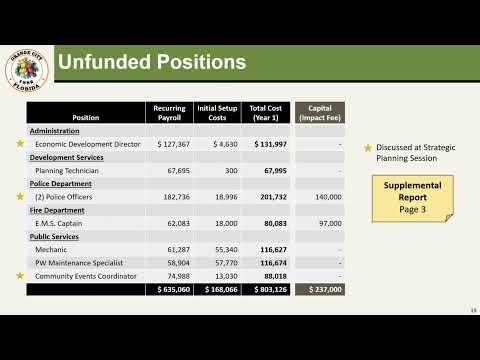
Staff presented a list of eight unfunded requested positions (economic development director, planning technician, two police officers, EMS captain, mechanic, public works maintenance specialist and a community events coordinator) with a recurring payroll estimate near $635,000 and setup costs of about $168,000. Council agreed to defer adding an economic development director for now, and to move the two police officers and a community events coordinator from unfunded to funded in the draft budget. The events coordinator would be placed in Parks & Recreation and is intended to consolidate special-event paperwork and planning that staff said has expanded beyond the capacity of the current PIO and parks team; Parks staff agreed the new role would take the event-application and on-site coordination workload off the manager’s office and PIO.
Pay adjustments and other costs
Moore confirmed pay adjustments discussed previously are reflected in the budget, including $691,000 for pay adjustments (which reflected earlier executive-session direction), a $40,000 compensation study line, and $70,000 for a fire assessment study. He said post-publication salary adjustments discussed that night would add about $274,356 to recurring costs.
Millage-rate discussion
Moore presented one option to fully fund the additions shown that would increase the millage to 7.2387 (from 6.8691), which he calculated would be an 11.33% increase over the rollback rate and would require five council votes. He said the average taxable home value used in the analysis was about $146,000 and that the illustrative tax impact of that millage would be about $108 per year (roughly $9 per month) on that average home. Council members were split but several said they were prepared to recommend the increase to fund public safety and the events coordinator; others cautioned about impacts on residents on fixed incomes. No formal vote was taken at the workshop — staff noted millage and tentative budget hearings occur in September and a formal vote on the tentative millage must follow statutory notice requirements.
Next steps and ledger review
Moore asked whether the council wanted a second budget workshop on Aug. 25; council members asked to review the general ledger and budget breakout staff provided before deciding whether to hold another workshop. Moore noted any final budget or capital spending would come back to council for formal approval and reminded the council of statutory deadlines for tentative and final millage and budget adoption in September.
Ending
Council members closed the workshop having given staff direction to include two police officers and a community events coordinator in the FY2025–26 draft budget, to reinstate several post-publication items (grant writer, PIO camera and attorney funding as proposed by staff), and to defer one-time purchases such as the fingerprinting machine because of staffing limitations. The council did not take a formal vote on millage but heard staff’s calculation of the possible increase and its estimated homeowner impact. Staff will return refined estimates and formal ordinance/advertising language for council action in September.