Get Full Government Meeting Transcripts, Videos, & Alerts Forever!
Get email alerts on the Land And Water Budget Grants Invasives Wildlife Erosion topic
No spam. Unsubscribe anytime.
Adams County land‑and‑water budget gains state grant support; debate over phragmites treatment, wildlife damage and erosion funding
Summary
County conservation staff told the Adams County Land and Water Committee that state allocations will raise local conservation staff funding and that a $17,000 nutrient‑management education grant was awarded for 2026.
County conservation staff told the Adams County Land and Water Committee that state allocations tied to the debt‑cap storm grant will increase the county’s 2026 conservation aids account and that a locally written nutrient‑management education grant was fully awarded.
‘‘We were looking for a $20,200,000 increase statewide. We were given approximately 11,200,000,’’ Colton said when describing the state biannual budgeting outcome and its local effect; he said the county will see roughly $58,000 more in staff funding and about $4,000 more in cost‑share allocations in the draft 2026 allocation.
Colton also reported the county was fully awarded a nutrient management farmer education (NMFE) grant worth about $17,000 for 2026 to help producers write nutrient‑management plans. On invasive‑species work, staff said remaining carryover funds from a Wisconsin DNR early‑detection grant will be used for phragmites control at a nonmetallic‑mining site in the Town of Leola. Staff said the county contracted with Environmental Resource Consulting (ERC) for chemical control this year—‘‘there were 4 chemical treatments applied over the course of the year’’—and that the county is responsible for native replanting after treatment.
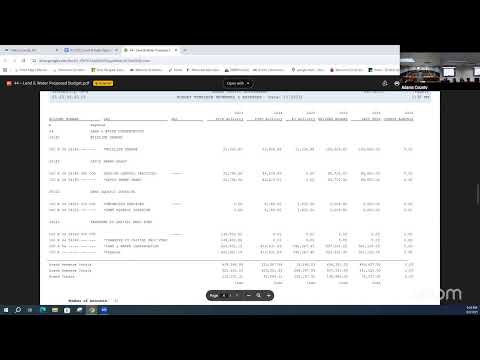
Supervisors raised procedural and policy concerns over chemical treatments and site selection. One supervisor said she might move to cut the carryover line item from the budget; that motion was made on the floor but died for lack of a second. Committee members also discussed a wildlife‑damage program administered with USDA‑APHIS support that would funnel stipends to farmers for damage from deer, birds and other species; the line item discussed is budgeted at $100,000. A motion to cut that wildlife‑damage line (identified in committee discussion as line item 56180) was also made and failed for lack of a second.
On erosion control, staff explained that $88,000 is budgeted as cost‑share for ‘‘hard’’ practices (gully control, stream‑bank protection) and softer practices such as cover crops and nutrient‑management planning; that funding is part of the larger debt‑cap allocation breakdown. Supervisors asked whether alternatives such as contour farming had been considered; staff said those programmatic details can be debated when specific projects are brought forward and that the budget sets categories rather than project‑level practices.
Other notes: staff said the county will not act as fiscal agent for one of two producer‑led watershed groups in 2026, and planning staff are finishing a 10‑year plan draft that will be returned to committee and the board this fall before a state presentation.
Ending: No budget line items were cut at the committee meeting; proposed motions to remove funding for invasive‑species response, wildlife‑damage stipends and erosion cost‑share died for lack of seconds. Staff will bring more project‑level detail back to the committee and to the full county board as the budget process continues.