Get Full Government Meeting Transcripts, Videos, & Alerts Forever!
Get email alerts on the Public Defense topic
No spam. Unsubscribe anytime.
Public defender office asks commissioners for four attorneys; officials warn private‑market replacements would cost more
Summary
Spokane County public defense leaders requested about $480,653 to fund four attorney positions for 2026, saying losing the positions would increase reliance on expensive private contracts and lengthen case processing; presenters gave comparative cost and capacity data for public vs. private representation.
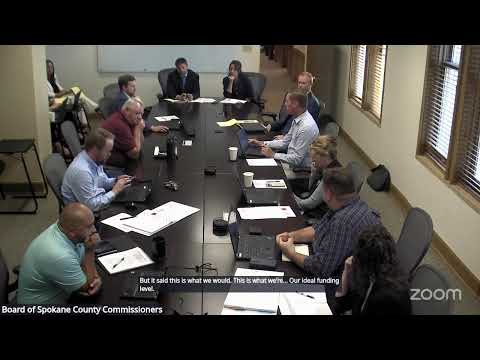
The Spokane County public defense director, accompanied by business manager Michelle Lee, told commissioners the office submitted a 2026 budget that would require four additional attorney‑level positions to meet local caseload demand and ethical standards for representation.
The office said the target budget from the administrator would leave the public defender’s office short roughly $480,653, the amount the office identified as the salary and benefit cost for four attorneys. Public defense leaders explained that eliminating those positions would force the county to send an estimated 406 misdemeanor filings and roughly 300 felony filings to private counsel under current assignment practices; the county’s existing conflict‑counsel contracts are limited in capacity and the private‑market rates are substantially higher than the county’s cost to provide services in‑house.
Officials walked commissioners through current assignment and capacity data, including several data points generated from 2023–2024 filings: the county’s in‑house cost per assigned case under Supreme Court/WSBA standards is materially lower than private‑market rates; current county conflict contracts pay flat rates (e.g., $1,200 per misdemeanor, $1,800 for felony class A with additional hourly pay after 20 hours at $110/hour); private attorneys contacted by the office quoted wide market ranges (homicide representation ranges cited in the briefing from roughly $20,000 to $100,000). The presenters noted this private‑market volatility and capacity shortfall as a reason to preserve in‑house positions.
Public defense leaders outlined mitigation steps they are already using: moving first‑appearance attorneys into caseloads where needed, prioritizing in‑custody assignments, and pursuing additional grant funding from the Office of Public Defense (OPD) and other sources to hire more attorneys in January (the office expects a distribution of approximately $1.05 million in January OPD funding that will fund several hires). They also said they are implementing better time‑tracking and data collection to monitor workloads and to align assignments with WSBA case‑credit standards.
Commissioners asked several procedural and statutory questions about case‑waiting rules and the feasibility of using ECR/docket options and about whether legislation or an expanded state funding role could shift the county’s burden. The public defense director said the office will continue to pursue grants and will return with more detail on assignment changes, time tracking and the plan for January hires.