Get Full Government Meeting Transcripts, Videos, & Alerts Forever!
Get email alerts on the Juvenile Detention topic
No spam. Unsubscribe anytime.
Juvenile court warns proposed cuts would reduce supervision, training and electronic‑monitoring capacity
Summary
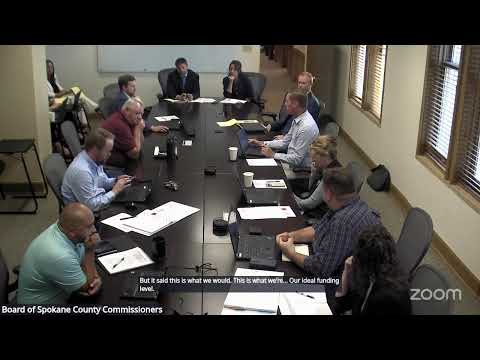
Spokane County juvenile court leaders told commissioners proposed budget cuts for 2026 would eliminate positions, reduce supervision and training capacity in the juvenile detention center, and could increase out‑of‑county placements and use of Martin Hall under a fixed 99‑year contract.
The juvenile court director told the county commissioners that a proposed set of cuts to the juvenile court’s 2026 budget would remove staff and services the court considers high‑risk to public safety and to the juvenile case model used in Spokane County.
The presentation said the juvenile department has 88 full‑time positions (68 county funded and 20 state funded), with four current vacancies. The department told the board it needs roughly $8.0 million to maintain current operations; the budget office’s target reduced that request and the department proposed a package of cuts to reach the target. The department characterized the net proposed cut as an 8.5% operational reduction (about 10% including position removals taken in 2025), and said that would materially affect services.
Court officials described specific program and position impacts they would prioritize for restoration if money returns later in the budget process: a flex‑shift detention supervisor (responsible for floor coverage and training new juvenile corrections officers), juvenile corrections officers (JCOs), probation and diversion counselors, and staff supporting electronic monitoring (EM). The director said Spokane’s diversion program referred 418 youths in 2024 and is nationally recognized; cutting a diversion/probation counselor would slow processing and reduce the program’s effectiveness.
The juvenile presentation detailed an increase in cases and risk: a 12% increase in supervision cases from the prior year and a 34% increase since 2022, plus rising assault case filings. Staff noted Washington statutes and local practice require casework and oversight; the director said many juvenile care tasks are mandated by RCW and cited the Family First Act as increasing in‑home dependencies and supervision workload.
The department described its EM program as a core detention‑alternatives tool that provides 24/7 monitoring (geofences, location monitoring) and reported 212 new EM placements in 2024 representing a total of 431 monitored days; program staff provide home and school checks. Removing EM counselors, the director said, would reduce the number of youths who can safely remain in the community while monitored.
Commissioners and staff discussed Martin Hall, a long‑term out‑of‑county placement consortium. The director said the county pays a contract amount for Martin Hall (the budget showed a roughly $403,000 contract figure previously and a current number near $456,000 for 2025) and that the county’s contractual obligation is long term. Commissioners asked whether the county could staff up and accept more contracted beds from other counties to generate revenue; presenters said the limiting factor historically has been staffing and that bed rates paid by other counties have ranged and are currently under negotiation.
Court leadership said they will prioritize restoring detention staffing and EM counselors if the commissioners provide additional buy‑back funding later in the budget process. No formal budget decisions were made in the meeting; commissioners asked for follow‑up materials and emphasized the difficulty of the choices.