
St. Pete Beach committee reviews tentative FY26 budget; staff recommends $5.8 million transfer to resiliency fund
Get AI-powered insights, summaries, and transcripts
Subscribe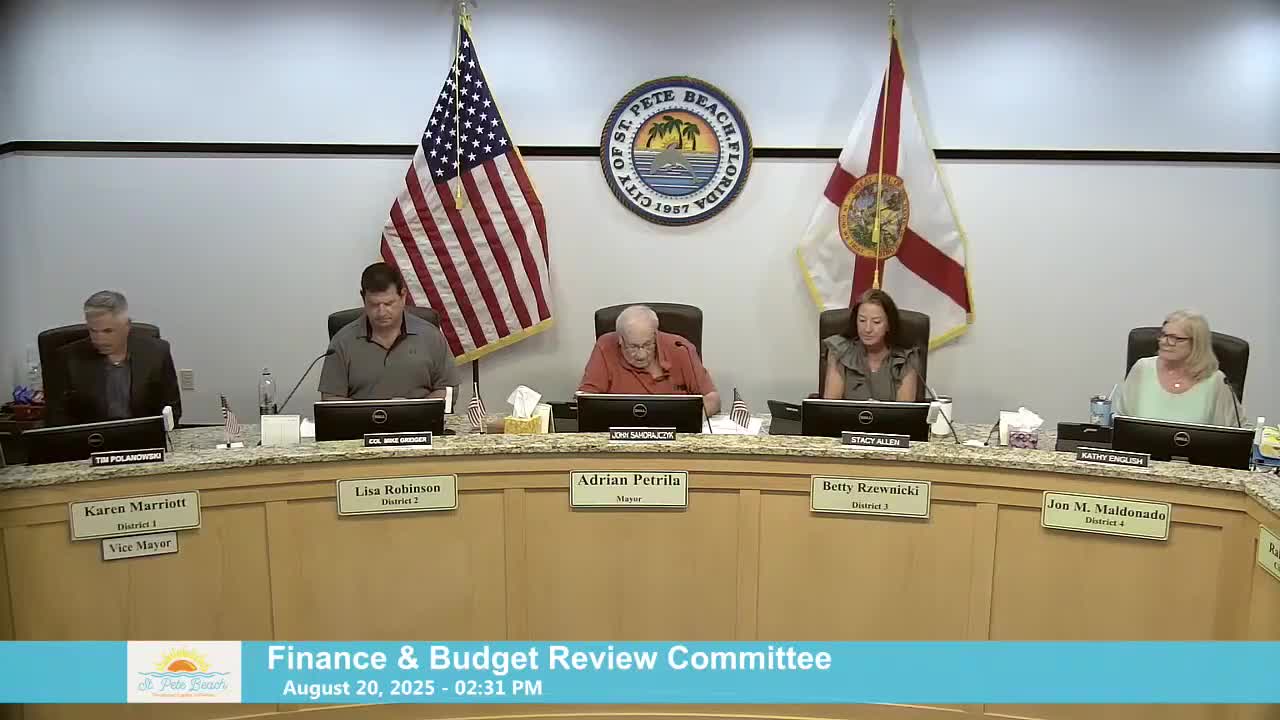
Summary
Finance staff presented the tentative budget and proposed policy changes, disclosed a $5.8 million previously earmarked fund balance that staff recommends transferring to a newly defined resiliency fund, and outlined policy changes on reserves, performance pay and quarterly reporting ahead of commission hearings in September.
Devin Schmidt, the city finance director, presented the tentative fiscal-year 2026 budget and a set of new financial policies at the Aug. meeting of the St. Pete Beach Finance & Budget Committee, saying the packet was expanded so the city can apply for the Government Finance Officers Association (GFOA) Distinguished Budget Award.
Schmidt told the committee the draft budget includes a recommended transfer of $5,800,000 that had been set aside by a 2022 resolution but not previously included in the general fund balance used to launch the FY26 budget. The staff recommendation is to move that amount into a resiliency fund to be used for shoreline protection, seawall replacement, watershed management and adaptation projects identified under the city—s comprehensive plan.
Why it matters: moving the $5.8 million to a resiliency fund would make the money available for capital and adaptation projects and reduces the practice of using general-tax dollars to subsidize enterprise funds, staff said. The committee will forward recommendations to the full City Commission, which will consider the proposed budget and millage at two public hearings in September.
Key changes and policy proposals
- Fund-balance reconciliation and transfer: Schmidt said the city—s Annual Comprehensive Financial Report and the audit (completed July 31) revealed an unassigned general-fund balance item of $5,800,000 that had not been carried into the tentative budget. Staff recommends transferring that amount into the resiliency fund and holding the general-fund unassigned balance at 35% of operating expenditures (excluding transfers out). Schmidt described the 35% figure as the operating-reserve target and said anything above that level should be directed to capital or resiliency projects with commission approval.
- Formal reserve targets: The draft financial policy proposes a minimum general-fund unassigned reserve of 25% for liquidity, plus an additional 10% tied to catastrophic preparedness (yielding a 35% operating target). Staff proposes that replenishment of any draws on the catastrophic portion occur within three years using surplus, FEMA reimbursements or insurance proceeds.
- Resiliency and capital projects: The resiliency fund packet lists planned projects such as shoreline protection improvements, a community seawall replacement, a watershed management master plan, and three adaptation projects. Schmidt highlighted that some projects will span fiscal years and are shown as reappropriation items in the five-year capital improvement plan. One capital change noted in the packet increases the estimated cost of Fire Station 22 from $5 million to $7 million.
- Personnel and pay-structure changes: The FY26 packet includes a 2.6% cost-of-living adjustment (COLA). As a budgeting placeholder, staff included an additional 1.5% to be allocated through a new performance-evaluation framework: employees meeting minimum standards would receive COLA; higher-performing employees could receive COLA plus 1% (good) or COLA plus 2% (high performers, estimated to be about 20% of staff). Schmidt said managers would define performance standards and that employees on performance-improvement plans could have COLA withheld until standards are met.
- Vacancy budgeting: For larger departments that historically operate below 100% staffing (public services, community development, library, parks & rec, fire), staff applied a budget vacancy factor so the adopted budget more closely matches expected payroll outturns.
- Audit and accounting items: Schmidt told the committee the late completion of the annual financial report meant the FY26 tentative budget was launched from the 2023 balance sheet during earlier workshops. Auditors will present the annual comprehensive financial report and a management letter to the commission; Schmidt said there are three audit recommendations (deficiencies), but no material weaknesses. He said the city—s single-audit work will increase because FEMA reimbursements pushed federal expenditures above the new $1 million single-audit threshold.
- Reporting and GFOA application: The packet adds a city-manager—s budget message and more narrative (community profile, strategic roadmap) to align with GFOA best practices. Staff proposed quarterly reporting (balance sheet, income statement, fund balances) to the commission and integrating performance measures into the budget over time. Schmidt said the city intends to apply for the GFOA Distinguished Budget Award beginning with the 2026 budget.
Public and committee discussion
Committee members pressed staff for clarity on the $5.8 million and the mechanics of the balance-sheet reconciliation; one member emphasized that the finding was not cash "found in a closet," but a fund-balance entry that had not tied to the cash accounts. Committee members also asked for clearer quarterly reporting (balance sheet, income statement, fund balance) and requested a follow-up that maps capital and maintenance spending by district to improve transparency about perceived imbalances in project distribution (several committee members cited concerns that Pass-a-Grille had received disproportionate attention after storm recovery work).
Next steps and schedule
Staff asked the committee for consensus on the tentative budget and said the City Commission will receive the same packet at an upcoming commission workshop. The commission will hold the first public hearing and millage-setting at its Sept. 8 meeting and a second hearing and adoption at its Sept. 22 meeting. Committee members scheduled an "after action" discussion for Nov. 5 to review process improvements for the 2027 budget cycle.
Ending
Schmidt and staff thanked budget staff for the packet and analysis; Vanessa Sanchez, the city—s budget management analyst, received a specific acknowledgment for her work on the document. The committee made no formal changes to the budget numbers at the Aug. workshop; staff will relay the committee—s recommendations to the commission ahead of the September hearings.