Get Full Government Meeting Transcripts, Videos, & Alerts Forever!
Get email alerts on the Community Redevelopment Agency Budget topic
No spam. Unsubscribe anytime.
Port Richey CRA reviews FY26 budget, CIP priorities and developer request for tax assistance
Summary
Port Richey City’s Community Redevelopment Agency discussed a proposed FY26 spending plan that emphasizes land acquisition, parks and wayfinding, and heard about an 8.5‑acre developer request for roughly $4.7 million in assistance via tax rebates; no formal budget vote was recorded at the meeting.
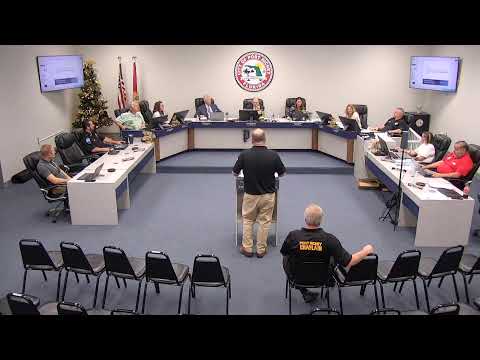
Port Richey City’s Community Redevelopment Agency on Tuesday reviewed a draft fiscal year 2026 budget and capital improvement plan that would prioritize land acquisition, park projects and signage, and set aside funds while staff continues discussions with a private developer seeking city assistance.
The budget discussion, led by Finance Director Adam Thompson and City Manager Andrew Butterfield, showed CRA fund revenues projected to rise from about $4.91 million to $5.34 million in FY26, driven in part by higher taxable values in the CRA district. Butterfield told the board a developer working on an 8.5‑acre mixed‑use project has asked the city to consider assistance to close an estimated $4.7 million financing gap, including a request for a 15‑year, 75% tax rebate as one option.
The CRA matter matters because the agency captures tax increment revenue from redevelopment; money used for incentives or rebates can affect what the city and county collect for services and how quickly redevelopment benefits appear. Adam Thompson and other staff laid out specific spending proposals and line‑item changes so board members could see how revenue and reserves would move if the plan is adopted.
Key budget figures and CIP items presented by staff include: revenues rising to about $5,340,000 in FY26 (a 9% increase from the FY25 projection of $4,910,000); a projected decrease of roughly $458,177 from reserves; a $49,336 transfer from the general fund (about a 7% increase); rental income of about $12,600; and a net expenditure budget of approximately $5,336,033 compared with last year’s $5,010,317. Staff proposed a roughly $1.9 million land acquisition line (about $500,000 above the prior figure), $1,079,957 for park work (a $500,000 increase), $500,000 for road improvements, and $300,000 for sidewalk construction and repairs.
“There's a $4,700,000 assistance that they want the city to help with in some way, shape, or form,” City Manager Andrew Butterfield said of the developer’s initial request, adding the city is still in early conversations and any formal assistance would come back to council or the CRA for consideration. Butterfield described the request as one of several financing approaches under review, including tax rebates, infrastructure investments the city could own, reduced impact fees, or other guarantees to shore up project financing.
Butterfield and Thompson explained how CRA tax increment financing works in Port Richey: valuation increases above a base year are routed to the CRA in large part, which can be used to fund redevelopment projects but also concentrate tax increment revenues in the CRA rather than immediately into the general fund that pays for city services. The staff presentation included illustrative math showing how a large valuation increase could generate substantial incremental CRA revenue while the locked baseline valuation continues to fund general services.
On parks and facilities, staff highlighted Brushy Park as a high priority for FY26 and recommended budgeting for restroom facilities and playground upgrades. “Brushy Park really needs to have that bathroom put in there so that they can be used,” Butterfield said. The parks package also contained funds for repairs or upgrades at Waterfront Park, boat‑ramp and dock improvements, and a parking/lot overlay tied to park amenities.
The board also reviewed a proposed $300,000 allocation for a wayfinding program (brand and signage) covering main entry signs—northbound and southbound US‑19 and Henry’s Road—and broader signage and branding work that would be guided by consultant findings and later public workshops. Staff described the $300,000 as an earmark for implementation if the study identifies signs and construction that should move forward in FY26.
Sidewalk and trail work appeared in the CIP as well, with staff proposing funds for sidewalk repair and targeted additions inside the CRA district, an asphalt overlay/remill project for Old Post Road and the parallel hike‑and‑bike trail, and other maintenance items. Thompson noted prior years had used broad “professional services” lines; FY26 budget items are reallocated to more specific line items to improve clarity.
No formal vote on the FY26 budget or CIP was recorded during the meeting; staff said the draft could be reallocated at the first budget hearing in September if negotiations with the developer or other matters require changes. The CRA board did approve procedural motions on meeting minutes and adjournment: motions to approve the May 13 and June 10 meeting minutes carried on voice vote, and a motion to adjourn passed.
What’s next: staff will continue discussions with the developer and return to the CRA or city council with specifics if the developer’s financing request matures into a formal proposal. Butterfield and Thompson said projects earmarked in the CIP could proceed separately from any decision about developer assistance if the board wants to move ahead on park or wayfinding work.
Votes at this meeting included routine approvals of minutes and the adjournment motion; no CRA budget ordinance or developer incentive resolution was presented or adopted at this session.