Get Full Government Meeting Transcripts, Videos, & Alerts Forever!
Get email alerts on the Pfas Dac Sampling topic
No spam. Unsubscribe anytime.
State Water Board: 70% of AB 178 disadvantaged‑community wells sampled; PFAS detections mixed
Summary
State Water Resources Control Board officials on Aug. 6 gave a midterm briefing on the 2024 order implementing Assembly Bill 178, reporting results from a statewide sampling effort of disadvantaged‑community wells.
State Water Resources Control Board officials on Aug. 6 gave a midterm briefing on the 2024 order implementing Assembly Bill 178, reporting results from a statewide sampling effort of disadvantaged‑community wells.
The Division of Drinking Water (DDW) said field teams have sampled roughly 2,500 of the 3,600 wells on the order — about 70% complete — at a pace of roughly 156 wells per month. "PFAS is a 4‑letter acronym, but it is a class of chemicals that is over 10,000 strong," Dan Newton, assistant deputy director for DDW's Northern Field Branch, told the board.
Why this matters: AB 178 funded one‑time, no‑cost sampling in disadvantaged communities to reveal statewide occurrence patterns rather than only testing near known release sites. The dataset is large and geographically broad, officials said, and staff will use findings to refine testing methods and to inform future monitoring and potential treatment or regulatory approaches.
Most important findings presented
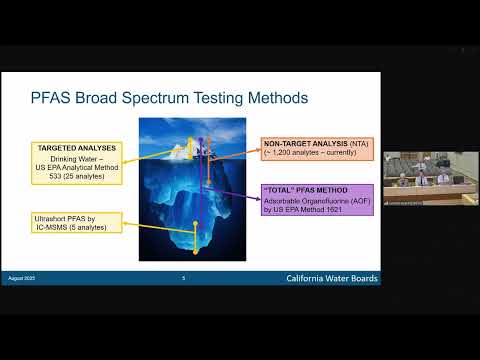
- Targeted testing (EPA Method 533 for drinking water analytes) detected at least one of the 25 targeted PFAS analytes in about 10% of wells sampled so far. DDW said the majority of detections were among the more historically studied carboxylates and sulfonates such as PFOA and PFOS.
- Absorbable organic fluorine (AOF), used here as a proxy for broader PFAS mass (EPA method 1621 as stated in the briefing), had a presence in about 36% of tested wells; DDW reported current AOF limits of detection around 600–700 parts per trillion (ppt) and a program goal to reduce that limit to about 200 ppt.
- Ultra‑short PFAS: in a budgeted subset of roughly 300 wells analyzed for ultra‑short chain compounds, DDW reported a 100% detection rate for trifluoroacetic acid (TFA). Officials cautioned that TFA's health impacts are not as well established as for PFOA or PFOS and that international guideline values differ (for example, the presenters cited a Netherlands guideline near 2,200 nanograms per liter for TFA).
- Non‑target analysis (NTA) using high‑resolution mass spectrometry and a spectral library has identified many additional signals. Presenters said their current library can match roughly 1,200 analytes and that roughly 90% of unique NTA compounds detected so far do not appear to be fluorinated. The laboratory reported about 94% confidence in identifications for the bulk of the dataset and flagged about 53 low‑confidence compound matches that will be re‑evaluated as the library grows.
Concentrations and compliance context
- Where detectable, PFOA median concentrations thus far were reported near 3.5 nanograms per liter (ng/L), below the U.S. EPA MCL of 4 ng/L for PFOA; PFOS medians are higher but still concentrated mostly below tens of ng/L in the statewide dataset, according to DDW box plots shown to the board.
- DDW staff underscored that for drinking water the targeted analytes seen most often remain the historical carboxylates and sulfonates; many of the newer ether or fluoro‑telomer analytes were rarely detected in the statewide drinking‑water samples.
Sampling program design, partners and next steps
- DDW said the project was designed with substantial federal and academic partnerships (U.S. EPA Office of Research and Development, a ROAR grant, a Sac State Office of Water Programs contract, and a statewide lab contract expanded to Babcock Lab, with Geosyntec as the field contractor).
- The sampling effort was described as a one‑time, AB 178–funded event for disadvantaged communities. Staff plan to complete field sampling in early 2026 and perform full data analysis through the remainder of 2026. DDW said it will then issue a new order starting in January 2026 to cover remaining systems that must comply with the federal monitoring period under the federal PFAS rule and to clarify which quarter systems should sample.
- Method development remains a priority: presenters said they will continue to refine AOF and related total mass approaches (and consider EOF), lower detection limits, expand NTA spectral libraries, and use findings to evaluate treatment‑technique approaches and potential class‑based regulatory strategies.
Follow‑up and public outreach
- Staff described a notification and response workflow for systems that trigger advisory or response thresholds: field contractors and district engineers deliver outreach materials and connect systems with funding sources and guidance on next steps. "When they are triggered at certain concentrations...we have different health based advice and packets that we're handing out to the water systems," Dan Newton said.
- Board Chair Joaquin Esquivel noted capacity constraints at federal partners and thanked the team for the midcourse update: "We have the strongest standards in the nation here as a state when it comes to the safety of our water," he said, adding that the work should give the public confidence that the state is using data to address PFAS.
What the briefing did not change
- Presenters and board members emphasized that the sampling is descriptive and that no new regulatory standards were adopted at the meeting. Staff repeatedly described the work as informational, with further technical review and public‑comment steps planned before any regulatory decisions.
Provenance
Topic introduction excerpt: "This is day 2 of our 2 day workshop, and so we'll get right into it. And today, we have a pair of informational items...we will be hearing item number 7 before we hear item number 6, both regarding, PFAS work here within the state." (Transcript segment starting 267.88998)
Topic finish excerpt: "That concludes, our first impressions of the 2024 order and sampling data." (Transcript segment starting 2484.7551)
Ending
DDW called the dataset "a tremendous dataset" and said further laboratory work and re‑analysis of nontarget spectra will follow as the spectral library grows. Staff expect to finish field sampling early in 2026 and to publish follow‑on orders and proposed method updates for public comment before any regulatory changes are adopted.