
County staff: juvenile detention budget close to year‑to‑date actuals; overtime traced to staffing gaps and safety needs
Get AI-powered insights, summaries, and transcripts
Subscribe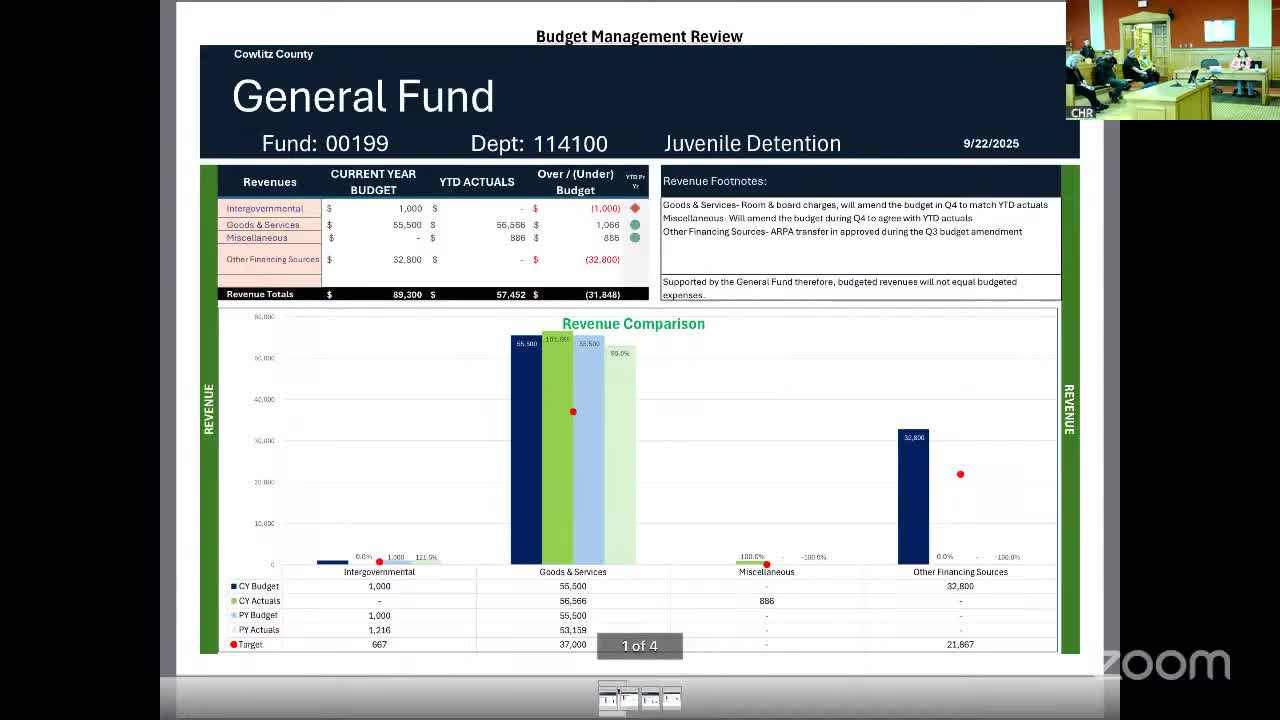
Summary
Finance staff and juvenile administrators reviewed detention and probation budgets, FTE counts, and an overtime audit that identified reasons for spikes tied to vacancies, vacations and opening an extra housing pod for security reasons.
Cowlitz County finance and juvenile court staff briefed commissioners on year‑to‑date budget performance for juvenile detention and probation programs and on recent overtime trends and a payroll audit.
Susie Moon, county finance manager, reported that juvenile detention’s goods and services line (about $5.056 million budgeted) has already exceeded the adopted budget and will be increased in a fourth‑quarter amendment; Moon said much of that overspend reflects room‑and‑board charges. She said miscellaneous revenue (previously not budgeted) has brought in roughly $800 so far this year and will be added in the fourth‑quarter amendment. Moon said other financing sources (about $33,000 budgeted) had not yet recorded revenue; that sum represents a planned ARPA transfer approved in a prior amendment.
Moon said the juvenile detention personnel budget was slightly over $2.8 million with about $1.7 million expended to date. She reported 27.75 filled FTE and roughly 2.5 FTE vacancies in detention; two of the openings are detention officer positions. Moon said the vacancies explained about $127,000 of payroll savings through August before benefits; when benefits are counted the department would be slightly over budget by roughly $20,000 for personnel.
Moon said supplies and many services lines remain under budget once internal service billings are removed.
The board turned to probation. Moon said probation had 13 filled FTE and two openings; intergovernmental revenue (budgeted about $406,000) had produced about $268,000 so far, much of it state grant funding (approximately $203,000). Some other revenue categories reflect BECA funding and mental health tax transfers, Moon said.
George Moya, juvenile court administrator, described an internal payroll audit of overtime that confirmed payments complied with the union contract and found no payroll discrepancies. Moya said staff and auditors have trended overtime month‑by‑month, broken down by position, and the department provided a written analysis showing month‑to‑month increases.
Moya and Moon told commissioners the most significant overtime spikes reflected operational drivers: in May the facility opened a third housing pod because several youths who were members of rival gangs were in custody at the same time and needed separation for safety reasons; the extra pod required additional staffing. Both Moya and Moon said July saw additional spikes when supervisors and staff took scheduled vacation, and the department also experienced overlap overtime for new hires during training.
Moya described the recruitment and training timeline: hiring from first interview through on‑floor duty typically takes about 4½ to 5 months; the department’s internal training course is five weeks, followed by a state‑required 80‑hour academy later in the year.
Commissioners said they would review the written overtime tracking documents and follow up with staff. Moya said the department would continue active recruitment and that staffing shortfalls (roughly three‑quarters of an FTE short of minimum staffing, he said) keep a baseline of overtime in the schedule.
Ending: Commissioners accepted the reports and asked staff to provide any follow‑up budget detail; no formal action was taken at the meeting.