
Public safety panel approves Prop S 2026 RFP timeline and selects Mental Health Board as external reviewer
Get AI-powered insights, summaries, and transcripts
Subscribe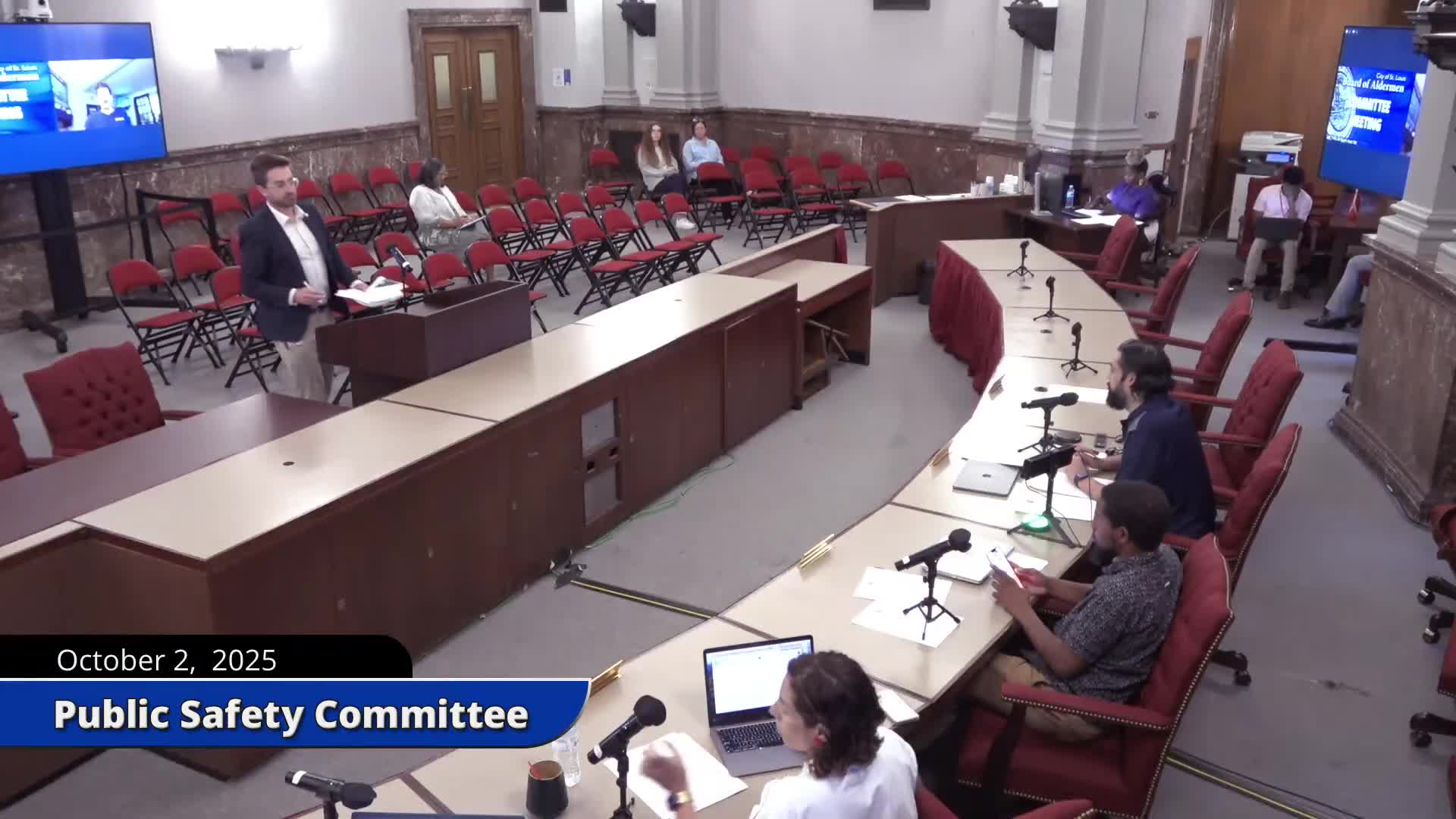
Summary
The St. Louis City Public Safety Committee approved the Office of Violence Prevention’s Prop S 2026 RFP timeline and named the Mental Health Board as the external reviewer, setting submission and review deadlines that aim to keep grant awards on a calendar-year schedule.
The St. Louis City Public Safety Committee voted to open the Office of Violence Prevention’s (OVP) Proposition S 2026 request for proposals and confirmed the Mental Health Board as the external reviewer for the grant round.
Brett Delaria, public information officer for the Office of Violence Prevention, told the committee the RFP process is largely unchanged from prior cycles but will move from email submissions to a required online form. “There is about $890,000, available for this cycle of, Prop S,” Delaria said during his presentation, noting the RFP’s scoring categories and that the city will use a digital form to reduce missing application materials.
The committee confirmed the Mental Health Board as the external reviewer by unanimous voice/roll-call indication. Committee members then set a timetable for the RFP process: open Monday, Oct. 6, 2025; deadline for organizations to submit questions Oct. 17; publication of Q&A Oct. 24; application submission deadline Nov. 6; committee review meetings provisionally scheduled Nov. 13 and Nov. 20; and an estimated contract start date of Feb. 1, 2026. The committee voted to approve the RFP pending edits to reflect those dates and the confirmed external reviewer.
Why it matters: The Prop S allocation funds community-based violence-prevention programs. How the city solicits, reviews and selects grantees determines which organizations receive funding and what services are funded in neighborhoods identified as high need.
Key details presented by OVP: Delaria described the RFP structure and scoring: record of successful delivery (20 percent), equity-centered practice (20 percent), proposed programming (40 percent), data collection (10 percent) and budget/fiscal management (10 percent). He said the OVP will require a standardized budget template and a 12-month timeline for funded proposals. OVP also plans to require applicants to document equity practices and to identify target neighborhoods; Delaria said preference will be given to the 12 neighborhoods the city has identified as high need and high risk.
Deliberations and committee concerns: Several alderpersons pressed the OVP on timeline tightness and on making review results transparent. Vice Chair Aldridge said the committee needs time to digest applications before voting: “I think there needs to be time baked out so that the committee can actually digest that information and ask questions,” he said. Committee members discussed the required city approval steps (committee, full board, then ENA/fiscal review), and requested two committee review meetings to allow questions of applicants and time to consider denials and approvals before forwarding recommendations to ENA.
External review and conflict-of-interest safeguards: Delaria said OVP will obtain conflict-of-interest disclosures from reviewers and can anonymize commentary while publishing basic rubric scores. The committee signaled acceptance of using the Mental Health Board as the reviewer and asked OVP to publish the scoring rubric and consider posting anonymized reviewer scores.
Outstanding items and limits of the record: Delaria said the draft RFP lists a per-organization award cap in the document, but the amount was unclear in the meeting record; committee members did not change program weighting. The RFP text and final award amounts and contract start date remain subject to administrative and ENA review. Delaria noted the city has used email and social media outreach in past cycles and reported more than 40 applications in the last cycle.
Ending: The committee approved the timeline and reviewer, and instructed OVP to update the RFP dates and reviewer language for final committee approval and posting. OVP must still complete the posted RFP, run the online form, and follow administrative steps (full board and ENA) before awards are finalized.