
Board members raise height, rooftop and parking concerns for 17‑unit lodging proposal at 702 Pass‑a‑Grille Way
Get AI-powered insights, summaries, and transcripts
Subscribe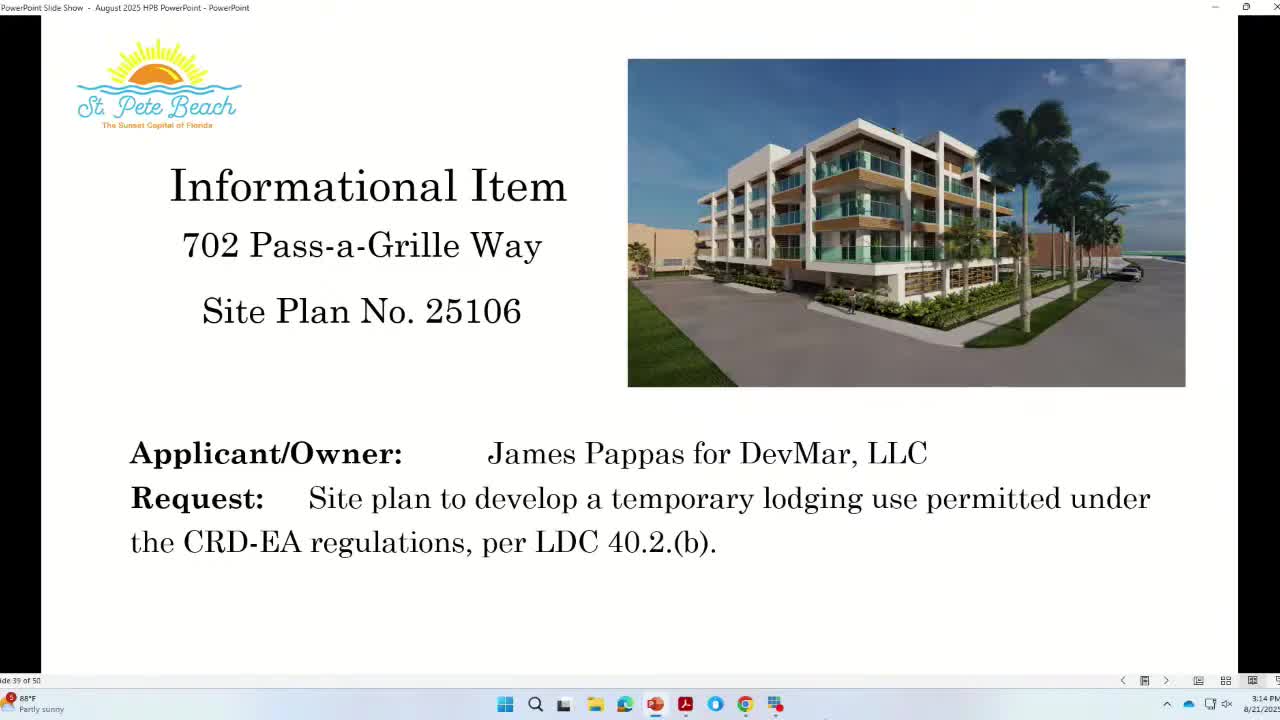
Summary
City planning staff presented a site plan for a proposed 17‑unit, four‑story temporary lodging building at 702 Pass‑a‑Grille Way and Historic Preservation Board members pressed staff and the applicant on height, rooftop amenities and alley/parking requirements.
City planning staff presented a site plan for a proposed 17‑unit, four‑story temporary lodging building at 702 Pass‑a‑Grille Way and members of the St. Pete Beach Historic Preservation Board raised detailed questions about height, rooftop use, parking and neighborhood compatibility.
Brandon Berry, planning staff, told the board the project is a permitted use in the Community Redevelopment District (CRD) under land development code section 40.2(b) and that the submission to technical review is the same site plan the city reviewed last week. “This is a site plan. It is a commercial development for a temporary lodging facility at 702 Passer Girl Way. It is proposed to be a 17 unit project, 4 stories,” Berry said during the presentation. He also said the applicant has provided 17 on‑site parking spaces, including one accessible stall, and that the applicant had been asked to respond to several technical review comments and will resubmit modifications.
Board members repeatedly questioned how the project fits the CRD and the Pass‑a‑Grille historic context, and whether existing code provisions allow the rooftop amenity program shown in the plans. Chair Lowry pressed staff on rooftop limits and public‑safety implications: “I’m not quite understanding what we’re allowing on rooftops,” she said, raising concerns that nonhabitable rooftop features and open amenity spaces could effectively become an extra, public‑facing story.
The principal concerns raised by the board and speakers: - Height and flood elevation: Staff said the project’s roof level measures roughly 40 feet, 6 inches above grade under the city’s measurement practice that adds design flood elevation and freeboard to building height. Board members noted that measurement produces an effective visual mass taller than nearby buildings and asked staff and the city attorney to confirm the interpretation. - Rooftop program: Plans show a roof terrace with a spa and seating areas and two stair/elevator access points. Staff told the board the spa and rooftop features were represented to meet existing height limits, but members questioned whether those amenities are appropriately treated as “nonhabitable architectural features” under the code or whether they require a conditional use. - Parking and alley access: The plan shows 17 spaces (one accessible), with garage access oriented to the lot. Board members asked how the proposal complies with section 40.11 (minimum off‑street parking) given the site abuts an alley and cited language that parcels abutting an alley must place parking in rear yards and use alley access. Staff said the development team and an independent zoning reviewer are examining those and other technical comments. - Use and unit configuration: The board asked whether the units are full apartments with kitchens and how units are internally configured (the plan indicates 17 two‑bedroom units on the submission). Staff advised the detailed layouts (bath counts, internal doors) would be shown on later submittals and the city will review them to ensure the project matches the transient‑occupancy definition used in the code (rentals under 30 days). - Neighborhood impacts: Several board members and a public commenter urged the applicant to reconsider massing and design to better reflect the historic character of Pass‑a‑Grille and to reduce perceived visual dominance on Eighth Avenue and nearby single‑family homes.
Applicant representatives on the Zoom call described their material and structural choices as responses to storm and flood conditions. The architect team said the building is designed with concrete and white stucco to resist wind and water and that rooftop mechanicals and access were organized to meet code and resiliency objectives. The architects also said they had assembled precedent examples and used online massing data when preparing visualizations.
Board direction and next steps: board members asked staff to send the board’s questions and the packet to the city attorney for a written legal analysis of land‑use, height measurement and rooftop allowance questions, and to the independent zoning reviewer for a second technical opinion. Staff agreed to share the board’s comments with reviewers. Several board members asked that the item return to the Historic Preservation Board for informational review after the applicant submits revised plans addressing technical and design comments; staff said a return date will likely fall in October, after the team finalizes changes and demolition permits for existing buildings are completed.
Why this matters: the proposal transforms a vacant or low‑rise site into a four‑story temporary lodging development with rooftop amenities in the heart of Pass‑a‑Grille, inside the local historic district. The board emphasized that, while the CRD permits temporary lodging use, the board’s role under the historic preservation ordinance is to encourage new construction that preserves the district’s historic scale and character.
Board members and staff said they will await the independent zoning review and a written legal opinion before the board takes further action or makes a formal recommendation.