Get email alerts on the Building Energy Code topic
No spam. Unsubscribe anytime.
Board completes final votes on Low Energy and Carbon Code; most amendments approved, several fail
Summary
At a May meeting to finalize the Low Energy and Carbon Code, the board approved the 2024 IECC as the base and passed the majority of commercial and residential amendments after sequential votes on 44+ voting blocks; several provisions failed after debate, and the board clarified the statutory two‑thirds approval threshold.
The Low Energy and Carbon Code board met remotely May 20 to continue final voting on the draft code, approving the 2024 IECC as the base and advancing most of the commercial and residential amendments after sequential votes on more than 40 numbered voting blocks.
The board’s meeting facilitator (Staff member) opened the session by reviewing voting procedures and reminding members that each voting block would be taken in sequence. The facilitator instructed members to use a Google Form to submit “yes,” “no,” or “abstain,” and to wait to submit until all members who wished to speak had done so. “A vote yes in this case today means I, board member, approve this code section as written for inclusion in the low energy and carbon code,” the facilitator said while explaining options and process.
Why it matters: The session represented the second‑to‑last scheduled meeting to finalize the model low energy and carbon code. The board’s decisions will determine which energy‑saving, electrification and fuel‑neutrality measures enter the published model code and which remain optional or are removed. Several debated items touched on enforceability, impacts on affordable housing projects and alignment with other state codes.
Key outcomes and context
- The board voted to adopt the 2024 International Energy Conservation Code (IECC) as the base of the Low Energy and Carbon Code (Voting block 1). That vote passed unanimously as recorded in the meeting, with the facilitator announcing 19 yes votes.
- Board members and staff clarified the statutory approval threshold during the meeting. Legal and staff participants identified the controlling language as “two‑thirds of the members.” The board recorded that, with 21 possible seats, the practical threshold the board used during the session would require 14 yes votes for a provision to be approved when all members are present; the facilitator announced that 14 yes votes would be required for approval going forward.
- After stepwise consideration of more than 40 voting blocks, the board approved most commercial and residential language changes (see “Votes at a glance” below). Notable approvals included reorganized compliance credit tables in the commercial chapter, multiple energy efficiency credits and the renumbering and relocation of renewable energy language into an appendix for optional adoption.
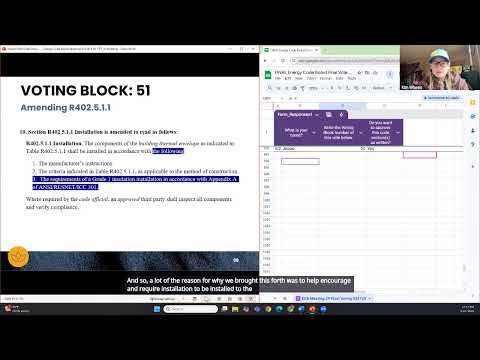
- Several amendments failed after discussion. Examples recorded in the transcript include a protective piping‑insulation amendment (Voting block 14) that received 12 yes votes and failed; an indoor‑pool energy requirement (Voting block 15) that received 10 yes votes and failed; and a residential insulation installation amendment (Voting block 51) that failed (received 2 yes votes as recorded). Board members expressed concerns on failed items about enforceability, statutory scope and impacts on housing affordability.
Discussion highlights
- Statutory threshold. Several board members, and staff (including David and Kim in the transcript), reviewed the statutory language for approval threshold. After discussion the board operated on the interpretation that the statute requires two‑thirds of all board members (not just those present) to approve an element to include it in the model code; the facilitator repeated that 14 yes votes would be needed when the full board is present.
- Equity/affordability and enforceability concerns. Multiple board members raised enforceability and affordability concerns before voting. For example, Tim and others said some proposed requirements would be difficult to enforce during plan review or final inspection; Will and Elizabeth argued that deleting a provision about mechanical equipment penetrations would avoid penalizing some affordable housing projects; conversely, Will later argued that removing an item on mechanical penetrations could reduce insulation performance.
- Technical trade‑offs. Board members debated fuel‑neutral accounting and how to weigh energy efficiency versus onsite renewables. Adam and others explained that reorganization of credits was intended to preserve energy‑efficiency outcomes and to avoid allowing solar alone to substitute for efficiency. Board members who supported that approach said it preserves long‑term compliance independent of fuel source.
Ending: The board completed a substantial portion of its agenda and set a final meeting for Friday to finish remaining votes. The facilitator closed the session noting the board will reconvene at 9 a.m. Friday to complete the remaining items and to publish the final code language after verifying tallies and any clerical errata.
Votes at a glance (selection — voting block number, short description, recorded result as stated in transcript)
1 — Adopt 2024 IECC as the base code: passed (19 yes, recorded) 2 — Amend commercial code section C105.2 (commercial definitions/requirements): passed (19 yes) 3 — Amend C107.202: passed (17 yes) 4 — Add new C111 section: passed (19 yes) 5 — Add new commercial definitions: passed (19 yes) 6 — Establish commercial compliance options (amendments 5–7): passed (17 yes) 7 — Delete mechanical equipment penetrations (C402.1020…): passed (15 yes) — supporters: argued deletion avoids penalizing unitary heat pumps and affordable housing; dissent: concerns about reduced insulating value 8 — Suspended ceilings tables and amendments: passed (19 yes) 9 — Correct errors in C402.601.01/.02: passed (19 yes) 10 — Amend C402.602.03 (access for inspection/repair): passed (18 yes) 11 — Amend C403.401.101 (heat pump supplementary heat): failed (did not reach required yes threshold; transcript indicates it did not receive 14 yes votes; exact tally not specified) 12 — Add new C403.406 (demand response): passed (17 yes) 13 — Amend C403.5 (economizer capacity): passed (18 yes) 14 — Amend C403.130301 (piping insulation protection): failed (12 yes) 15 — Amend C404.803 (pool systems): failed (10 yes) 16 — Add C404.101 (demand‑responsive water heating): passed (6 yes as recorded in transcript) 17 — Amend C405.204 (daylight responsive controls): passed (19 yes) 18 — Amend C405.208 (controls): passed (17 yes) 19 — Delete automatic receptacle control sections (C405.12): passed (17 yes) 20 — Amend energy monitoring (C405.13): passed (16 yes) 21 — Delete renewable energy mandatory sections (move to appendix): passed (17 yes) 22 — Replace C406.1 (compliance reorganization; build‑out wording noted for errata): passed (17 yes) 23 — Replace and renumber multiple C406 sections and tables (credits): passed (16 yes) 24 — Administrative amendments tied to credit adoption: passed (19 yes) 25 — Add evaporative cooling credit (C406.20206): passed (19 yes) 26 — Add high‑efficiency heating equipment credit: passed (19 yes) 27 — Add refrigerator doors credit: passed (18 yes) 28 — Renumber and amend C406.301 (renewable energy): passed (17 yes) 29 — Renumber remaining sections under C406.2: passed (19 yes) 30 — Add refrigerants section (C406.216): passed (19 yes) 31 — Delete old C406.3 (remaining content moved): passed (17 yes) 32 — Adopt ASHRAE 90.1 Appendix G (site energy basis) with modifications: passed (17 yes) 33 — Adopt site energy reduction pathway (90.1 alignment): passed (17 yes) 34 — Add fixed site EUI targets (performance pathway): passed (17 yes) 35 — Add electric/solar/EV‑ready content into the low energy and carbon code (bulk insert): passed (19 yes) 36 — Solar‑ready electrical sizing & space, small/multifamily: passed (19 yes) 37 — Solar‑ready electrical sizing & space, large commercial: passed (19 yes) 38 — Amend solar‑ready zone area (C410.402): passed (18 yes) 39 — EV infrastructure table corrections (C410.505): passed (18 yes) 40 — Allow Level 1 charging substitution for multifamily in some cases: passed (19 yes) 41 — New EV infrastructure/related section (C410.505.209 / numbering correction): result not specified in transcript (vote recorded but announcement not captured) 42 — Amend C503.6 (commercial chapter 5): passed (17 yes) 43 — Delete listed appendices from the base code (C I, CB, CG, CH): passed (19 yes) 44 — Add appendix CK (renewable energy systems — optional appendix): passed (17 yes) 45 — Amend R105.2 (administration/residential): passed (19 yes) 46 — Add new residential definitions: passed (19 yes) 47 — Amend R401.2 home‑size thresholds and related application (establishes when different residential pathways apply): result not explicitly announced in transcript; later votes continued (see blocks 48–50). The transcript indicates substantial support during discussion. 48 — Amend R401.2.x series (pathway clarifications): passed (20 yes recorded) 49 — Amend R402.1 (residential envelope minimums / rules): passed (20 yes) 50 — R402.213 (sunroom and heated garage slab insulation): failed (13 yes — short of required threshold) 51 — R425.011 installation (insulation installation grade requirement): failed (2 yes recorded)
For full tallies and the official record, staff will publish the verified vote spreadsheet after the final meeting and after staff resolves any clerical corrections the board directed; the transcript records some tallies but not every final tally announcement for every block.
Quotes from the meeting
- “A vote yes in this case today means I, board member, approve this code section as written for inclusion in the low energy and carbon code,” the meeting facilitator (Staff member) explained while describing the form‑based voting process.
- On deleting a section about mechanical equipment penetrations, Elizabeth (Board member) said: “The original code language would really have penalized unitary heat pump equipment … That tends to penalize affordable housing projects the most, which is why I had proposed deleting it.”
- Tim (Board member) raised an enforceability concern about piping insulation: “From an enforceability standpoint, this would be virtually impossible … we would have to be asking for the specifications for the proposed paint product through the plan review, and most of the time, they don't even have that selected.”
Clarifying details extracted from meeting
- Statutory approval threshold: participants cited a statute requiring “two‑thirds of the members” to approve something for it to be included in the model code; staff interpreted that as 14 yes votes when the full board is present.
- Attendance during the meeting: staff recorded 19 board members present at several points and noted members joining later; in some later votes staff counted up to 20 board members present and logged votes up to 20 yes (transcript records both 19 and 20 as totals at different times).
- Procedural notes: Board members used a Google Form to record votes; staff displayed the tally spreadsheet live and accepted a limited number of verbal votes for members who could not use the form.
Community relevance and next steps
Most of the board’s substantive votes advanced energy‑efficiency credits, reorganized compliance pathways for commercial building performance (including a site‑energy approach aligned to ASHRAE 90.1 Appendix G), and moved some renewable‑energy language into an appendix for optional jurisdictional adoption. The board left in place a requirement for two‑thirds approval and flagged multiple items for final clerical fixes before the code publication. The board scheduled a final session Friday morning to conclude remaining votes and to finalize the published code text.
Ending
Staff will publish the final, staff‑verified tally spreadsheet and the finalized code language after the remaining votes are completed on Friday. The board adjourned the May 20 session and planned to reconvene at 9 a.m. Friday to finish remaining votes.
AI generated
The text on this page is AI generated. Summaries, highlights, analysis, and video transcripts are all produced from the original source material.
AI can make mistakes, so if you spot one, and we will fix it for everyone.
Note: the source content is unaltered by us. Any content source we link to, be it a video, an audio recording, or a document, is presented exactly as its publisher released it. That publisher is usually a government body, sometimes an individual official or another organisation.