Get Full Government Meeting Transcripts, Videos, & Alerts Forever!
Get email alerts on the Community Redevelopment Area topic
No spam. Unsubscribe anytime.
St. Pete Beach begins study to determine whether a community redevelopment area could fund resilience upgrades
Summary
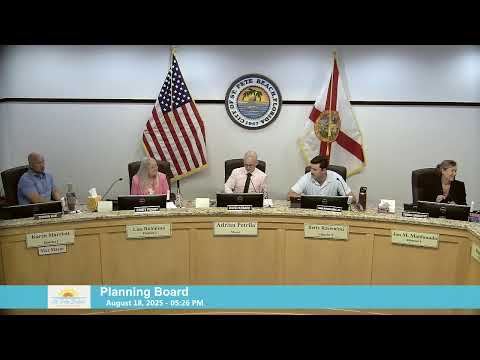
Consultant for St. Pete Beach briefed the planning board on a two-month finding-of-necessity to assess whether conditions justify establishing a Community Redevelopment Area (CRA) and using tax-increment financing for storm resilience and infrastructure projects.
The Planning Board heard a presentation from consultant Matt Lewis of Stantec on an initial finding of necessity (FON) that could lead to a Community Redevelopment Area (CRA) and tax-increment financing (TIF) focused on storm resilience and infrastructure in St. Pete Beach.
Lewis said the finding of necessity is the first technical step to determine whether statutory conditions exist in a defined study area that could justify a CRA and TIF. He told the board the FON will evaluate three broad statutory areas used by the state — inadequate ventilation/light/sanitation, population density/overcrowding relative to adjacent areas, and conditions that endanger life or property by fire or other causes — and that the team will emphasize the latter given known storm and flooding risks in portions of the city.
"What the statute looks for is three broad areas...the one we're really looking at though is the existence of conditions that endanger life or property by fire or other causes," Matt Lewis said.
Lewis described study steps: gather data to quantify risk to structures and infrastructure (including storm surge exposure shown on a vulnerability map presented to the board), coordinate with city staff on a proposed boundary, then, if warranted, prepare a resolution stating conditions exist and later a CRA plan listing projects and revenue projections. He estimated the FON itself would take about two months.
Board members asked how a CRA could address infrastructure shared with other jurisdictions — for example a subaqueous sewer pipe that carries wastewater off the island. Lewis said ownership and interlocal agreements governing that pipe would matter and that, at the CRA plan stage, the city would consider options including interlocal agreements or focusing CRA funds on assets such as pump stations while coordinating costs for shared piping.
Community Development Director Laura Canary told the board the FON boundary shown was preliminary and subject to change after data collection, and that the FON will not need to be parcel-specific; the team can recommend expansion if the southern neighborhoods warrant inclusion. She also said county criteria will be important because Pinellas County's assessment affects whether the county will contribute TIF funds and at what percentage.
Board members raised concerns about prioritization and potential unintended consequences. Member Perry urged focus on infrastructure and resiliency rather than broad exploratory studies, and noted homeowners' concerns about property values and tax shifts if a CRA is established. Lewis and Canary said the process will document conditions for future grant opportunities even if the county declines a TIF contribution and stressed that the plan can include public input and a phased capital improvement schedule.
No vote or formal action to establish a CRA was taken; the board received the presentation and discussed next steps for data collection and community engagement.