
San Benito supervisors workshop on budget shortfall; departments urge alternatives to layoffs
Get AI-powered insights, summaries, and transcripts
Subscribe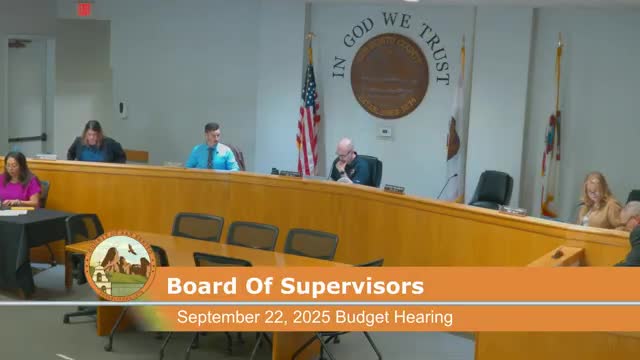
Summary
At a special budget workshop, county staff outlined a multimillion-dollar shortfall and proposed reductions including eliminated positions and furloughs. Department leaders, union representatives and the sheriff urged using reserves or other measures to avoid service cuts; the board continued the public hearing to Thursday at 9 a.m.
San Benito County Board of Supervisors on Wednesday held a special budget workshop to address a multi‑million dollar shortfall in the county—s fiscal year proposal, hear requests from department leaders and unions, and direct staff to continue analysis and outreach ahead of a scheduled public hearing.
The county—s budget presenter said the administration identified a need for $8,720,000 in additional reductions but departments could only identify roughly $3,300,000 in cuts so far, leaving a remaining gap the presenter described as several million dollars. The board voted to continue the public hearing on the proposed budget to Thursday at 9 a.m.
Why it matters: The workshop focused on options to close the gap without undermining mandatory or revenue‑generating services, such as public safety and behavioral health. Department heads and union representatives warned that proposed eliminations of filled positions and proposed furloughs would reduce service capacity, increase liabilities for accrued leave, and could lower revenue that depends on staff availability.
County staff framed the shortfall as the result of long‑term structural mismatch between recurring revenues and ongoing expenditures, noting prior years— capital commitments and one‑time uses of reserves. The presenter said the administration had moved some capital items and used restricted funds to preserve operations, but still needed additional savings or revenue to present a balanced budget.
Several department leaders and employee representatives addressed the board in public comment. Vina Quinis, speaking for county employees, said the workforce is already strained and warned, "The quality of the services are in jeopardy," urging use of reserves and prioritizing staffing before contracting out work. Multiple county employees and union representatives asked that layoffs be avoided, that reserves be used where appropriate, and that the county prioritize retaining institutional knowledge in areas such as county counsel and accounting.
The sheriff (name not specified) told the board the sheriff—s office represents a large share of county general fund cost and that some trust funds historically used for sheriff projects should be reviewed to ensure equitable application across departments. The sheriff also said service reductions will be felt but urged collaboration to minimize effects on response services.
Board members pressed staff on several technical issues: how salary and benefits are being calculated, the accuracy of position counts and payroll accruals, where contract dollars are recorded, and the consequences of different reserve‑use scenarios. Supervisors requested a department‑by‑department reconciliation of FTEs, salary/benefit assumptions and savings estimates and asked staff to confirm the liability impacts of eliminating filled positions (sick‑leave and other accrual payouts).
On specific cuts, staff presented a range of tools: targeted position eliminations, consultants and contract review, furlough scenarios (described in the workshop as options such as one or two unpaid days per pay period), and one‑time use of reserves. Staff cautioned that repeated one‑time funding would not address the structural gap and could require deeper reductions in future years.
Several speakers recommended alternatives to layoffs: pursuing local revenue options, pausing capital projects, reducing contracts and consultants before eliminating in‑house positions, and renegotiating labor agreements. County counsel staffing was raised repeatedly as a particular concern: one commenter warned that reducing counsel capacity could raise future outside‑counsel costs and risk to the county.
The board and staff agreed to continue the workshop process, provide more detailed payroll and position reconciliations, and meet again to refine options. Supervisors emphasized the need for transparent, department‑level detail so the board and public can evaluate tradeoffs before final votes on the budget.
Votes at a glance: The board voted to continue the public hearing on the proposed fiscal year budget to Thursday at 9 a.m.; the motion carried on a roll call with all supervisors voting in the affirmative.
What—s next: Staff will return with updated reconciliations of positions, salary/benefit calculations, a clearer accounting of one‑time versus ongoing uses of reserves, and more detailed estimates of savings from proposed eliminations, furloughs and contract reductions. The board scheduled additional workshop time to allow departments, labor and the public to review those details before final adoption.