Can Do Kalamazoo outlines expansion of entrepreneur hub, seeks $1.4 million to finish building
Loading...
Summary
Can Do Kalamazoo told the Kalamazoo City Commission’s Committee of the Whole that its transition from a food-kitchen incubator to an inclusive entrepreneur hub has expanded services, reached more than 136 people last year and relies on grants and donors to close a $234,000 operating gap and a $1.4 million capital goal.
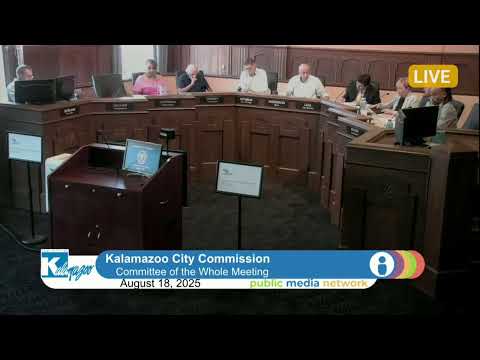
Can Do Kalamazoo, a nonprofit that began as a shared kitchen incubator, told the Kalamazoo City Commission’s Committee of the Whole on Aug. 18 that it has transitioned into a broader entrepreneur hub at 519 South Park Street and is raising $1.4 million to complete the remaining work on its building.
The hub’s director and founder, Lucy Dilley, told commissioners the organization expanded its scope in 2022 from serving primarily food businesses to supporting entrepreneurs in any industry, and opened a new facility in 2024 after a capital campaign and outside funding. “We set a 10 year goal to be the entrepreneur hub for the greater Kalamazoo area,” Dilley said.
Dilley described services now offered under one roof: co‑working space, meeting rooms, offices, an incubator kitchen and staff who make customized referrals to community partners. She said the hub continued specialized food support through its incubator kitchen and added services such as ServSafe exam proctoring, translation, workshops and twice‑yearly learning cohorts.
The presentation quantified recent reach and support: Dilley said Can Do Kalamazoo supported 136 people through its programs in the prior year; 63 participants used more than one program; four food companies graduated from the three‑year kitchen incubator; Can Do Camp had 47 participants; and business‑boost consulting provided 75 meetings, 22 of them free introductory sessions. She said scholarships and a mix of grants and donations filled a $234,000 gap between program costs and participant fees.
Dilley told commissioners that the hub received a $1,900,000 Michigan Economic Development Corporation (MEDC) HUB grant and plans to regrant roughly 40% of that MEDC funding to partner organizations. She said the hub will distribute more than $400,000 in business grants, work closely with partners such as SCORE and the Small Business Development Center (SBDC), and has a partnership rotation in the hub that includes city economic development staff.
On capital needs, Dilley said Foundation for Excellence (FFE) funds helped complete roughly half of the new building at 519 South Park Street and that the hub is now in an active capital campaign with a $1,400,000 goal; she reported the campaign was about 33% funded at the time of her remarks. She described the campaign as currently in a “quiet phase,” with a planned public phase near the end of the year or early next year.
Dilley described pricing and accessibility efforts for entrepreneurs, saying the hub offers below‑market rental for kitchen space through an incubator model intended to help businesses scale. She stated that the hub uses scholarships and staggered payment options to reduce barriers for participants. Dilley also said Can Do Kalamazoo will regrant a portion of its MEDC hub funds to local partners including Room 35, Beta, Startup Zoo and Southaven Regional Business Hub and that it is partnering with Southwest Michigan First on the First Path program to support idea exploration for early entrepreneurs.
Commissioners responded with praise and a few operational questions. Vice Mayor Hess thanked the hub for supporting local food entrepreneurs and invited commissioners to tour the facility; Dilley said tours are available weekdays between 9 a.m. and 3 p.m. Commissioner Cooney asked about referral pathways; Dilley said referrals come from word of mouth, partner intake forms and internet searches, with partner referrals the primary source. On classroom capacity, Dilley said the hub currently limits some class sizes and hopes to finish the building by 2027, subject to fundraising.
Can Do Kalamazoo gave examples of local business outcomes supported by its programs, including one business, Dessert First, that received a 2014 Business Builder Scholarship funded by a $50,000 Community Development Block Grant (CDBG) award and later opened a storefront. Dilley emphasized partnerships with El Concilio and Urban Alliance for translation services and with city staff for direct developer and funding questions inside the hub.
No formal action or vote was taken by the commission; the presentation was informational. The organization provided specific funding figures and timelines during the session but noted some items—such as the capital campaign public phase and final construction schedule—are contingent on current fundraising.