Get Full Government Meeting Transcripts, Videos, & Alerts Forever!
Get email alerts on the Seawall Materials topic
No spam. Unsubscribe anytime.
Staff recommends reevaluating seawall materials; committee signals preference to keep reinforced-concrete panels
Summary
Mark Storm and staff briefed the Burnt Star Isles committee on a 2021 Taylor Engineering seawall-materials study and recent cost updates; members said reinforced-concrete panel designs remain the preferred option but asked staff to return with updated costs and limited alternative pilots.
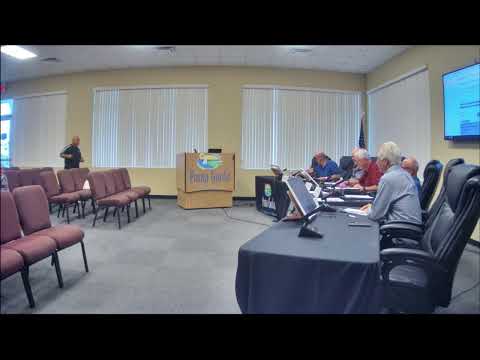
City canal-maintenance staff on Sept. 9 presented a revised review of seawall materials and construction methods and asked the Burnt Star Isles Canal Advisory Committee whether to pursue further evaluation. Mark Storm, canal maintenance supervisor, summarized the 2021 Taylor Engineering feasibility study and a staff update on construction costs and lifespan estimates.
The packet showed the city's inventory: about 109 miles of seawalls overall, with approximately 91 miles in Punta Gorda Isles and 18 miles in Burnt Star Isles. The 2021 analysis compared nine wall systems, including precast concrete panels with rebar, corrugated steel sheet piles, fiber-reinforced polymer panels, vinyl (PVC) driven panels, timber, segmental block and living-shoreline options. The study recommended reinforced-concrete panels as the durable, cost-effective solution for the city's canal environment.
Storm told the committee staff's current installed-cost estimate for the city-standard concrete panel (including rebar and installation) was about $6.12 per linear foot for a 10-foot panel based on a July 28 staff update; the 2021 study used earlier cost baselines. Staff asked the committee to confirm whether to (a) reevaluate the current concrete-panel design and updated costs, (b) reexamine stainless-steel rebar and polymer (FRP) alternatives, and (c) limit additional evaluations to one or two alternatives and, if desirable, run small pilot installations.
Committee members asked practical questions about handling heavy material removal and replacement, barge/crane needs, panel weights and transition details when different materials meet. One committee member, Rick Daugherty, said the study and follow-up work were thorough and expressed support for the current reinforced-concrete approach. "I don't think we're gonna find a more durable panel than what we've got now," he said, adding that longevity offsets higher initial cost.
Staff recommended a modest next step: update cost estimates and life-expectancy figures for the recommended concrete design, evaluate stainless options and one lightweight alternative (for example, vinyl driven panels), and return to the committee with a narrowed set of options and supplier availability notes.
Key technical details discussed included estimated panel weights (a 10-foot concrete panel roughly 4,000 pounds; 12.5-foot panels near 6,000 pounds), typical engineered life estimates cited in the study (about 65 years for modified reinforced concrete designs), the city's on-site panel production capability and the operational implication that lighter driven systems could ease staging and barge-size requirements but would not eliminate the need to remove heavy existing panels.
The committee gave staff direction to proceed with targeted reevaluation and cost updates and to consider limited pilot testing rather than wholesale specification changes at this time.