Get Full Government Meeting Transcripts, Videos, & Alerts Forever!
Get email alerts on the Rezoning Summit Chase topic
No spam. Unsubscribe anytime.
Residents urge Snellville council to deny rezoning of Summit Chase country club property
Summary
Dozens of Summit Chase and nearby residents urged the Snellville City Council to reject a rezoning request for the former Summit Chase Country Club, citing traffic, blasting, wildlife loss, sewer capacity and compatibility with the city's comprehensive plan.
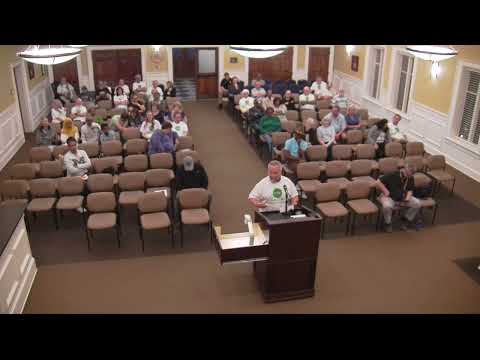
Dozens of residents told the Snellville City Council on March 24 that a rezoning request for the former Summit Chase Country Club threatens neighborhood character, local wildlife and infrastructure.
At a public-comment session dominated by neighbors of the Summit Chase community, speakers described blighted wildlife, increased silt in Johnson Lake and traffic impacts on Summit Chase Drive and surrounding corridors. "It's an invasion in our right to peaceful living," said Mila, a resident of 3251 Garment Drive, describing plans she said include "almost 43 houses directly along my property line" and an overall project she said would add about 125 houses.
The residents framed their opposition around several recurring concerns: (1) traffic and cut-throughs on Summit Chase Drive, Rosebud Road and U.S. 78; (2) blasting and construction next to existing homes that could harm foundations, pools, septic systems and wells; (3) environmental damage to Johnson Lake and the Big Haines Creek watershed, including increased silt observed since nearby construction at the Soleil development began; and (4) infrastructure capacity, notably sewer lines that some speakers said are not sized for the proposed additional homes.
Four long-time and newer Summit Chase residents said the proposal conflicts with the neighborhood’s established character. Ross Lee, a Summit Chase resident, asked the council to "keep intact the character area of Summit Chase while allowing for the owner to sell his land for reasonable use within the existing zoning designation of the property." Several other residents asked the council to honor the planning commission’s earlier unanimous vote against approving the rezoning.
Speakers also raised questions about the mechanics of homeowner-association covenants and who must approve changes. David Impiccitori, a Summit Chase HOA board member, said covenants “can only be released by two-thirds of the votes of the members of the [HOA],” not by the board alone, and warned the HOA and a small membership could not likely afford to maintain the club amenities if ownership reverted to the association.
Technical and environmental concerns were also highlighted. Julie Reese, who lives on Johnson Lake, said silt from the Soleil project is already entering the lake and damaging habitat. She invited councilmembers to visit her property to see the extent of sedimentation. Multiple speakers asked whether detention ponds, slopes and granite outcroppings shown on site plans would function as designed and whether builders without blasting or complex-topography experience can safely complete the work.
Some residents proposed alternatives. Ross Lee said he had contacted golf-course managers willing to discuss a nine-hole course; others suggested conservation or park uses had been considered previously. Other comments stressed that the owner could currently sell the land under existing R-30 zoning, and one resident said the city should not "rescue" the owner from business decisions at the expense of neighbors.
Several speakers appealed to the council’s prior actions and plans. James Doppelhauer said Snellville adopted the Gwinnett County 2045 comprehensive plan in February 2024 and asked whether the proposed rezoning would be consistent with that plan. David and others cited the city’s Unified Development Ordinance (UDO) language on concept plan review to argue for stronger scrutiny of the developer’s conceptual site plan.
No rezoning vote or council action on the proposal was recorded during the meeting. The public-comment period closed after sustained testimony from Summit Chase residents urging denial or more rigorous review. The meeting concluded with a procedural motion to adjourn that passed 5–0.
The council did not announce any next steps on the rezoning request during the meeting; multiple speakers urged the council to reaffirm earlier planning-commission recommendations and to require additional study of traffic, stormwater, blasting plans and covenant mechanics before any zoning change.
Residents who spoke identified themselves by address and described long-term investments in their properties and the neighborhood, emphasizing health, quiet and wildlife as reasons to oppose the rezoning request.