
City attorney briefs committee on "customary use" legal framework and recent statutory changes
Get AI-powered insights, summaries, and transcripts
Subscribe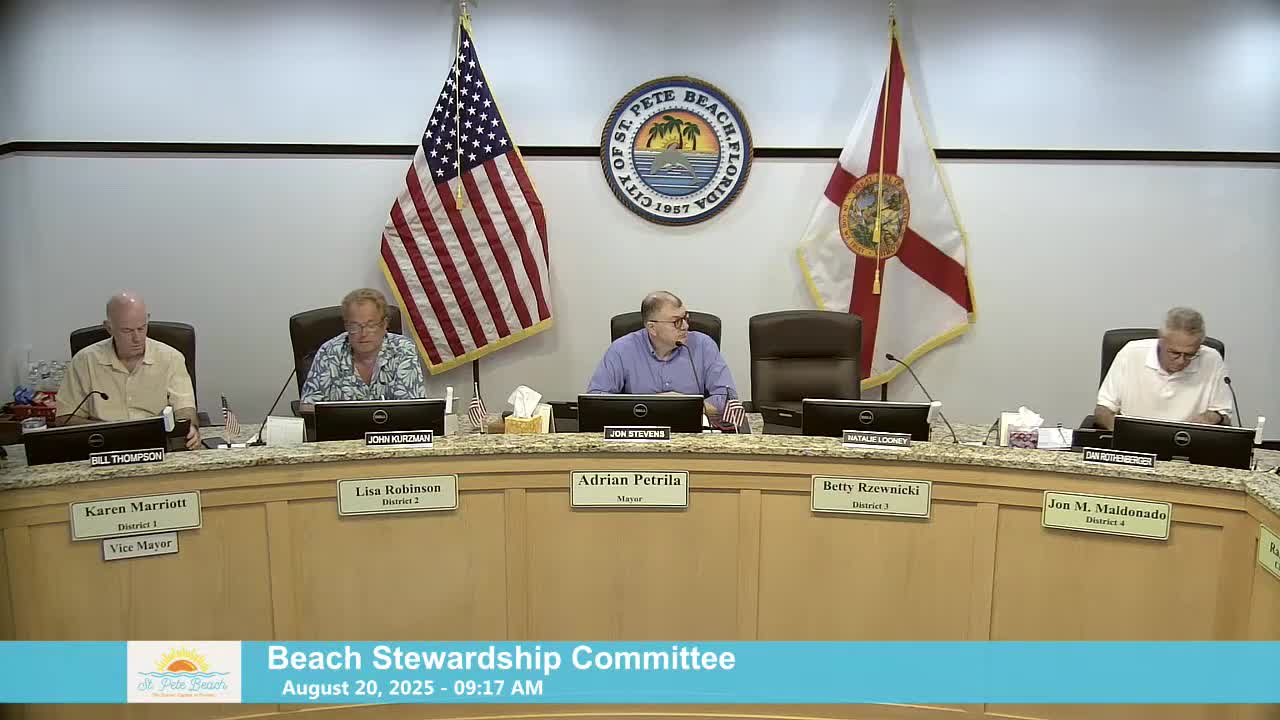
Summary
City attorney reviewed Florida case law and recent legislative changes affecting "customary use" claims on dry sand, urging caution for any citywide ordinance and recommending recognition of common law rather than a countywide prescriptive regime.
The city attorney gave a detailed legal briefing on the customary use doctrine and its recent developments in Florida law, telling the Beach Stewardship Committee that customary use claims are inherently site‑specific and that recent state legislation has returned the issue to the courts for case‑by‑case determinations.
"The customary use doctrine deals with the dry sand area of the beach," the city attorney said, and described how the 1974 Tony Rama decision and later cases clarified that customary use requires proof that a recreational use on dry sand was "ancient, reasonable, without interruption, and free from dispute." The attorney said that the Treponier v. County of Volusia case and subsequent developments show courts must analyze custom on a property‑by‑property basis.
The attorney reviewed more recent events in Florida: Walton County's ordinance and multi‑year litigation, a 2018 legislative change (House Bill 631) that altered the process and a subsequent repeal of the judicial‑determination requirement in the 2023 legislative session (Senate Bill 1622 in the transcript), which returned customary use questions to the common law framework. "The customary use doctrine can be used as a shield...or it can be used as a sword," the city attorney said, explaining that it may be an affirmative defense in trespass cases or be invoked against proposed private development that would interfere with long‑standing use.
Public commenters cautioned against broad restrictions that might conflict with private contracts or hotel operations. Dave Winkler of Suncoast Watersports, who said he has operated on St. Pete Beach for 47 years, urged the committee to "take those [property complexity] considerations into account" when drafting ordinances because hoteliers and concession operators have existing contractual roles on the sand. Committee members asked about tax and easement implications and raised the practical difficulties of defining "ancient" or documenting prescriptive access.
Why it matters: customary use questions affect whether members of the public may lawfully walk or set up on privately owned dry sand and therefore constrain what a municipal ordinance can require or forbid. The attorney recommended acknowledging common‑law customary use and avoiding a Walton‑style universal buffer that would mandate specific public corridors without adjudication.
Ending: Committee members indicated they want a measured approach; the city attorney and staff recommended workshop discussion and legal review as drafting proceeds.