Get Full Government Meeting Transcripts, Videos, & Alerts Forever!
Get email alerts on the Disaster Recovery Permitting topic
No spam. Unsubscribe anytime.
City reports steady permitting and limited Elevate Florida gains; 800 properties to receive detailed FEMA‑compliance letters
Summary
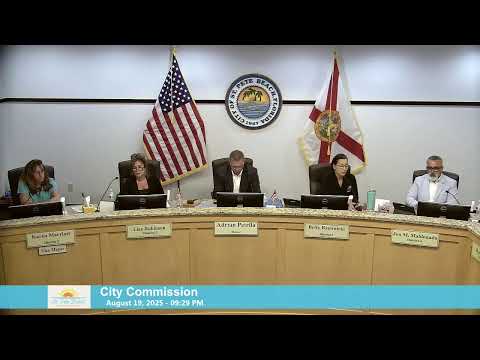
St. Pete Beach staff reported on Aug. 19 that permit processing is steady but outside recovery programs have advanced relatively few local applicants; the city will mail detailed FEMA‑compliance letters to about 800 properties in early‑to‑mid September.
St. Pete Beach staff on Aug. 19 gave a status update on hurricane recovery and preparedness, detailing permit throughput, historic‑designation activity, Elevate Florida outcomes and next steps on FEMA compliance.
“Beginning with the hurricane recovery, we’re going to talk briefly about historic designations, permit processing, demos, elevations, FEMA compliance,” Community Development Director Laura Canary told the commission, then laid out the current counts and timelines. Laura Canary and Public Services Director Camden Mills presented the report.
Key figures staff presented (staff‑reported totals at Aug. 3 unless otherwise noted): - Historic designations: 45 local historic designations approved; 12 pending; 3 withdrawn. - Certificates of appropriateness (for demolition/review of contributing historic structures): 27 applications; 23 approved; 4 pending. - Permit intake: 5,118 applications submitted to date; staff said they are issuing on average about 69 permits per day and performing about 83 inspections daily; 867 permits have been closed to date. - Demolition permits: 138 demo permit applications received; 82 issued; 19 closed. Average time to issue a demolition permit: about 30 days when documentation is complete. - Elevation permits: 30 applications received; 13 issued. The average issuance time on those is about 32 days.
Elevate Florida results and FEMA compliance Canary said the statewide Elevate Florida program had received more than 12,000 applications; 328 of those applicants originated from St. Pete Beach. Of the statewide group that moved to the next step, staff said 305 applications were advanced by the program and, of that group, four moving applicants were St. Pete Beach residents.
Notifying and funding: staff said notification letters for prioritized and wait‑listed applicants began in late July and unfunded notices were sent between Aug. 5 and Aug. 15. Canary told commissioners Elevate Florida administrators expect — but have not finalized — funding that might support roughly 2,000 applications statewide based on available dollars, leaving many applicants likely to be prioritized, wait‑listed or unfunded.
FEMA‑compliance follow‑up: staff said they have about 800 properties that require more detailed follow‑up to confirm damage status and next steps. Canary said the city will mail a more specific, property‑level letter in early to mid‑September describing the city’s records for that property (elevation, water intrusion, documented damage) and asking owners to confirm status so that the city can follow FEMA compliance processes.
“Notifications to the prioritized and wait‑listed applicants began in late July and then the unfunded notifications were starting to be sent between August 5 and the fifteenth,” Canary said. “We have talked to some individuals already in St. Pete Beach that have started to receive those notifications.”
Operations and procedures Canary also described how Senate Bill 180 (2025) has changed recovery‑period operations: examples she listed included prohibitions on local moratoria and no‑impact‑fee rules for same‑use structures, a requirement to make post‑storm permitting and inspection procedures more transparent, and a stated minimum of 40 operating hours per week “as soon as is reasonably feasible” after a storm. Canary said the city had already removed the local “look‑back” cumulative‑improvement provision after the storm and that staff is updating the city’s Substantial Damage Assessment Plan (SDAP) to reflect SB 180 requirements and the 40‑hour staffing expectation.
Public services and preparedness Public Services Director Camden Mills gave a separate preparedness update on capital repairs and pre‑event staging: roof repairs at City Hall and other facilities, work beginning at the aquatic center and Heron Park pavilion, generator inspections for critical facilities, rental bypass pumps to augment owned units for storm season, an auxiliary fuel tank for a utility vehicle to fuel pumps in the field and plans to solicit bids for on‑site fuel storage.
Mills summarized pre‑landfall actions: a 72‑hour review of the EOC plan and hazards, staging and stocking equipment; a 48‑hour check and equipment relocation to higher ground; and final relocations to the off‑site emergency operations center the day before an event, plus increased coordination with Pinellas County, the City of St. Petersburg and Duke Energy.
Questions and next steps Commissioners asked about the low number of St. Pete Beach applicants moved forward in Elevate Florida and about how the city will reach property owners who have not responded. Canary said the next round of, more detailed letters will be sent in early to mid‑September and that staff intends to prioritize outreach beginning with the oldest open permits if response rates remain low. She also said staff is exploring use of volunteers to help with outreach and that a targeted enforcement phase has not yet begun.
Staff recommended a planned RFP for a local nexus study on multimodal impact fees (separate agenda item) and committed to publishing the SDAP and related permit checklists on the city website as they are finalized.
Why it matters: the figures show the city processing large volumes of recovery permits while most federal and state programs remain oversubscribed. The low advance rate for local Elevate Florida applicants and the 800 properties still requiring follow‑up underscore remaining gaps in external funding and the need for targeted local outreach and enforcement to complete FEMA compliance.