Get Full Government Meeting Transcripts, Videos, & Alerts Forever!
Get email alerts on the Land Use Rezoning topic
No spam. Unsubscribe anytime.
Snellville council pauses vote on 70-home Lenoir Church rezoning after public debate
Summary
A proposal to rezone 15.15 acres at 2587–2597 Lenoir Church Road for 70 homes — 28 detached and 42 townhomes — was presented April 28. Planning staff recommended approval but council voted to table the final decision to May 12 after resident concerns and requested plan revisions.
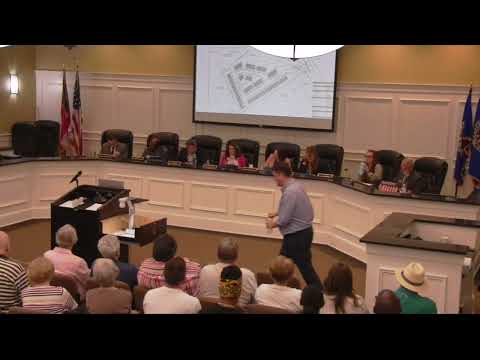
Snellville Mayor Barbara Bender and the City Council on April 28 heard a contested rezoning and land‑use amendment for two parcels at 2587 and 2597 Lenoir Church Road that would allow 70 homes on about 15.15 acres.
Planning Director Jason Thompson told the council the application (RZ25‑03 and LUP25‑01) would change the Snellville 2045 future land‑use map from low‑density residential to medium density and rezone the property from RS‑30 (single‑family) to RX (mixed residential). Thompson said the applicant requested a variance to increase the portion of the front yard used for driveways — from 35% to 67% for townhomes and to 40% for detached houses — and staff recommended approval of the three requests. “We recommended approval,” Thompson said.
The applicant, represented by Shane Lanham of Mahaffey Pickens & Tucker LLP and developer Neville Allison of Revive Land Group, described a mixed scheme with 28 single‑family detached homes around the property perimeter and 42 townhomes inside, a gross density of about 4.62 units per acre, and roughly 5.9 acres of open space mostly tied to the No Business Creek stream buffer. Allison said the planned stormwater facility is a water‑quality pond about four feet deep, meant to be largely vegetated and hold water only briefly after rain events. “The pond is only about 4 feet deep from the top of the dam to the bottom… It holds water after a rain event for 12 to 24 hours,” Allison said, adding the developer will plant evergreens for screening and has shown a deceleration lane on the concept plan.
Residents and nearby property owners voiced safety, traffic and character concerns. A resident who identified himself as the owner of 2587 Lenoir Church Road said he supports new homes over higher‑density apartments but asked for a required deceleration lane and said Lenoir Church Road is fast and difficult to turn onto. “A deceleration lane is a must,” the resident said. Neutral and opposition commenters, including Megan Palich and Suzanne Krieger, argued the proposal conflicts with the No Business Creek character area in the comprehensive plan and questioned whether medium density is appropriate on the west side of Lenoir Church Road.
Council members pressed the applicant on drainage, the visual impact of the detention/water quality pond and waste‑collection routing; the developer agreed to investigate screening, berms and alternatives to hammerhead turnarounds after concerns that garbage trucks would need to make noisy maneuvers near existing homes. Project engineer Barry Edgar explained stormwater conveyance would use curb and gutter collection routed through underground pipes and a creek crossing to the pond.
After discussion the applicant agreed to revise the conceptual plan to remove or reconfigure hammerhead turnarounds and to show a deceleration lane and landscape screening. A council motion to table the rezoning and land‑use amendment until the council's May 12 meeting passed by voice vote; the council recorded the outcome as tabled with four votes in favor, none opposed, one abstention/recusal and one absent. The motion asked staff and the applicant to return with a revised plan addressing the traffic, berm/landscaping, and garbage‑truck turning concerns.
Why it matters: The application is the first RX (mixed residential) rezoning to appear before council since that district was added to the Unified Development Ordinance. It touches on competing priorities found in Snellville’s 2045 comprehensive plan: adding housing diversity and homeownership opportunities while preserving established low‑density neighborhood character and stream buffers.
Next steps: Council set a new public hearing for final action on May 12; the applicant will submit a revised site plan that eliminates the hammerhead turnarounds or provides an alternative, and staff will circulate any revised mitigation conditions for council review.