
Cowlitz County staff outline $11.7M consolidated homeless grant and commissioners press for stronger oversight
Get AI-powered insights, summaries, and transcripts
Subscribe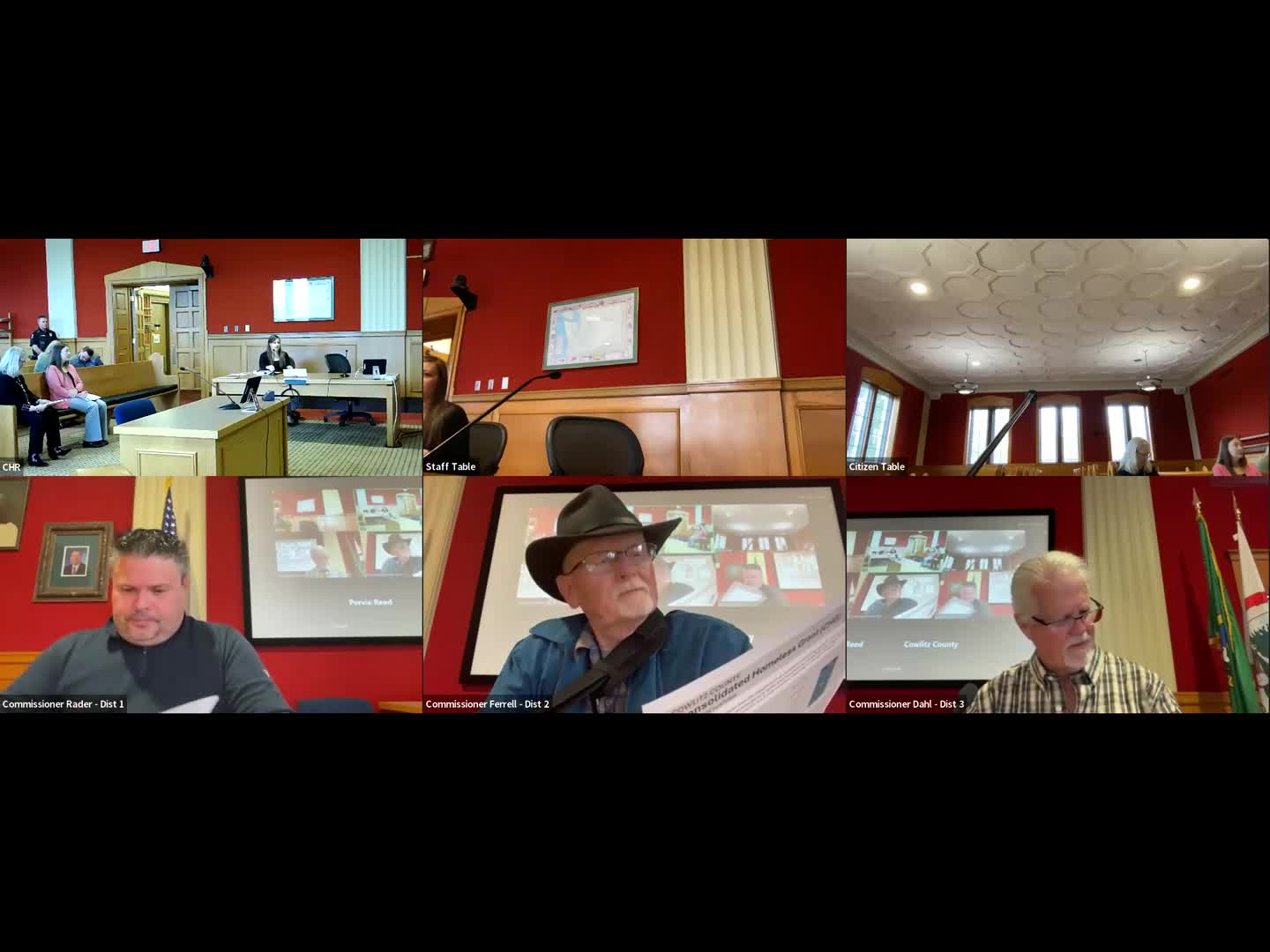
Summary
Health and Human Services described an $11.7 million state consolidated homeless grant and related pass-through contracts; commissioners pressed staff on results, spending trends and whether independent audits or tighter monitoring could be funded from the grant.
Gina James, director of Health and Human Services, briefed commissioners on the state Consolidated Homeless Grant (CHG) and several pass‑through contracts on the upcoming agenda. James said the current CHG contract is about $11.7 million and combines state general funds and locally collected document‑recording fee revenue that the state returns for homeless services.
James walked the board through recent biennial outcomes and program uses. She said past bienniums (July 2021–June 2023 and July 2023–June 2025) each show roughly 350 individuals served with about 210 households moving into housing in the earlier biennium and 211 in the later one; she clarified those are different households counted per biennium. She said eviction‑prevention dollars and eviction‑prevention processes (including mediation) were a notable change in the most recent period.
Planned pass‑throughs on the agenda include contracts with CAP and the Community Mediation Center and continued funding for coordinated‑entry partners (Family Health Center, Community House, Emergency Support Shelter). James said the pass‑throughs and these service contracts would allocate somewhat less than half of the CHG award, leaving funds available for future allocations subject to state contract parameters.
Commissioners pressed officials on oversight and results. Commissioner Dahl asked whether the county could hire independent auditors to review how pass‑through dollars are spent; county staff said existing practice is risk‑based monitoring (including random spot checks, receipts review, and review of federally required single-audit reports from large subrecipients), and that staff are willing to investigate whether independent audits could be procured and charged to the grant. "We typically with those capital type projects, we review every receipt... With these contracts, we do a risk assessment in the beginning of contracting," James said. Commissioners asked staff to explore whether the CHG can fund independent, outside audits and to bring the options back to the board.
James also said the state uses a formula based on census, poverty and related data to allocate CHG funds and confirmed the state does not use the point‑in‑time homeless count to set allocations; staff said the state is shifting toward basing future allocations more on actual spending history.
Ending
Staff said the contracts (CHG, CAP, Community Mediation Center and coordinated‑entry agreements) are on the agenda for formal action and that they will provide further materials about monitoring options and potential independent audit costs for commissioners to consider at a follow‑up meeting.