
Troutdale advisory committee presses police for clearer crime-reporting dashboard
Get AI-powered insights, summaries, and transcripts
Subscribe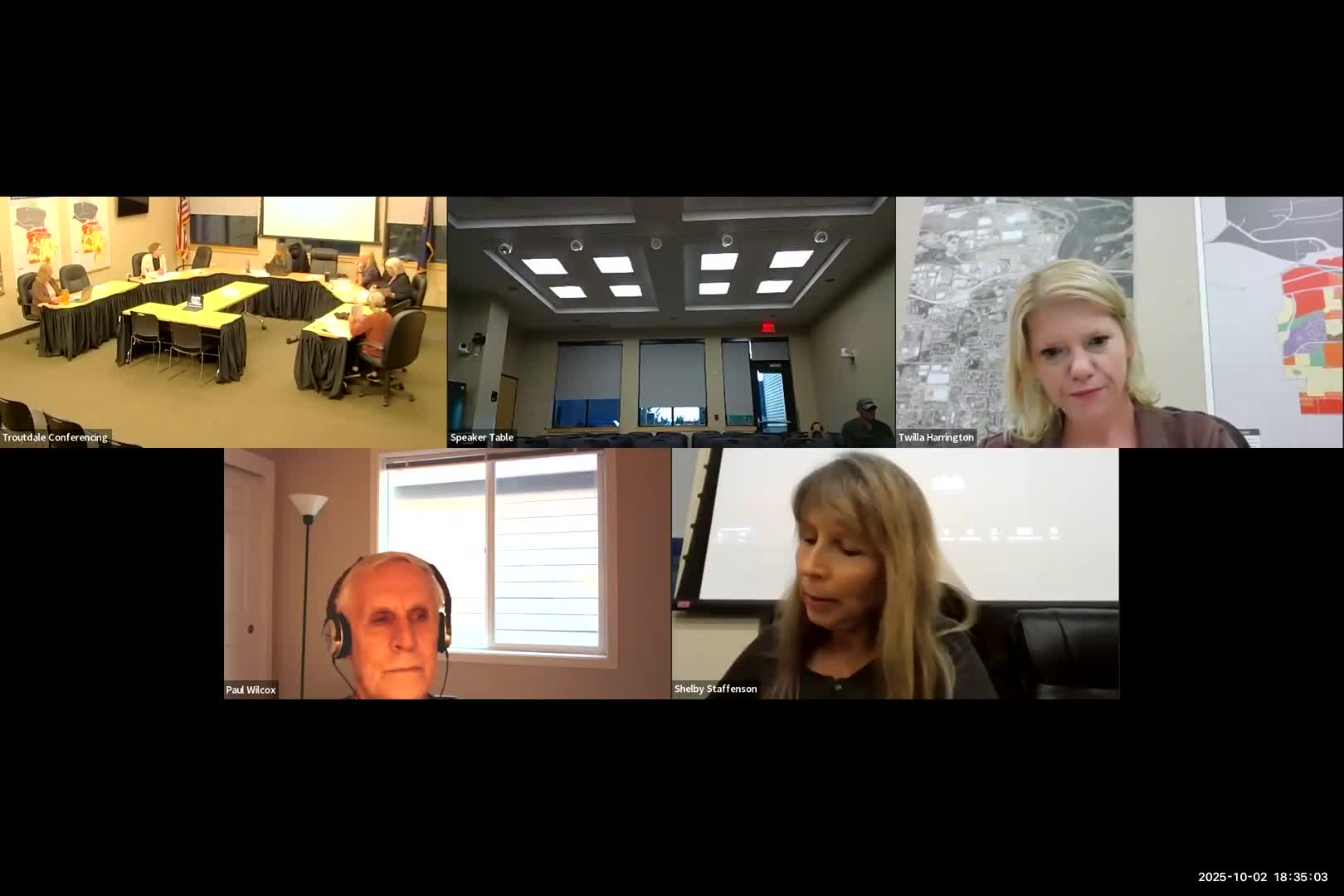
Summary
Members of the Public Safety and Equity Advisory Committee raised questions about inconsistencies between printed and online police data, asked for clearer definitions and hotspot mapping, and requested a data analyst briefing to break down welfare checks, abandoned-vehicle reports and HOPE-team activity.
Troutdale’s Public Safety and Equity Advisory Committee on Oct. 2 pressed local law enforcement for clearer crime-reporting definitions and a more usable dashboard after members found discrepancies between printed reports and the city’s online incident listings.
Committee members said the monthly law enforcement packet and the department’s public website show different totals for categories such as welfare checks, trespass and certain assault subtypes, and they asked the department’s analyst to come to the next meeting with definitions and a breakdown the committee can use. “They showed up quickly, and it’s on the report,” said Twila Harrington, describing a recent welfare-check response that she said was reflected in the monthly packet.
The exchange began after the committee reviewed the law enforcement report for September. Members noted that the packet showed 688 total calls for the month while a prominent “other” category contained 333 entries; they also said some online category totals appear as zero even when the printed packet lists incidents. “It looks like there’s quite a number of things on the website that is not reporting at all,” said one committee member, summarizing concerns about missing or mismatched counts.
Committee members asked the city’s data analyst, Kevin Morelli, or his designee to attend the next meeting to explain how incident types are defined and how online and printed counts are generated. “He’s the one that does all the data analysis, and he’d be able to break everything down for you,” committee member Nick said when asked who could supply the definitions. Members agreed to compile a list of specific questions and send them in advance to the analyst.
Members requested several concrete changes to reporting and tools: a color-coded heat map that can be filtered by category (property crimes, person crimes, welfare checks), clearer documentation of whether an entry reflects the location of the incident or the location of the report, and monthly summaries that separate calls that do not generate written reports (civil standbys, follow-ups) from those that produce formal case reports. “If we could have it broken down… welfare checks and how many that you would have to talk to Kevin Morelli about,” a committee member said.
The committee also heard neighborhood-specific concerns. Paul McCox said he had generated a large share of the “abandoned vehicle” entries on the 800 block of Halsey near Mountain Meadows apartments, and that officers had tagged and removed some cars. “So all of those calls that you see on there, those are actually every probably every single one of those was generated by me last month,” McCox said. A law-enforcement representative on the call said the department tags vehicles with expired registrations to prevent them becoming targets for stripping or other crimes.
Members pressed for better tracking of HOPE-team responses to houselessness-related calls; Frank Stevens asked whether calls that fall under “unwanted person” or “suspicious” could be attributed to HOPE-team unit numbers so the committee could see those activities in the monthly totals. The committee was told that unit-level tracking would need to be produced by the analyst and that some responses are currently lumped into an “other” category.
Committee members also asked about recent encampment enforcement on state-managed land known as “Thousand Acres.” Nick, the department representative, said state police led a sweep with local participation and that Rapid Response crews were contracted to clear debris; he said roughly 10 people were removed in the most recent action and that a 24-hour security contract was expected for the site. “Yesterday, we closed the entire location down… I think there was about 20 state police officers that went in with us,” Nick said.
The committee agreed to send questions in advance to Morelli so the analyst can present a walkthrough of the dashboard and produce the requested breakdowns at the next meeting.
Ending — The committee set its next meeting for Nov. 6 and asked members to send written questions for the data analyst ahead of that date. The group said better, standardized reporting and a usable heat map are priorities for future meetings.