Get Full Government Meeting Transcripts, Videos, & Alerts Forever!
Get email alerts on the Early Childhood Report topic
No spam. Unsubscribe anytime.
Early Childhood Commission endorses September report draft, urges clearer funding graphics and stronger match language
Summary
The Early Childhood Care and Education Commission reviewed a draft of its September report, recommended clearer visuals linking funding to seats, urged language to codify state matching for locally raised funds, and voted to endorse the draft allowing minor technical edits before submission.
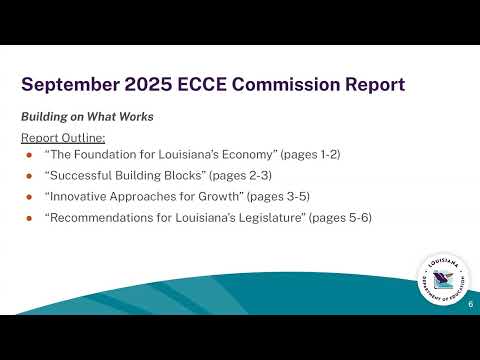
Representative Freiberg called the meeting to order and turned the session over to Erin Powell of the Department of Education, who presented the draft Early Childhood Care and Education Commission report that will be submitted to the governor and legislature in September.
Commissioners and members focused on three issues: making the report’s charts and graphics clearer for legislators (so they show how state investment affects seat availability), clarifying the goals of business tax credits and local matches (emphasizing that local funds should complement rather than supplant state funding), and specifying the long-term financing approach for the early childhood education fund and the local match program. Erin Powell said the draft emphasizes the economic argument for early childhood investment and noted the report was intentionally shorter and more direct.
Members suggested concrete changes: add an executive summary or one‑page brief; revise the map/graphic to show both timing of local investments and the number of seats produced (for example, color and saturation to indicate early vs. recent funding and seat counts); and make explicit that local fundraising is intended to be matched by the state, not to replace state general fund commitments. Commissioners also asked that the report call out parish‑level differences in how local dollars were raised (philanthropy, city/parish appropriations, millage, or business contributions) and to include a link to the department’s data dashboard so legislators can see updated local fundraising figures over time.
Participants cited figures used in the draft as items to clarify in text or footnotes: the draft lists nearly 3,500 birth‑to‑3 children on a waiting list (noted in the draft as an as‑of date in a footnote: July 2020) and the commission discussed state fiscal year 2025 appropriations (speakers said roughly $78,000,000 for FY25, and described a one‑time $40,000,000 investment previously expended). Staff reported the match fund balance and fundraising totals are dynamic: the department noted roughly $35,000,000 was in the match fund as of August 4 (figures and dates will be updated in the final submission).
On recommendations, members debated ordering and wording. Suggestions included: lead with the largest additional state investment request (to avoid implying tax incentives are the primary solution), rephrase language so workforce child‑care tax credits and employer contributions are framed as partnerships that expand access rather than mechanisms to reduce state outlays, and revise any phrasing that might suggest the issue is “too expensive” for the state. The draft currently highlights (a) codifying the state match, (b) an additional requested investment (members discussed $30,000,000 as an illustrative figure for next‑year matching capacity), and (c) continued use/expansion of workforce child care tax credits.
After discussion, a motion to endorse the September 2025 report draft, allowing staff to make minor technical edits before submission, was moved by Libby Saunier and seconded by Marcus Toppler. The motion carried and staff said they will circulate the designed version once the editors and graphic team have integrated the group’s feedback. The commission also scheduled follow‑up public briefings and noted the draft will include clearer references to the Department of Education’s data dashboard for legislators seeking more detailed, time‑series data.
The commission closed the item and proceeded to the next scheduled presentation.