
San Benito County leaders weigh $8 million-plus in cuts as CAO seeks authority to bargain with unions
Get AI-powered insights, summaries, and transcripts
Subscribe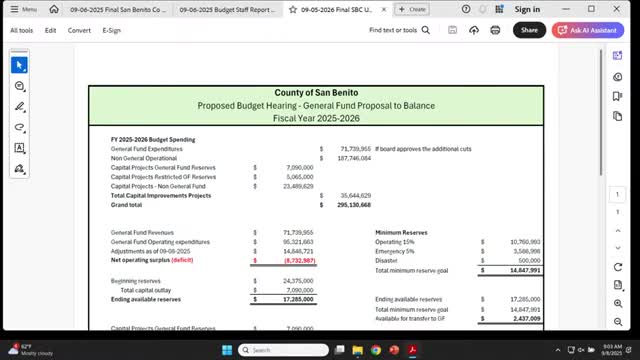
Summary
County officials presented a revised FY2025–26 budget showing a multiyear reserve draw and a remaining shortfall of roughly $8 million; department heads and elected officials described potential deep service reductions and urged alternatives while the CAO asked the board for authority to negotiate with unions and additional time to refine cuts.
San Benito County leaders on Tuesday laid out a revised fiscal year 2025–26 budget that reduces proposed expenditures but still leaves a gap the county must close before the Sept. 22 public hearing on adoption.
Chief Administrative Officer Esperanza Colio Warren told the Board of Supervisors that staff reduced planned spending after intense department-level review but that “we need $8,000,000 more in reductions.” She told the board she lacked direct access to the county’s enterprise financial system (ERP) and received final audit numbers late Friday, which limited her time to reconcile figures: “the final numbers were received at 11:23 on Friday,” she said.
The shortfall emerged from a larger revision to a previously higher budget proposal. Colio Warren said the county’s operating budget is roughly $71 million and that the board had directed staff to reduce an initial roughly $98 million expenditure plan down toward that amount — a reduction she described as roughly $24 million once contingency funding was removed. She said total reserves now stand at about $24 million but that, after accounting for required minimum reserves (15% of operating expenses), emergency set-asides and project transfers, only about $2.4 million would be available for one-time use without risking minimum reserve levels.
Why it matters
County leaders and department heads said the cuts on the table would materially affect basic public services. Elected and appointed officials warned that departments composed largely of personnel costs have limited options other than layoffs or pay reductions, and that reduced staffing will slow or curtail services the public expects.
During a lengthy public comment period, multiple department heads outlined the concrete operational impacts of the proposed reductions. Francisco (elections official) said his office would need to reduce staff and services dramatically to meet a large cut request, saying, “So right now, based on the numbers, I will need to lay off 60% of my staff,” and warned that mandated services such as postcard mailings and bilingual translations could fall out of compliance. The county assessor (Tom) said an $850,000 cut would be about 24% of his office’s budget and would remove roughly 40% of staff, creating a long-term backlog and risking future property-tax revenue. Joel (district attorney) described the proposed reductions to his office as “devastating,” noting most of his costs are salaries and benefits and that major cuts would reduce the office’s ability to respond to quality-of-life crime.
Sheriff Eric Taylor said his office had already offered significant internal shifts and could likely contribute roughly $400,000–$420,000 without cutting staffing to levels he believed would jeopardize public safety: “of the million dollars that's being requested of our office, I think that I could get you somewhere close to about 400 to 420,000.”
What was proposed and what the board directed
- Colio Warren presented a methodology that spread cuts across departments based on department budgets and employee counts, and said the county had identified roughly $14 million in reductions so far, including about $11 million associated with projects moved out of the general fund. She said that even after those changes a remaining reduction target of roughly $8 million remained.
- Colio Warren asked the board for authority to continue negotiating with labor unions and to have an additional 14 days to work with departments and labor to identify further savings before the statutorily required public hearing process continues. She said she lacked authority to negotiate pay or furloughs without board direction.
- Board counsel advised that the board may meet in closed session to give direction to the county’s negotiator and offered to add a closed-session item to the next day’s agenda; board members expressed support for giving the CAO and HR authority to begin negotiations and for continuing department-level efforts to find cuts.
- The board affirmed the existing hiring freeze (with an exception for elections staffing to support the November ballot) and acknowledged that a Sept. 22 public hearing on budget adoption is already scheduled and published.
Departments’ accounts of likely service changes
Multiple department heads described the operational consequences of deep cuts:
- Elections (Francisco) said cuts would force elimination of services — including fewer vote-center staff, reduced postcards, fewer ASL/bilingual translations and longer wait times — and that some reductions could render the office noncompliant with state mandates.
- Assessor (Tom) said losing staff would reduce the office’s ability to process supplemental assessments and to defend large appeals that affect future tax rolls.
- Auditor/finance (Joe Paul) warned that cuts to fiscal staff would eliminate internal controls and redundancy, increasing risk of delayed vendor payments and a late, incomplete annual financial report.
- Treasurer–Tax Collector (Melinda) said most of her office’s budget is payroll and that the tax-collection function could not be sustained if staff were eliminated.
- Public Works (Steve Blue) asked for clarification of a line item labelled “disaster recovery” and flagged capital project amounts for follow-up.
Board discussion and next steps
Supervisors emphasized the need to identify uncommitted, recurring costs and to review five-year trends in department spending to refine the county’s revenue and expenditure picture. Several supervisors supported exploring revenue options — including a 1% local sales tax measure the board has discussed previously — and urged renewed attention to fee schedules, contract consolidation and vacancy management as ways to shore up the budget without wholesale service cuts.
Colio Warren said staff will continue working with departments and requested explicit authority to enter union negotiations and more time to present a further-refined proposal at the Sept. 22 hearing. County counsel said the board could provide negotiation direction in closed session and staff indicated they would place a closed-session bargaining direction item on the next regular-meeting agenda if the board wanted.
Ending
No final budget adoption vote occurred at the special meeting. The board left the Sept. 22 public hearing date in place, sustained the hiring freeze (except for election-related hires), and gave informal direction that the CAO and HR pursue negotiations with labor and continue department-level work to identify further reductions ahead of the public hearing. Colio Warren cautioned that using the roughly $2.4 million in available reserves would provide only a short runway and that further structural fixes will be needed to avoid repeating deficits in future years.