
Athens committee weighs expanding noise rules to cover fairgrounds, AR zone events
Get AI-powered insights, summaries, and transcripts
Subscribe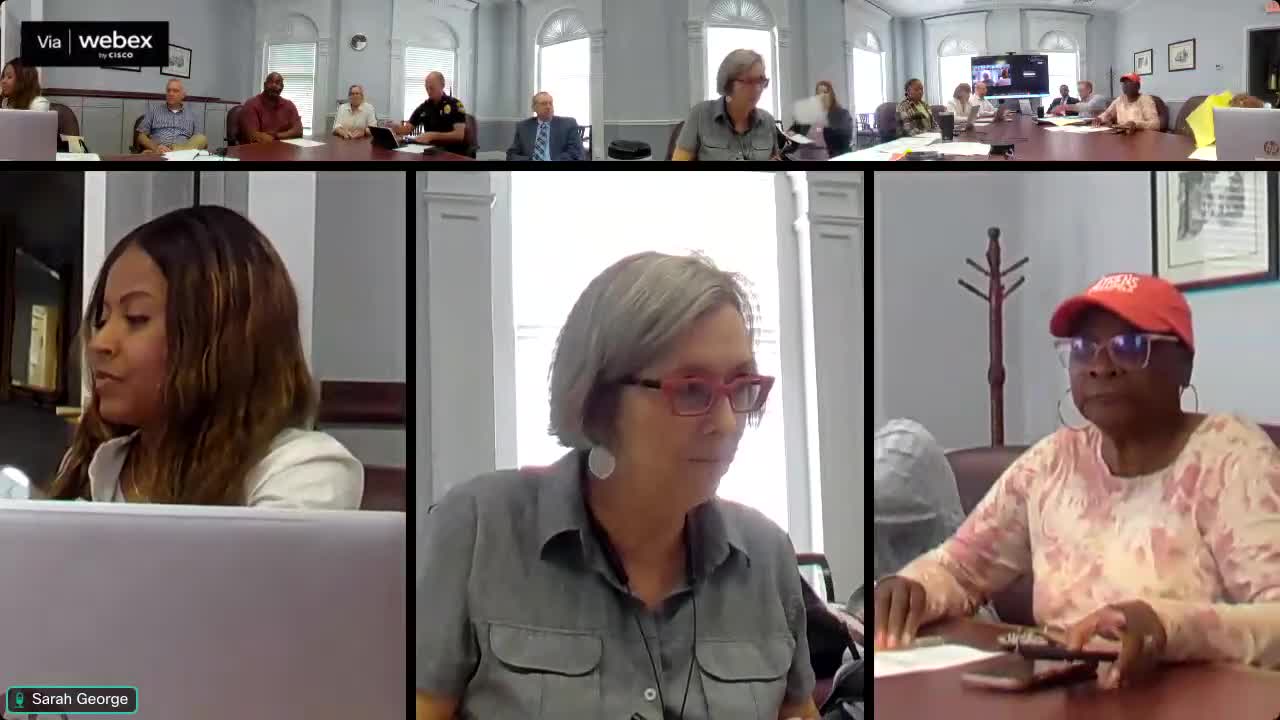
Summary
The Legislative Review Committee discussed options to address loud commercial and special-event sound in agricultural-residential (AR) areas, including drafting a text amendment to the city noise ordinance, enforcement changes and penalties, and further data collection for downtown amplified-noise complaints.
The Legislative Review Committee on Thursday, Aug. 7, discussed drafting changes to Athens’ noise ordinance to make commercial and special-event sound in agricultural-residential (AR) zones subject to the same restrictions that now apply in single-family residential zoning districts.
The committee — meeting at City Hall — focused on complaints tied to events at the fairgrounds and other AR properties where amplified music has carried into residential neighborhoods. Staff said they will prepare a draft ordinance amendment for the committee to review and asked the attorney’s office to research legal limits on penalties and whether citations should be issued to event promoters, tenants or property owners.
Committee members said the current zoning- and distance-based approach has produced enforcement gaps. Bruce Lonnie, planning staff, reviewed the temporary special-event permit rules at the fairgrounds and described how the zoning code treats such uses: “You can't have more than 2 of those in a calendar year, and you can't have more than 1 of them in a 3 month period,” Lonnie said, and noted that the permit period covers 72 consecutive hours, inclusive of setup and takedown. He also pointed out that the code's 300-foot distance is to property boundaries, not structures.
Deputy Chief Harrison Daniel emphasized that a special-event permit does not exempt a vendor from the noise ordinance, saying, “special event permits do not exempt vendors from noise ordinance.” City staff and the attorney's office advised caution about using permit conditions to impose more restrictive sound limits because amplified music can raise first-amendment issues and because permit decisions must be applied evenhandedly to avoid constitutional risk.
Staff presented options discussed in prior research, including language modeled on an Atlanta provision that applies certain commercial-sound restrictions where noise is plainly audible inside single-family residential zones, and a possible expansion of the enforceable distance beyond the city's current 300-foot rule. Committee members suggested a specific distance will be required in any ordinance and staff indicated a working range of roughly 500 to 1,000 feet as a starting point for drafting.
Discussion covered enforcement challenges: callers and commissioners described events at the fairgrounds that are audible across miles in some terrains, and staff said most downtown complaints occur between about 10 p.m. and 1–2 a.m., with Fridays, Saturdays and Sundays generating the most calls. Jack Redick and code-enforcement staff provided an initial five-year complaint trend and a downtown “heat map” showing high incident counts at several downtown locations; the dataset identified one fraternity location with 34 complaints in the chart’s time window.
Committee members asked the city to evaluate several enforcement changes: clearer online guidance explaining how to determine whether a permit is required and how to apply; whether warnings should go first to an on-scene event operator with a follow-up notice to a property owner; whether fines and repeat-violation penalties can be increased; and whether staff can track complaint dispositions by zoning category (for example, complaints originating from addresses in RS zones near AR events).
Attorney staff told the committee they had circulated confidential legal memoranda, including a February 2023 memo analyzing the constitutional and equal-protection risks of imposing permit-based speech restrictions. The attorney’s office recommended against using the special-event permit process as the primary tool for imposing new, case-by-case noise conditions because discretionary permit conditions risk liability unless they are narrowly tailored and evenly applied.
Next steps assigned by staff: attorneys Austin and Courtney will prepare draft ordinance language and research any state-law limits on penalty amounts and legal considerations for citing event promoters versus property owners; planning staff will produce a draft noise-ordinance text amendment for committee review; police and code enforcement will update the complaint chart (top-10 locations and dispositions) and pull RS-zone complaint dispositions tied to the fairgrounds; and staff will return with a draft at the committee’s next meeting on Sept. 4.
Votes at a glance: the committee approved the minutes from the May 1 meeting by voice vote at the start of the session (motion and second — mover/second not specified in the transcript; outcome: approved). At the end of the meeting the committee moved and seconded to adjourn (outcome: approved).