
Student speakers and staff push district to publicize ICE-response plan; board hears ethnic-studies clarification
Get AI-powered insights, summaries, and transcripts
Subscribe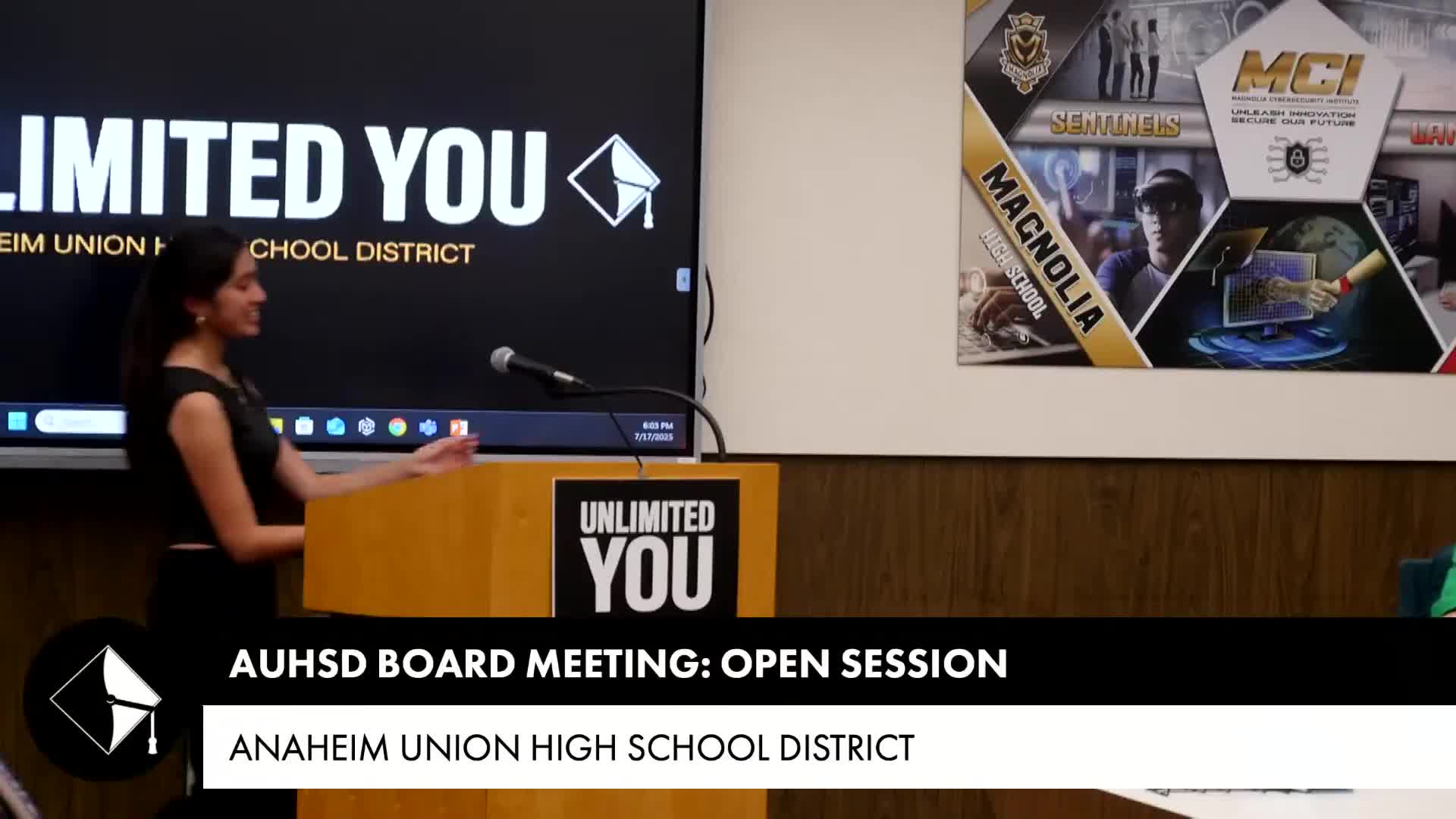
Summary
A student urged the Anaheim Union High School District to publish a plan to protect students amid recent immigration enforcement activity; district staff said a multi-layered plan exists and described options, plus clarified changes to ethnic-studies graduation implementation.
A student speaker and parents urged the Anaheim Union High School District to publish clear campus safety measures and family supports after a summer of immigration enforcement activity in Anaheim-area neighborhoods, and district staff told the board they have drafted layered protocols and supports to deploy before the start of school.
"I'm here today for two reasons. 1 of them is to ask that you all create and publicize a plan on how to protect students once the school year starts, especially because of the recent ICE activity in and around the Anaheim area," said Hailey Sotelo, who identified herself as a rising sophomore at Savanna High School.
Parent speakers amplified the request. Dulce Sotelo told the board families want "increased surveillance before and after school at dismissal time" and asked whether schools would lock down "if immigration activity is confirmed around our schools." She said many students walk home and families need to know how the district will respond.
District staff described work underway. Dr. Jaren Fried said the district "actually have[s] a plan in place" and that site administrators will be given talking points at the start-of-school site meetings so families and staff understand the protocols. Fried said the plan comprises three parts: ICE protocols aligned with existing policy, extra layers for situations in which enforcement agents do not follow usual procedures, and centralized resourcing for mental-health and community supports.
Superintendent Michael Matsuda and a district cabinet member said the district is increasing supervision at campuses, coordinating with local law enforcement and community partners, and preparing communication protocols so students and families receive campus-specific instructions. "We're looking to increase supervision," Dr. Fried said, adding the district had asked local law enforcement to be more visible before and after school.
Staff also told the board the district is preparing options for families and students who feel unsafe coming to campus, including remote-access alternatives; Dr. Fried said the site-level rollout of those options will be explained to administrators on Monday prior to registration. "We have a plan to support our students who would like to stay home because of the fear," Fried told the board.
The meeting also included a staff report on ethnic-studies graduation requirements. Board members and staff clarified that district changes do not eliminate year-long ethnic-studies instruction. Dr. Fried explained the district has offered ethnic studies prior to the state mandate and has been working to integrate ethnic-studies content across courses so students can meet the requirement through multiple options. He said the district will enroll students in year-long ethnic-studies courses but the graduation policy language being revised will allow a student to meet the requirement by passing a semester if the board ultimately chooses that path in the future. "The change that we're making in the graduation policy ... is not about reducing ethnic studies from once year long to a semester," Fried said, adding the district is four years ahead of the state implementation timeline and is keeping the year-long course structure while providing more options and credit recovery safeguards.
Board members and staff asked how the district will communicate the protocols; administrators said site teams and district communications staff will run a coordinated outreach campaign, including messages tailored to students, parents and staff. Staff also said the district has been coordinating with community organizations and local elected officials to provide resource distribution and outreach this summer and will continue that work into the school year.
No board action was taken on the safety or ethnic-studies items at the meeting; staff said they will present protocol materials and site-level guidance to administrators ahead of the first day of school.