
Council hears citywide supplemental budget requests including finance software and staffing needs
Get AI-powered insights, summaries, and transcripts
Subscribe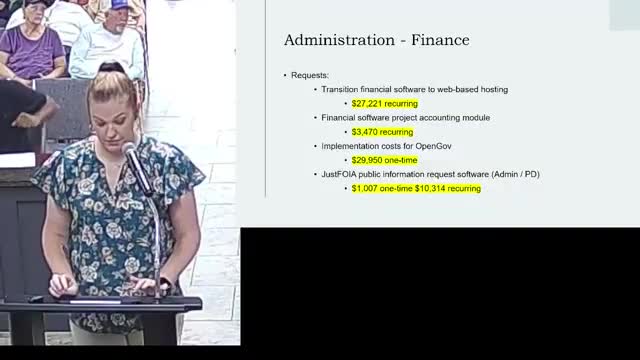
Summary
Freeport — Department directors presented supplemental budget requests at a special August meeting that ranged from finance software upgrades and a public-records portal to parks repairs and museum generator needs.
Freeport — During a special City Council meeting in August 2025, department directors presented supplemental budget requests for fiscal 2025–26 covering finance and IT, human resources, building permits, museum maintenance, parks and recreation, and the golf course.
Finance and records: Finance Director Ashley Hurst asked the council to approve a one-time implementation fee and recurring costs to transition the city’s financial software to a web-hosted (cloud) deployment and to subscribe to OpenGov for budgeting and public financial transparency. Hurst said the current on-premises system prevents staff from running reports in meetings and blocks access outside the office. She presented a package that included a waived implementation fee from the software vendor for the hosting transition, a recurring hosting fee ($27,221 recurring), a $3,470-per-year project-accounting module (available only if hosted), and a discounted OpenGov implementation fee of $29,950 plus a recurring OpenGov subscription (OpenGov would replace current manual data-feeding processes). Hurst gave a total for her four requested items of $71,962 and said OpenGov would free staff time and provide dashboards for council and the public.
Public-records system: Hurst also described a shared public-information-request portal (JESSTFOIA) that would be split between administration and the police department: a one-time implementation cost split between the two departments (approximately $1,007) and a combined recurring cost of roughly $10,314.
Human resources: The HR director requested two one-time items: two staff certifications (Texas Municipal Human Resources Association certification) and consultant support to reorganize the city policy manual; total one-time cost requested was $6,000. The director said policy modernization would move the city from reactive to proactive policy updates.
Building permits and code enforcement: New Building Official Reggie Harris, recently hired, asked for a modest advertising/posting budget ($3,000) to cover notifications and mailings necessary for permit-related processes.
Museum and cultural facilities: Museum leadership asked for a generator and dehumidifier to protect artifacts, and noted success this year in attracting more visitors after exhibit rework. Council asked staff to provide visitor metrics to justify staffing/advertising line items.
Parks, recreation and pool: Parks staff requested several one-time capital fixes: exterior metal coating for RiverPlace, playground repairs and edging/mulch replacements, plus pool repairs including replastering and pump-room work. Staff said some work might be funded from existing fiscal-year resources and that a company review of pool systems was imminent; a splash pad replacement was estimated conservatively at $10,000 but could rise depending on infrastructure needs.
Golf course: Golf Course Manager Brian reported growing rounds (projected 37,000 visits this year), a stronger revenue picture and equipment requests limited to path repair and long-term platform replacement. He and council discussed strategic revenue opportunities — membership changes, corporate sponsorships, and a climate-controlled clubhouse as potential next steps to increase non-green-fee revenue.
Budget context and next steps: Finance staff presented an updated projection of available resources and highlighted roughly $1.6 million in one-time funds that, if council approves, could be earmarked for priority capital needs at year-end. Council directed staff to return with more precise quotes and a recommended prioritization of one-time items, and to provide metrics (museum visitation, golf-course usage) before final appropriation decisions.
Ending: Council did not make final appropriations at the meeting; members asked staff to bring firm quotes and implementation plans to the next session.