
Freeport council approves water, sewer rate package after split debate
Get AI-powered insights, summaries, and transcripts
Subscribe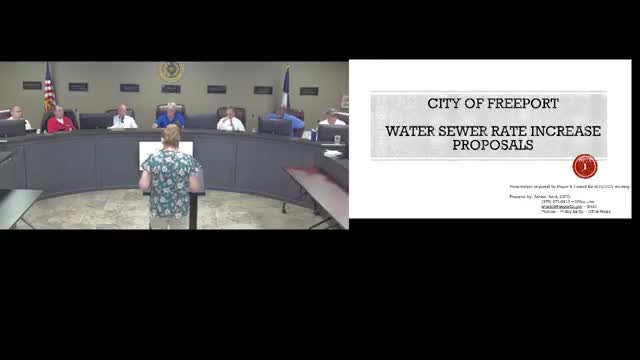
Summary
At a special August meeting the Freeport City Council voted 3–2 to adopt a new water and sewer rate package (option E) intended to cover a projected FY25–26 utility fund shortfall; the plan raises revenues but prompted debate about small-business exemptions and future capital needs.
Freeport — The City Council voted 3–2 at a special meeting in August 2025 to adopt a water and sewer rate package (agenda ordinance and companion fee-schedule resolution) aimed at closing a projected shortfall in the utility fund for fiscal year 2025–26.
The package council approved — labeled option E in staff materials — would generate roughly $1.4 million in additional annual revenue, according to Finance Director Ashley Hurst. Hurst told the council the water and sewer fund “should operate like a business,” and that recent contract and vendor cost increases have pushed the fund into a deficit unless user charges are raised.
Why it matters: Freeport’s water and sewer operations are run as an enterprise fund; staff reported combined increased costs of about $1.2 million since the last rate adjustment and recommended a rate change now to avoid repeated back-to-back increases. Council members pressed staff on distributional effects, definitions of “small business,” and whether the city should protect independent restaurants or apply increases uniformly.
What was considered: Staff presented four packages (options E, F, G and H). All would raise revenue; options F and H were larger increases ($1.6 million projected) and were described by staff as providing more headroom if vendor costs continue rising. Options G and H were “hybrid” versions that treated small, independent restaurants as residential-equivalent customers (a lower, 5% water / 10% sewer increase for defined small restaurants) to reduce pressure on those businesses. Hurst said she used an existing meter-size code—three-quarter-inch residential meters—and a food-service permit + size threshold (under 5,000 sq. ft. or fewer than 50 seats) to define the small-restaurant class.
Council debate: Several council members said they sympathized with small restaurants but worried that creating exemptions would invite requests for exceptions from other small businesses. Councilman Matamoros said he liked the idea of protecting small restaurants but recognized the enforcement and code-definition burdens staff flagged. Others pushed for the larger packages to catch up with capital needs and avoid repeating rate hikes next year.
Council action: Councilman Matamoros moved to adopt option E; Councilman Rosso seconded. The motion passed 3–2 (no roll-call names recorded for the two opposing votes). The agenda referenced an ordinance (No. 2025-2745) to effect the rate changes and a companion resolution (No. 2025-2946) to amend the city master fee schedule; staff brought the ordinance and resolution forward in the same agenda item for adoption.
What council and staff said next: Hurst and City Manager staff stressed the change covers operating and vendor costs only and does not include capital project funding such as pump or line replacements. Several council members pointed out that upcoming or proposed state limits on property-tax increases would make it harder to subsidize enterprise funds from the general fund in future years, increasing pressure on utility rates or on borrowing for capital projects.
Where this leaves residents and businesses: Staff estimated the typical residential impact listed in the materials as $4.74 per month for the most common (three-quarter-inch) residential meter under the packages under consideration; larger commercial users would see higher monthly changes. Council explicitly left open future discussions of capital planning and possible additional action if costs continue to rise.
Ending: The council directed staff to incorporate the ordinance and updated fee schedule into the budget documents and to return as needed with implementation details and public notices.