Get Full Government Meeting Transcripts, Videos, & Alerts Forever!
Get email alerts on the Water Quality Pfas topic
No spam. Unsubscribe anytime.
Committee acknowledges 2024 drinking-water report; PFAS treatment tanks expected in August
Summary
The Public Works and Utility Committee acknowledged the village's 2024 consumer confidence report, discussed a service-line inventory data issue and heard an update that PFAS treatment tanks are due in August with system start-up expected in mid-September.
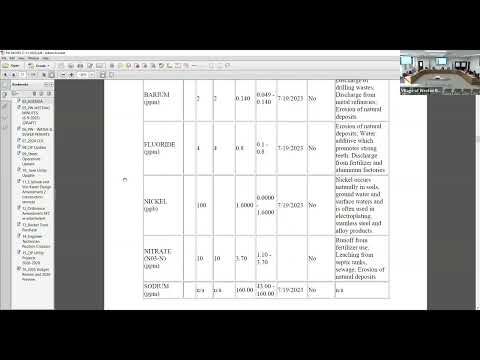
The Public Works and Utility Committee on July 14 acknowledged the village's 2024 annual drinking-water quality report (consumer confidence report) and heard updates about PFAS treatment and a service-line inventory discrepancy.
The committee voted to acknowledge the consumer confidence report and earlier also acknowledged June 2025 water and sewer permits. Committee members and staff discussed that the report covers sampling and compliance for 2024 and that the state's data output drives much of the report formatting and sample-date labeling.
Committee members and utility staff noted the village now has eight wells in its overall system: seven tied to the main distribution system and one located in Cary. Staff said results from the federal unregulated contaminant monitoring program (UCMR5) arrived too late to include in the 2024 report and will appear in next year's report. Staff characterized the results shown in the consumer confidence report as under the maximum contaminant levels (MCLs) for regulated contaminants.
The committee also discussed a temporary data "violation" listing tied to the village's service-line material inventory. Staff said some customer-side service lines had been labeled "unknown" in the database when the inventory was submitted; staff corrected those entries, confirmed the inventory was submitted and received, and reported the apparent violation was a record/status issue rather than a continuing materials noncompliance.
On PFAS treatment, staff reported the permanent granular-activated-carbon (GAC) tanks for Well 4 are now scheduled for delivery in August, with startup of the permanent system expected in mid-September and contract completion targeted for October. Those tanks are intended to replace the village's temporary PFAS treatment, which staff said previously could pump at about 450 gallons per minute. Once the new tanks and associated work are online and Well 3 is also returned to service, staff said the system should be able to pump roughly 1,200 gallons per minute and reconfigure operations so Wells 1 and 5 are used minimally except to keep them mechanically active.
Staff emphasized that some PFAS-related funding and treatment work has depended on state loan and grant programs and that the village has applied for an "emerging contaminant" safe-drinking-water loan for Well 3 in the current funding cycle. Committee members asked about delivery delays and surface-preparation needs for the tanks; staff warned that further shipping delays could affect on-site painting and installation timelines.
The committee received the report and accepted the updates without further action. No formal public-health exceedance or ongoing contamination event was reported at the meeting.