Get Full Government Meeting Transcripts, Videos, & Alerts Forever!
Get email alerts on the Waste Management topic
No spam. Unsubscribe anytime.
Council sets Nov. 18 hearing on solid-waste franchise agreement after public comment from haulers
Summary
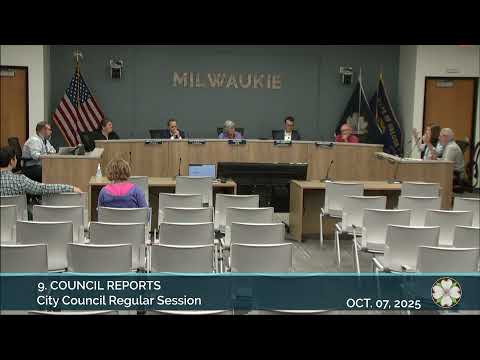
After hearing from the city finance director, a consultant and two franchise haulers, Milwaukie councilors directed staff to schedule a Nov. 18 hearing to consider terminating the city's current rolling 10‑year franchise framework and begin a public process.
Milwaukie councilors on Oct. 13 directed staff to hold a public hearing Nov. 18 to consider terminating the city’s current rolling 10‑year solid‑waste franchise arrangement and to start a public process to explore alternatives.
Finance Director Michael Osborne briefed council that the current agreement functions as a rolling 10‑year arrangement that renews annually and that council previously expressed interest in changing it. Independent consultant Chris Bell told council terminating the rolling franchise would give future councils flexibility to consolidate service territories, evaluate procurement models and open the market to potential bidders; he said he saw no inherent downside to initiating a termination and subsequent public process. Council clarified that the Oct. 13 discussion was not a decision on a replacement model but a direction to hold a hearing on termination.
Representatives from the two franchise haulers serving Milwaukie — Chris Wright of Hood View (Waste Connections) and Dave Huber of WM — urged retention or careful refinement of the franchise model. Wright argued that long terms allow haulers to make capital investments (trucks, carts) and pointed to examples in other jurisdictions where short or uncertain terms contributed to larger rate increases. Huber said franchise oversight allows the city to set services and rates and cited other local 10‑year franchise arrangements in Clackamas County, Washington County and Beaverton.
Advocates for termination told council a termination and public hearing would prevent a future council from being indefinitely constrained by a long, rolling agreement and would restore the city’s flexibility to shape collection territory and procurement timelines. After discussion the council agreed — verbally and by consensus — to schedule a Nov. 18 hearing; staff confirmed notice and the formal hearing process will follow. Council did not adopt a replacement model on Oct. 13.
Councilors and staff also discussed operational details including typical vehicle depreciation periods (presenters said heavy trucks are often depreciated over roughly seven years) and options for performance review and low‑income rate assistance programs that could be adopted under either system.