Get Full Government Meeting Transcripts, Videos, & Alerts Forever!
Get email alerts on the Naming Policy topic
No spam. Unsubscribe anytime.
Milwaukie council reviews new citywide naming, memorial and donation policies; asks for edits and public outreach
Summary
Councilors heard a staff report and community-led draft policy to guide naming or renaming city facilities, parks and internal rooms, plus a companion memorial-and-donation policy. Council suggested edits, asked for targeted outreach to foundations and community groups and set a path to return the revised draft for adoption in December.
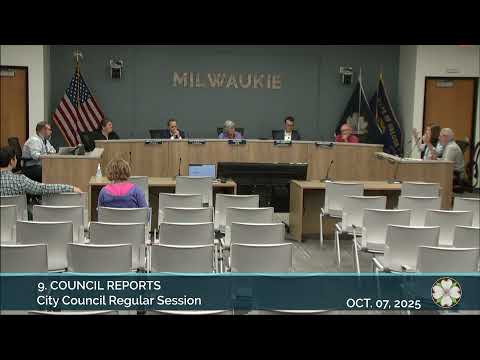
Milwaukie councilors on Oct. 13 reviewed a community-led draft citywide naming policy and a companion memorial-and-donation policy intended to standardize how the city names or renames parks, facilities and internal rooms and how it accepts and recognizes donations such as benches or memorial plaques.
The policies were drafted by Equity & Inclusion Coordinator Gabriela Santoyo Gutierrez and Parks and Green Space Development Manager Adam Moore with a volunteer subcommittee drawn from the Parks & Recreation board and the Equity Steering Committee. The subcommittee recommended limiting formal park- and facility-level naming to deceased individuals and setting criteria for donor recognition that avoid the appearance of “selling” naming rights.
Council members generally praised the outreach and work of the volunteer committee but requested several edits before the draft returns for formal adoption. Key requested changes included: (1) simplifying the definition for naming facilities after “outstanding individuals” so the policy is broadly inclusive (including international figures); (2) replacing ad hoc naming subcommittees with a standing, annually appointed naming committee composed of representatives from the Equity Steering Committee, the Parks board and the Library board; and (3) clarifying how donor recognition (plaques, time-limited memorials) differs from official asset naming. Staff said the memorial plaques would typically be maintained for a limited term (the draft follows NCPRD practice and guarantees plaques for 20 years) and that the city manager or designee would approve minor or temporary internal naming decisions.
Moore and Santoyo Gutierrez told council the draft draws heavily on regional examples (City of Portland and North Clackamas Park & Recreation District) and aims to avoid past inequities in naming by emphasizing community-driven processes and clearer criteria for naming after individuals. The draft also sets a minimum 45-day public submission period and assigns final naming approval to the City Council following review and recommendation by the naming committee and staff.
Councilors asked staff to post the revised draft on the city’s engagement portal, circulate it to partner foundations (Parks Foundation, Library Foundation) and local stakeholder lists, and return a revised draft in December with language changes and a proposed process for appointing an annual naming committee. Several councilors urged staff to clarify how the policy would treat naming requests for assets in the public right-of-way and to confirm that a master plan will guide whether specific memorials or donations are sited in particular parks.
Staff said they will incorporate the council’s edits, run targeted outreach, and return to council in December with a resolution for adoption. The council did not take a final vote on the policies on Oct. 13.