
San Benito supervisors hear Baker Tilly review showing multi‑year budget ‘snowball’; direct CAO to amend budget
Get AI-powered insights, summaries, and transcripts
Subscribe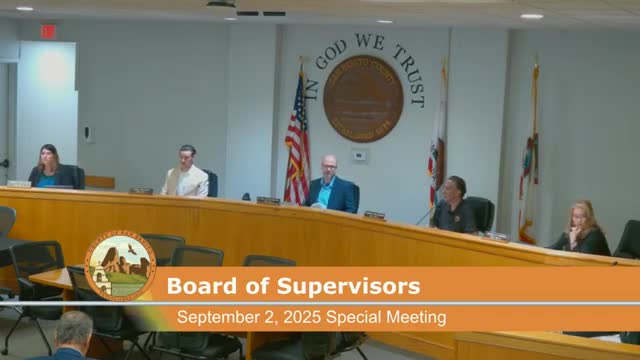
Summary
Baker Tilly consultants presented a multi‑year analysis of San Benito County’s finances and told the Board of Supervisors the county is facing a structural imbalance between recurring revenues and ongoing expenditures that has accumulated into a multi‑year shortfall.
Baker Tilly consultants presented a multi‑year analysis of San Benito County’s finances and told the Board of Supervisors the county is facing a structural imbalance between recurring revenues and ongoing expenditures that has accumulated into a multi‑year shortfall.
The analysis, presented by Steve Toler and Matt Stark of Baker Tilly, found large year‑to‑year swings driven by one‑time revenues (pandemic/grant receipts, developer fees, insurance settlements), conservative revenue assumptions and multiple capital projects that were budgeted but not completed. Steve Toler said, “what it identified is that there is a structural imbalance between the revenues … for the next year and the expenditures.” Matt Stark summarized the pattern: “the county was able to, budget for what looked like significant deficits,” then close them with one‑time items and underspending, producing large swings in fund balance over successive years.
The consultants’ numbers and board discussion
Baker Tilly reported that adopted budgets in recent years showed large deficit gaps (the adopted fiscal 2026 budget was discussed at roughly $98.7 million in appropriations), but actual year‑end results repeatedly benefitted from higher‑than‑budgeted property taxes, episodic one‑time revenues and lower‑than‑budgeted spending. The firm said the county’s general fund preliminary close for fiscal 2025 showed an estimated deficit of about $9.6 million (which could change as year‑end closing continues); consultants noted a projected transfer tied to Proposition 172 of roughly $4.3 million that had not been booked at the time of their pull of the data.
Baker Tilly outlined reserve and policy context: current county reserve targets discussed were an operating reserve of about 15% of the operating budget, an emergency reserve of about 5% and a small disaster reserve (the consultants cited a prior county policy that had produced segmented reserve buckets). They reviewed special revenue and capital funds, noting special revenue fund balances had been large in prior years (combined totals the consultants discussed ranged from roughly $70 million to $94.8 million in earlier years) but that a sizable portion of those balances had been converted or reclassified as part of recent budget actions and therefore were not as available as they had appeared.
Recommendations from the report and staff
Key recommendations the consultants offered and the CAO repeated to the board included: - Stop budgeting ongoing operations based on one‑time revenues; budget ongoing operations only with expected recurring revenues. - Tighten department baselines and line‑item assumptions so year‑to‑year budget variances are smaller and more predictable. - Separate capital project appropriations (and any unspent appropriations that carry forward) from the operating budget so one‑time capital funding does not inflate the appearance of recurring revenues. - Reconcile encumbrances and require carryover/encumbrance accounting for multi‑year capital projects so approved projects remain tracked and reserved for their original purpose. - Adopt or refine a minimum reserve policy (consultants referenced the Government Finance Officers Association guidance as a benchmark and said 15% is consistent with GFOA best practices) and produce a multi‑year (five‑year) forecast/CIP to align capital needs and funding sources.
Board reaction and direction to staff
Supervisors across the dais said they welcomed the clearer, transaction‑level view of revenues and expenditures. Several supervisors voiced a firm reluctance to approve another “deficit budget.” “I’m not interested in a deficit budget,” Supervisor Velasquez said. Board members repeatedly instructed staff and the CAO to operate from realistic revenue assumptions rather than the status‑quo practice of under‑projecting revenues and over‑projecting expenditures with the expectation that year‑end variances would close the gap.
The board gave the CAO direction to prepare an amended fiscal 2026 budget for board consideration in September. Staff described the near‑term schedule: the county must publish the proposed/amended budget file for public review by Monday, September 8, and the public hearing on the proposed budget is set for September 22; the CAO and finance staff said they would return recommended options to the board in that timeline. County staff and several supervisors said the board would likely need at least one special workshop before the September 8 posting to review specific reduction and reserve scenarios.
Choices and tradeoffs discussed
The consultants presented numerical scenarios to illustrate tradeoffs. Using the adopted budget figures, maintaining a 15% minimum general fund reserve would require roughly $13.7 million in expenditure reductions (or an equivalent combination of reductions and additional recurring revenue). Reducing the minimum reserve further to about 10% would reduce immediate cuts needed (roughly $9.8 million), but board members generally viewed using a smaller reserve as less prudent. Commissioners and staff discussed that a full structural rebalance in a single year — eliminating the entire gap between adopted appropriations and recurring revenues — would require much larger reductions (figures discussed in the report totaled roughly $25–26 million) and would carry significant service‑level impacts.
Operational controls and policy moves requested
Board members and staff identified several near‑term accountability steps the board wants implemented: - Enforce purchasing and procurement controls and require timely accruals/recording of revenues and expenditures so audits reflect accurate fiscal years. - Separate capital project appropriations and encumber funds for multi‑year projects so unspent capital dollars remain committed rather than released back into unassigned general fund balance. - Freeze hiring and salary increases until the board agrees a balanced, sustainable plan is in place; some board members also asked staff to prepare voluntary separation/buyout options for consideration. - Produce a five‑year forecast/CIP and tighten department baselines and contingency policy; several supervisors supported eliminating the board contingency line and relying on formal reserve policy.
What the board did (formal direction)
- The board directed the CAO to work with finance staff to return an amended fiscal 2026 budget and a set of options for balancing that budget under clear reserve targets in time to meet the county’s public‑notice and hearing schedule in September (direction recorded in discussion; no roll‑call vote recorded in the transcript). - Staff was instructed to separate one‑time capital appropriations from ongoing operating budgets and to return a proposal to reserve/encumber approved capital project funding. - The board and staff agreed to pursue stronger enforcement of purchasing and accounting controls and to provide additional department training and audit committee follow‑up on late accruals and transactions.
Why this matters
San Benito County’s recommendations and the board’s direction matter because they set the county’s operating baseline for the next fiscal year: whether the county budgets its ongoing services realistically, whether it preserves a prudent minimum reserve and how it funds and tracks capital projects will determine service levels for law enforcement, public works and other county operations. The consultants warned that relying on one‑time revenues to fund recurring spending masks the long‑term cost of services and leaves reserves exposed when windfalls do not reoccur.
What’s next
Staff will return proposed options for the amended budget and specific reduction scenarios on the schedule the CAO outlined for September. The board directed staff to deliver those options with estimated service‑level impacts and with a clear separation of capital project appropriations from the general fund operating baseline so the board can decide which projects, if any, to fund from reserves with formal budget amendments.
Ending note
Board members acknowledged the fiscal remedy will include difficult tradeoffs. Several said they want the board to balance the mid‑term operating budget while protecting a prudent reserve and ensuring capital commitments are separately tracked and funded.