
Birmingham amends open‑space rules: stone removed from impermeable list, new vegetated minimums for single‑family yards
Get AI-powered insights, summaries, and transcripts
Subscribe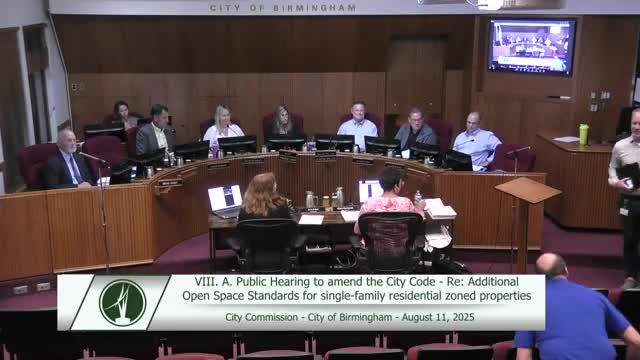
Summary
The City Commission adopted zoning ordinance amendments that revise the definition of impervious surface and require at least 75% of required open space in single‑family lots to be vegetated, limiting extensive stone and hardscape front yards.
The City Commission voted to amend Chapter 126 of the zoning code on Aug. 11 to clarify what counts as impervious surface and to tighten open‑space composition standards for single‑family properties.
What changed: The updated definition removes a blanket label of "stone" as an impervious surface and instead refines the term to focus on surfaces that truly restrict infiltration, including highly compacted soils and engineered paving assemblies. At the same time the code now requires that, of the 40% minimum open space required in single‑family zoning districts, 75% must be vegetated (lawn, planted beds, trees). Permeable pavers and other hardscape materials are explicitly excluded from the vegetated open‑space calculation.
Why it matters: Planning staff and the Planning Board brought the changes after staff enforcement and project designs uncovered inconsistent results: some engineered stormwater facilities use stone as part of an infiltration system, yet earlier wording treated stone universally as impervious. The amendment preserves the city’s intent to discourage front‑yard stone and non‑vegetated hardscaping while allowing engineered stormwater and pervious treatments to function where intended.
Meeting debate and rationale: Planning staff presented the revisions after review by the Planning Board. Commissioners and staff discussed trade‑offs — uniform tests for perviousness are technically precise but would require per‑site engineering and add permitting cost; the ordinance therefore uses a list‑based approach (driveways, roofs, sidewalks, compacted base layers) supplemented by the vegetated open‑space quota to deter expansive non‑vegetated yards while recognizing engineered pervious solutions.
Outcome: The ordinance amendment passed on a roll‑call vote; staff said the code change will be implemented as the baseline for future single‑family development and that the Building and Engineering departments will continue to use engineering judgment for unusual cases.
Ending: The changes aim to protect neighborhood character and stormwater performance while giving the city clearer, enforceable criteria for open space and hardscape in single‑family neighborhoods.