Lifetime Citizen Portal Access — AI Briefings, Alerts & Unlimited Follows
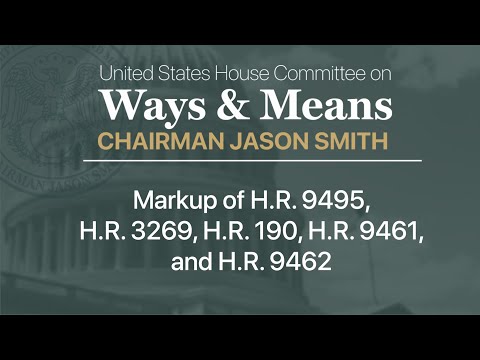
Ways and Means favorably reports five bills — hostage tax relief, taser exemption, gig-economy repeal, workforce credits and school-choice tax credit
Loading...
Summary
The House Ways and Means Committee voted to favorably report five bills, advancing a package that includes tax relief for Americans wrongfully detained abroad, a change to the tax treatment of less‑than‑lethal devices, repeal of a lower 1099‑K reporting threshold for peer‑to‑peer payments, a workforce‑training credit pilot, and a federal tax credit for private school scholarship donations.
The House Ways and Means Committee voted to favorably report five bills after hours of debate on tax and safety measures, advancing each to the full House.
The committee, chaired by Chairman Smith, opened the markup by saying the package would “help Americans tackle serious challenges,” and the panel then considered measures ranging from tax relief for hostages to changes in the tax treatment of less‑than‑lethal devices, a repeal of a 1099‑K reporting rule for peer‑to‑peer transactions, a workforce training tax credit pilot, and a federal tax credit to support private school scholarships. Ranking Member Neal criticized the agenda as partisan and said voters were still asking “what have House Republicans done for them.”
Why it matters: The measures move to the House floor after the committee recorded final votes. Several items drew bipartisan support; others prompted sustained questioning about scope, legal protections and potential unintended consequences (due process, gaps in oversight, public‑school funding and public safety).
Votes at a glance (final committee actions) - HR 94 95, "Stop Terror Financing and Tax Penalties on American Hostages Act" — Motion to favorably report as amended passed 38–0. Action: amendment in the nature of a substitute was agreed to; committee motion to report the bill carried. The bill directs the Treasury and other agencies to extend tax deadlines and penalty relief for individuals held hostage or wrongfully detained and authorizes suspension/revocation of tax‑exempt status for organizations designated as providing material support to terrorist organizations. Robert Harvey (Joint Committee on Taxation) said the proposal would have a negligible effect on federal receipts over the FY24–34 budget window.
- HR 32 69, "Law Enforcement Innovate to Deescalate Act" — Motion to favorably report as amended passed 21–15. Action: amendment in the nature of a substitute was agreed to and the bill was ordered favorably reported. The measure exempts certain "less‑than‑lethal projectile devices" and their cartridges from the firearms and ammunition excise tax and clarifies those devices are not "firearms" under the National Firearms Act when they meet the statute's definitions and velocity limits. Supporters said the change will remove a tax code quirk that complicates procurement and may speed adoption of nonlethal technology. Opponents warned it could create loopholes that allow unregulated or easily modified devices — sometimes described as a risk for “ghost guns” — to evade firearm regulations.
- HR 1 90, "Saving Gig Economy Taxpayers Act" — Motion to favorably report as amended passed 22–16. Action: amendment in the nature of a substitute was agreed to; the bill was ordered favorably reported. The bill would repeal the lowered $600 1099‑K reporting threshold created in the American Rescue Plan and revert to the prior reporting exception. The Joint Committee on Taxation estimated the measure would reduce federal receipts by roughly $10 billion over the FY24–34 window. Proponents argued the rule posed administrative burdens for small sellers and gig workers; opponents said reverting to the prior $20,000/200‑transaction threshold would open a large reporting loophole for higher‑income taxpayers and favored a middle ground.
- HR 94 61, "USA Workforce Investment Act" — Motion to favorably report as amended passed 22–15. Action: amendment in the nature of a substitute was agreed to; the committee reported the bill favorably. The bill creates a taxpayer credit for contributions to eligible workforce development and training organizations (501(c)(3) providers on the WIOA eligible‑training list), with an annual aggregate allocation cap of $5 billion for 2025–2028 (JCT estimates a $12.9 billion reduction to receipts over the FY24–31 window). Supporters described the measure as a pilot to expand employer‑driven training and apprenticeships; critics raised concerns the credit would exclude some registered apprenticeship models, create a "first‑come, first‑served" race for credits, and could funnel funds to lower‑quality training programs without stronger outcome requirements.
- HR 94 62, "Educational Choice for Children Act" — Motion to favorably report as amended passed 23–16. Action: amendment in the nature of a substitute was agreed to; the committee reported the bill favorably. The measure establishes a federal nonrefundable tax credit for contributions to scholarship‑granting organizations (SGOs). Annual federal volume caps of $5 billion would be available 2024–2028; JCT estimated the bill would lower federal receipts by about $19.8 billion over FY24–34. Supporters said the tax credit would expand scholarships primarily for low‑ and moderate‑income families; opponents warned it would divert revenue from public schools, create risks of double‑benefits when combined with state tax treatment, and lack adequate nondiscrimination and accountability safeguards.
Key points from the debate - Hostage tax relief and terrorism‑support provisions: supporters argued the law would correct an unfair result — Americans returning from wrongful detention facing IRS penalties — and would strip tax advantages from organizations that materially support terrorism. Some members pressed the panel about due‑process protections for organizations designated as "terrorist‑supporting" and whether Treasury would be required to publish the evidence supporting designations.
- Less‑than‑lethal devices: proponents framed HR 32 69 as a narrow fix to a tax‑classification mismatch that inhibits procurement and innovation. Opponents cautioned the bill’s definitions and carve‑outs could be exploited to produce unregulated weapons or modification kits; technical witnesses acknowledged the statute relies on a velocity cap and Secretary of Treasury lists to limit exemptions.
- 1099‑K repeal (gig economy): Republican supporters warned the $600 reporting rule would saddle ordinary Americans with new forms and IRS contact; Democrats argued the previous $20,000/200‑transaction threshold had been a loophole that let wealthy sellers escape reporting and urged a middle path.
- Workforce investment credit: questions focused on program quality, the absence of long‑term offsets for the $5 billion annual cap, the first‑come, first‑served allocation mechanism, and whether registered union apprenticeship models would be excluded or disadvantaged.
- School‑choice tax credit: Democrats repeatedly warned the credit could reduce resources for public schools, risk double benefits (federal credit plus state deductions/credits), and enable scholarship funds to channel public benefits to private and religious schools with varying accountability standards. Proponents emphasized parental choice and cited state scholarship programs that serve low‑income and minority families.
Speakers (excerpted and identified in the transcript) - Chairman Smith — Chair, House Ways and Means Committee (government) - Mr. Neal — Ranking Member, House Ways and Means Committee (government) - Robert Harvey — Deputy Chief of Staff, Joint Committee on Taxation (staff/government) - Representative Claudia Tenney / Representative Tinney — sponsor/co‑sponsors present in debate (government) - Representative Kustoff, Representative Schneider, Representative Titus — cosponsors and speakers on HR 94 95 (government) - Representative Schweickart, Representative Stanton, Representative Thompson, Representative Doggett, Representative Smucker, Representative Miller — speakers who led debate for and against various measures (government)
Authorities referenced in committee discussion - Internal Revenue Code (tax provisions cited throughout) - Section 501 (tax‑exempt organization rules) and related IRS administrative authorities - National Firearms Act (NFA) and the firearms and ammunition excise tax - Workforce Innovation and Opportunity Act (WIOA) (eligible training provider lists) - Undetectable Firearms Act of 1988 (mentioned in de‑regulation concerns)
Clarifying details recorded in the hearing - JCT budget estimates reported in committee testimony: HR 94 95 described as negligible effect on receipts for FY24–34; HR 32 69 estimated to reduce receipts by less than $500,000 over FY24–34; HR 1 90 estimated to reduce receipts by $10 billion over FY24–34; HR 94 61 estimated to reduce receipts by $12.9 billion over FY24–31; HR 94 62 estimated to reduce receipts by $19.8 billion over FY24–34. - Vote tallies as recorded by the clerk: HR 94 95 — 38–0; HR 32 69 — 21–15; HR 1 90 — 22–16; HR 94 61 — 22–15; HR 94 62 — 23–16.
Discussion → direction → decisions - Discussion points: due process for organization designations (HR 94 95); risk of creating regulatory loopholes for weapons and "ghost gun" concerns (HR 32 69); administrative burden and privacy concerns for small sellers (HR 1 90); program quality, exclusion of some apprenticeship forms, and first‑come allocations (HR 94 61); public‑school funding impacts, nondiscrimination and double‑benefit risks (HR 94 62). - Directions: Chair permitted amendments in the nature of substitutes for each bill and requested technical summaries from the Joint Committee on Taxation; staff were authorized to make conforming technical edits to reported bills before transmittal to the House. - Decisions: All five bills were ordered favorably reported to the House as amended; votes and amendments recorded as above.
What’s next Each measure will proceed to the full House for consideration and floor scheduling separate from the committee. Committee staff were authorized to make technical and conforming changes to the bills before transmittal; members have two additional days to file supplemental or minority views with the committee clerk.
Ending The committee concluded after the final roll call and authorized staff changes; members on both sides signaled they intend to continue negotiating technical fixes for several measures as the bills move toward the House floor.