Get Full Government Meeting Transcripts, Videos, & Alerts Forever!
Get email alerts on the Sign Code topic
No spam. Unsubscribe anytime.
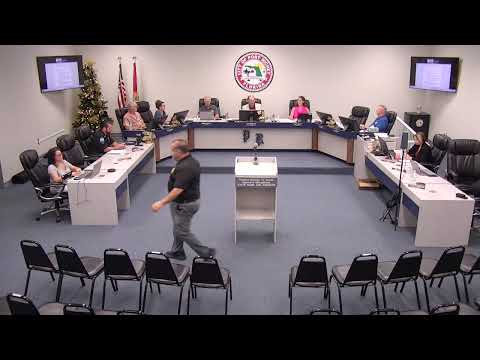
Port Richey council workshops updates to city sign code; members agree to allow pole signs
Summary
City council held an extended workshop on proposed updates to Port Richey’s sign code, debating pole signs, temporary/inflatable displays, maintenance rules and wayfinding. Council reached consensus to move pole signs out of the ordinance's prohibited list, directed staff to tighten language on interior/window signage and to step up enforcement on
Port Richey City Council members spent more than three hours reviewing a comprehensive rewrite of the city's sign code in a workshop, ultimately agreeing to move pole signs off the list of prohibited signs and directing staff to strengthen enforcement of dilapidated signage.
City Manager Andrew Butterfield opened the discussion, saying, "it's to address the amendments for the Port Richey sign code, which hasn't had an update in better part of 2 decades," and noted the draft incorporates Planning & Zoning recommendations and legal edits from outside counsel tied to recent Supreme Court rulings.
The workshop focused on a long list of technical and policy issues: whether signs inside storefront windows that are visible from the public right-of-way should be regulated; whether existing pole (sometimes called "poll") signs should remain prohibited or be allowed as grandfathered or converted monument signs; how to define and limit temporary signs and inflatables; standards for sandwich/A-frame signs on sidewalks; maintenance and abandoned-sign rules; and whether the city should create unified wayfinding or marquee signs to direct traffic to clustered businesses such as waterfront destinations.
Council debate centered on pole signs. Several council members and staff described practical concerns for small or setback properties that lack visibility from Nineteenth Street and said removing the blanket prohibition could help small businesses advertise. Others warned that allowing pole signs citywide could reintroduce visual clutter and that any allowance should include facade or base requirements so poles appear as intentional monument signs rather than raw poles. The council, by motion, moved to "remove pole signs from the ordinance" (i.e., take them out of the prohibited list) and the motion drew no objections in the workshop; the item will be returned to staff for draft code language that includes design/facade requirements for new pole signs.
Council members and staff also discussed temporary and inflatable signs. Planning & Zoning staff and the city attorney reviewed the draft's temporary-sign limits already in the code (the draft references a typical structure: a period before an event, a maximum event duration and a short removal window afterward) and suggested making temporary inflatables and portable signs subject to the same time-limited rules rather than allowing year-round use. The draft language discussed during the workshop would keep permanent inflatable or unattended devices prohibited while allowing short-term, permitted use for events, grand openings or approved special events.
The council directed staff to tighten language on several precise drafting questions: remove or reword a sentence that could allow regulation of any sign inside a business simply because it is visible from the public right-of-way; clarify definitions that differentiate pole signs, monument/ground signs and marquees (the draft uses specific height and base-coverage measures, including a pole-sign definition where the bottom edge of the sign face is 8 feet or more above grade); and add objective criteria for facade/material requirements that would allow existing pole signs to be converted to conforming monument signs over time.
On enforcement and maintenance, staff said the draft requires: routine maintenance (painted areas and sign surfaces kept in good condition), that debris be cleared for 5 feet around sign bases, and that signs that bear old business names or otherwise do not reflect current on-site activity be either covered/whited-out or updated; the draft defines an "abandoned sign" as one without copy or with obsolete copy for 6 consecutive months. Council asked code enforcement to redouble efforts on visibly dilapidated or damaged signs and to give property owners clear notice about repair or removal.
Council members also discussed wayfinding and marquee signage as a tool to direct motorists to clustered businesses (for example, waterfront districts or shopping centers that are set back from the main road). Staff said such wayfinding signs could be treated as city-authorized or city-managed signage (a governmental exception in the draft), with the city retaining design control and the option to lease advertisement spaces to businesses. Several council members favored a coordinated approach that uses consistent design standards rather than allowing scattered, privately installed directional billboards.
Two additional staff directions came out of the workshop: schedule a special meeting on Stantec's dredging study (the council settled on Wednesday at 9 a.m. for a follow-up briefing), and staff will return draft wording on the interior-window visibility issue and on facade requirements for pole signs for council review.
What was decided (summary): the council reached consensus at the workshop to remove pole signs from the list of expressly prohibited signs (the motion was seconded and carried with no objection at the workshop), to task staff with redrafting pole-sign/design rules (including facade/base requirements), to treat temporary inflatable and portable signs as short-term, permitted items under the temporary-sign rules (not allowed permanently), and to intensify enforcement of damaged or abandoned signs under the maintenance sections of the draft.
What remains to do: staff will draft precise code language to implement the design/facade requirement for new pole signs, reword the interior-window visibility section so indoor window displays are not unintentionally regulated, and propose objective time limits and permitting paths for portable and inflatable signs. Planning & Zoning will also return proposed language for sandwich/A-frame signs, bench signs and other sidewalk devices.
The council scheduled a follow-up special meeting on the Stantec dredging and survey work for Wednesday at 9 a.m., and council members agreed to resume the sign-code workshop at a subsequent council workshop session to finish remaining sections.
Ending: The workshop ended with no formal ordinance adoption. Council members instructed staff to return revised language at a future workshop so the council can consider a first reading once the draft reflects the council's design and enforcement directions.