Energy Code Board approves final Low Energy and Carbon Code package; 35 of 36 voting blocks pass
Summary
At its final meeting the Energy Code Board completed voting on the draft Low Energy and Carbon Code. The board approved 35 of 36 voting blocks; one appendix (Voting Block 87) failed. The board directed staff to finalize technical calculations and publish the code package on or before the statutory September 1 deadline.
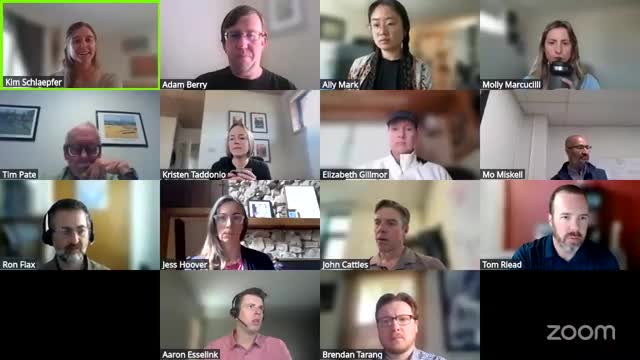
Kim (Board member) opened the board’s final meeting by congratulating members on completing the code-development process: "Happy Happy Friday, and happy final energy code board meeting." The board then completed roll-call voting across voting blocks 52–87 for the Low Energy and Carbon Code, approving nearly all sections and agreeing to two in-meeting amendments before final votes.
The vote mattered because the board's actions determine the language that will move into the code package the board plans to publish this summer. Adam (Staff member) said results and the livestream would be public: "we certainly are happy to make them public," and described next steps including technical calculations with PNNL and Group 14 and publishing the final code with the ICC before the statutory September 1 deadline.
The board used a Google Form and verbal confirmations to record votes; 14 votes were required to approve any amendment. Most voting blocks passed by comfortable margins. Two substantive in-meeting amendments passed: Voting Block 55 was amended to change Exception 4 to a 2 kW limit for electric-resistance space heating exceptions (the board then approved the amended block), and Voting Block 65 was amended to add language that the required energy compliance for a building be determined by the average credits required, "rounded to the nearest whole credit for all dwelling units in the building," before the board approved that amended block.
Board discussion was typical for the meeting's agenda: several board members spoke in favor of specific amendments and some raised repeated concerns about affordability and the condition floor area definition. Andrew (Board member) repeatedly said he could not support several blocks that used the board’s chosen condition-floor-area approach, telling the group, "I will not be supporting this," and noting concerns about ERI backstops and how credits map to dwelling unit sizes. Will (Board member) said he opposed Appendix RM—voting block 87—arguing it risked bias in metric outcomes: "I do think that the appendix RM approach sort of is biased in favor of gas, and I think that in the interest of fuel neutrality I'm going to vote against this one." Elizabeth (Board member) spoke in favor of keeping options for modeling approaches, saying she supported having an option for Appendix RM.
Votes at a glance (voting block — subject — outcome — tally):
- 52 — Table R402.5.0.1.01 (air barrier, air sealing, insulation installation) — approved — 19 yes - 53 — R402.5.0.1.03 (maximum air leakage rate; includes exceptions) — approved — 19 yes - 54 — new R403.50.4 (demand-responsive water heating) — approved — 17 yes - 55 — R403.7.0.1 (electric-resistance space heating) — amended in meeting (Exception 4 changed to 2 kW) then approved — 20 yes - 56 — R404.1.0.1 (exterior lighting) — approved — 20 yes - 57 — delete R404.4 (renewable energy certificate documentation) — approved — 19 yes - 58 — R405.1 (scope) — approved — 20 yes - 59 — R405.2 (site energy and home size; amendments 18 and 19) — approved — 15 yes - 60 — Table R405.40.21 (fuel debiasing, title corrected in meeting) — approved — 19 yes - 61 — R406.2 (ERI compliance pathway) — approved — 17 yes (Aaron recorded as abstain on the verbal roll) - 62 — R406.3 (building thermal envelope) — approved — 20 yes - 63 — R406.5 (replace table) — approved — 15 yes - 64 — new R406.50.1 (heat-pump building ERI increase) — approved — 19 yes - 65 — R408 (home size / table R408.2; amended in meeting to use "average credits required rounded to the nearest whole credit for all dwelling units in the building") — amended then approved — 15 yes - 66 — R408.20.2.1 (improved fenestration) — approved — 20 yes - 67 — R408.20.2 (more efficient HVAC equipment) — approved — 20 yes - 68 — new R408.20.2.2 (evaporative cooling) — approved — 20 yes - 69 — R408.20.3 (reduced energy use and service water heating) — approved — 19 yes - 70 — new R408.20.4.1 (duct leakage testing in all dwelling units) — approved — 15 yes - 71 — new R408.20.5.1 (ERV/HRV preheating limits) — approved — 18 yes - 72 — new Table R408.20.6 (energy-credit table, including CEE language) — approved — 20 yes - 73 — new R408.20.12 (backlight/uplight/glare ratings) — approved — 18 yes - 74 — new R408.20.13 (roof/gutter deicing controls) — approved — 18 yes - 75 — new R408.20.14 (refrigerants) — approved — 20 yes - 76 — R409.303.2.1 (electrical sizing and physical space for EV/solar-ready) — approved — 20 yes - 77 — R409.303.2.2 (electrical panel space) — approved — 20 yes - 78 — R409.403.3.2 (solar-ready zone area; applies to multifamily) — approved — 18 yes - 79 — R409.503.3.1 (parking / EV charging thresholds; small-parking flexibility) — approved — 18 yes (Aaron recorded an abstain on the roll) - 80 — EV infrastructure / space-substitution edits (allow Level 1 for multifamily) — approved — 19 yes - 81 — new R409.50.30.9 (accessible EV parking spaces) — approved — 20 yes - 82 — R405.202.1.1 (additions; use existing slab allowance) — approved — 16 yes - 83 — R402.205 (amendment) — approved — 19 yes - 84 — R503.101.2 (residential roof/ceiling scope) — approved — 20 yes - 85 — R503.101.2 (roof/ceiling/attic alterations) — approved — 16 yes - 86 — delete residential appendices incorporated into base code — approved — 20 yes - 87 — add Appendix RM (simulated building performance, energy cost) — failed — 9 yes (not enough to pass)
Several votes reflected brief substantive debate. Notable outcomes and clarifications included:
- Voting Block 55 amendment: Exception 4 was changed to a 2 kW limit for electric-resistance space heating exceptions to avoid creating a stringency conflict. (clarifying detail: "Exception 4 changed to 2 kW") - Voting Block 65 amendment: the board added text to base R408.2 clarifying that required compliance is determined by the average credits required for all dwelling units, "rounded to the nearest whole credit," to address multifamily unit-size variability. - Appendix RM (Voting Block 87) failed; members who opposed it said the appendix could bias outcomes across fuel sources and preferred the board’s site-energy approach or other debiasing approaches; members who supported it said jurisdictions should keep modeling options.
Board members and staff reiterated next steps: staff will work with PNNL and Group 14 to finish the credit calculations and produce an explanatory version of the code and final report. Adam (Staff member) told the board the project team would "get us the technical calculations needed to finish those credit calculations" and that the Low Energy and Carbon Code will be submitted to ICC as its own code book with publication on or before the statutory September 1 deadline.
The meeting closed with several board members thanking colleagues and the public for their time and comments. The board will forward any items needing executive-committee review before the code package is finalized, and staff will circulate final technical calculations for board review this summer.