Get Full Government Meeting Transcripts, Videos, & Alerts Forever!
Energy Code Board approves final Low Energy and Carbon Code package; 35 of 36 voting blocks pass
Summary
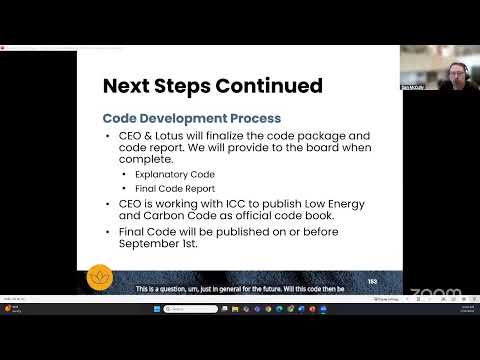
At its final meeting the Energy Code Board completed voting on the draft Low Energy and Carbon Code. The board approved 35 of 36 voting blocks; one appendix (Voting Block 87) failed. The board directed staff to finalize technical calculations and publish the code package on or before the statutory September 1 deadline.
Kim (Board member) opened the board’s final meeting by congratulating members on completing the code-development process: "Happy Happy Friday, and happy final energy code board meeting." The board then completed roll-call voting across voting blocks 52–87 for the Low Energy and Carbon Code, approving nearly all sections and agreeing to two in-meeting amendments before final votes.
The vote mattered because the board's actions determine the language that will move into the code package the board plans to publish this summer. Adam (Staff member) said results and the livestream would be public: "we certainly are happy to make them public," and described next steps including technical calculations with PNNL and Group 14 and publishing the final code with the ICC before the statutory September 1 deadline.
The board used a Google Form and verbal confirmations to record votes; 14 votes were required to approve any amendment. Most voting blocks passed by comfortable margins. Two substantive in-meeting amendments passed: Voting Block 55 was amended to change Exception 4 to a 2 kW limit for electric-resistance space heating exceptions (the board then approved the amended block), and Voting Block 65 was amended to add language that the required energy compliance for a building be determined by the average credits required, "rounded to the nearest whole credit for all dwelling units in the building," before the board approved that amended block.
Board discussion was typical for the meeting's agenda: several board members spoke in favor of specific amendments and some raised repeated concerns about affordability and the condition floor area definition. Andrew (Board member) repeatedly said he could not support several blocks that used the…
Already have an account? Log in
Subscribe to keep reading
Unlock the rest of this article — and every article on Citizen Portal.
- Unlimited articles
- AI-powered breakdowns of topics, speakers, decisions, and budgets
- Instant alerts when your location has a new meeting
- Follow topics and more locations
- 1,000 AI Insights / month, plus AI Chat