
Needham committee says community meeting showed mixed support for smaller homes
Get AI-powered insights, summaries, and transcripts
Subscribe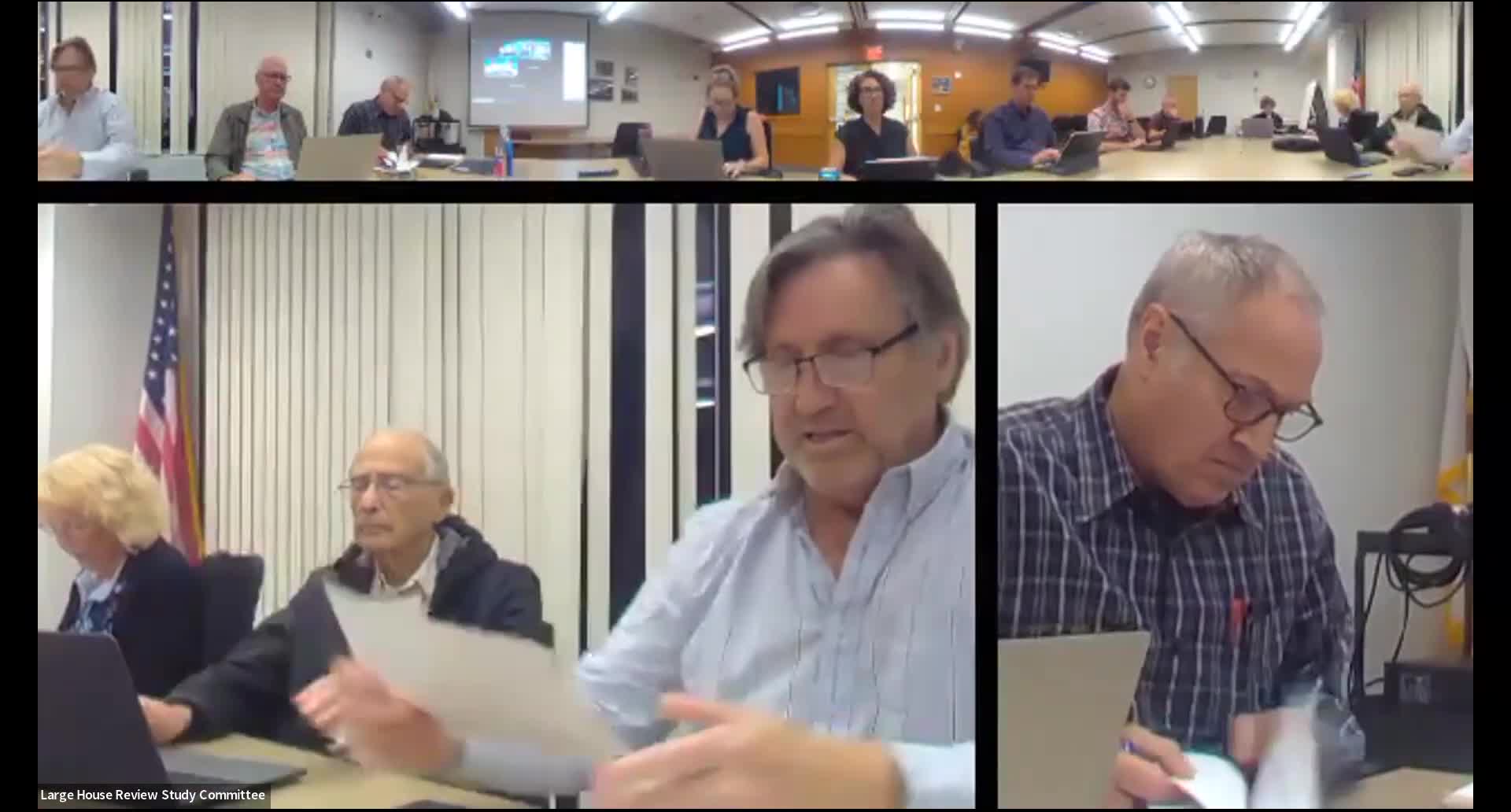
Summary
The Large House Review Committee on Sept. 30 reviewed public feedback from its community meeting and said the session produced mixed but useful input, including a live poll that split attendees and several written comments raising concerns about size, tree loss and affordability.
The Large House Review Committee on Sept. 30 reviewed public feedback from its community meeting and said the session produced mixed but useful input, including a live poll that split attendees and several written comments raising concerns about size, tree loss and affordability.
Committee members said the live survey — which was not scientific and allowed multiple responses — showed roughly two-thirds of attendees favoring some reduction in the maximum bulk of new houses while a substantial minority favored no change. At the meeting the committee reported the raw in-person survey counts as: 39, 40 and 36–37 for various “yes” questions about concern and direction; 19 respondents said “no” when asked if the committee was on the right track; and one display showed 18 people preferring “no change.”
Why it matters: The committee is weighing zoning changes — including lower floor-area ratios and other dimensional limits — that would affect what builders can construct on Needham lots, and public sentiment will shape the committee’s recommendations to the Planning Board and, eventually, to Town Meeting.
Committee members praised the visual presentation used at the community meeting. Committee member Heidi (committee member) said the slides “were really great and well represented visually,” and other members described the meeting as “informative” and “useful” for drawing in new participants.
Several residents submitted written feedback the committee read into the record. Akim (guest) spoke in person and said, “houses should be smaller, to give the community more people and to provide people more homes and living spaces.” A letter from Jen Leonard Schaffstein (submitted Sept. 24) described concerns about lot clearing and the increasing scale of new homes, saying newer houses on the same lot footprints were noticeably larger and placed fewer trees on the property; she also urged more multifamily housing as an alternative.
Several committee members and staff told the group they were cautious about using the live poll as a definitive guide because the tool allowed multiple votes and lacked controls typical for scientific surveys. Rob (committee member) asked whether the committee had cataloged meeting comments; he volunteered to extract and organize objections and questions from the meeting minutes to produce a public “frequently asked questions” or tracker the committee could use when preparing recommendations.
Members said the committee should formally record outstanding public concerns and respond to them, either at subsequent meetings or via posted answers. Joe (committee member) said the process and a near-term deadline had helped focus the committee’s work and prompted new residents to participate.
The committee discussed a range of public comments beyond the poll numbers: concerns that tear-downs and lot clearing reduce tree cover and neighborhood character; questions about whether renovation rules limit homeowners; and repeated requests for clearer information about what would be legally required versus what the committee might recommend.
Ending: The committee decided to continue reviewing public input and to incorporate the catalogued comments into the fiscal and regulatory analyses scheduled for upcoming meetings.