Get Full Government Meeting Transcripts, Videos, & Alerts Forever!
Get email alerts on the Land Use Development topic
No spam. Unsubscribe anytime.
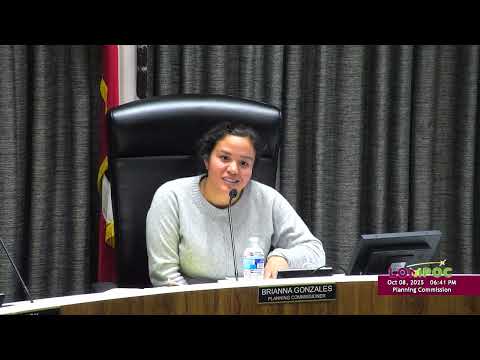
Lompoc planning commissioners amend overnight-parking rule, debate JV Automobile Service Center design review
Summary
Lompoc — At its Oct. 8, 2025 meeting, the Lompoc Planning Commission reviewed architectural-design and site-development plans for the proposed JV Automobile Service Center at 400 East Laurel Avenue and voted 5-0 to amend a draft condition that had prohibited any overnight vehicle storage on the site.
Lompoc — At its Oct. 8, 2025 meeting, the Lompoc Planning Commission reviewed architectural-design and site-development plans for the proposed JV Automobile Service Center at 400 East Laurel Avenue and voted 5-0 to amend a draft condition that had prohibited any overnight vehicle storage on the site.
The commission heard a staff report from Sharada, planning staff, who described the applicant as Mercutio Estrada and the proposal as a new 4,751-square-foot industrial building with four service bays, office and reception space, customer parking, a trash enclosure and 3,993 square feet of landscaping on a roughly 0.3-acre parcel. Sharada said the project is proposed for Monday–Friday hours of 8 a.m. to 5 p.m., and that staff found the design, as conditioned, “would meet the intent and purpose of the zoning districts and the associated required development standards.” She told commissioners the project is categorically exempt from environmental review under California Environmental Quality Act section 15332 (infill development).
The central policy dispute during the hearing concerned draft condition P50, which staff said mirrored language in the city code’s definition for minor vehicle repair and stated that “no vehicles will be stored overnight in the parking lot.” Several commissioners and staff explained that the code distinguishes between minor and major vehicle-repair uses; because the application was considered under a major-repair category, some commissioners said the condition could be removed or revised.
Commission debate focused on balancing neighborhood impacts with practical business operations. Commissioner Bridal and others raised concerns that a blanket ban on overnight parking could push vehicles onto neighborhood streets and questioned whether the city should hold a new business to stricter limits than long-established shops. Commissioner Cox and others sought clarity on whether the condition would prohibit customers or employees from parking briefly overnight or leave the business unable to provide a loaner or service shuttle.
Commissioner Beverly moved to amend P50; she stated for the record, “I am going to make a motion that we amend P50 to state no overnight parking of inoperable or in service vehicles.” The amendment was adopted by a 5-0 vote.
Planning staff explained the practical effect of the amendment: vehicles receiving service or inoperable vehicles may not be stored overnight in the parking lot, while operable customer vehicles left overnight incidentally (for example, awaiting pickup) would not be barred by that condition as amended. Staff also noted that any change to hours for shop services would be approved by the director or the director’s designee.
During the hearing staff displayed project elevations and materials boards (silver, charcoal gray and white exterior palettes; corrugated aluminum panels and stucco) and noted a 13-foot-7-inch landscape buffer between the industrial site and adjacent residential uses, meeting the city’s 10-foot buffer requirement. The application was circulated to city departments and was reviewed at a Development Review Board meeting on Sept. 18, 2025; the architect provided a letter on the dais indicating agreement with the draft conditions.
A commissioner moved to approve the project later in the meeting; the transcript records the motion to approve but does not record the roll-call vote on final project approval. The consent calendar vote earlier in the meeting passed 5-0.
Next steps: staff will reflect the amended language for condition P50 in the final conditions of approval and proceed with the project file; any future change to hours for shop services must be administratively approved by the director or designee. The commission adjourned to its next regular meeting at 6:30 p.m. on Wednesday, Nov. 12, 2025.