Get Full Government Meeting Transcripts, Videos, & Alerts Forever!
Get email alerts on the Traffic Safety Vision Zero topic
No spam. Unsubscribe anytime.
Vision Zero office cites drop in traffic fatalities and urges state action on automated speed enforcement
Summary
The city’s Vision Zero staff reported a 7% drop in traffic deaths between 2023 and 2024 and reiterated support for state legislation to permit the city to deploy traffic safety cameras. Committee members pressed for evidence linking local street redesigns and enforcement to the reduction and discussed outreach and post‑crash supports.
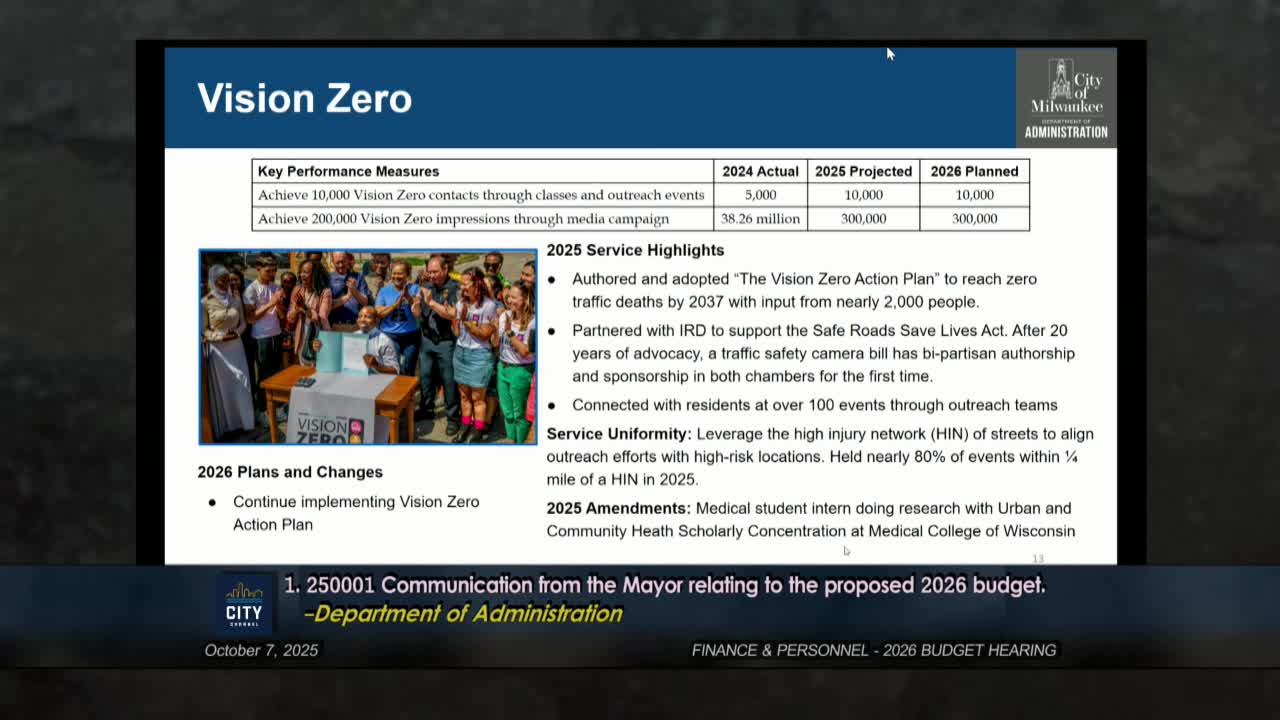
The committee heard a presentation from Vision Zero staff on the city’s traffic‑safety work and its public outreach during the 2026 budget review. Jessica Weinberg, Vision Zero policy director, told aldermen the office helped finalize the Vision Zero action plan and supported recent public hearings on state legislation that would enable Milwaukee to deploy traffic safety cameras for red‑light and high‑speed violations.
Weinberg said the city saw a 7% decrease in the number of people killed in traffic crashes between 2023 and 2024 and noted that 60% of serious injuries occurred on about 10% of the road network — the city’s “high‑injury network.” She said the office is coordinating with the Department of Public Works to target capital improvements and with community outreach to focus engagement within a quarter‑mile of those high‑injury corridors.
Committee members pressed for more evidence directly linking Vision Zero projects and road redesigns to the fatality decline. Weinberg said capital projects and redesigns on targeted corridors correlate with lower speeds and reduced crash severity, but she also said some of the high‑injury network is on state‑owned roadways where the city needs intergovernmental cooperation. She urged support for state legislation discussed at a recent Senate hearing—Senate Bill 375 was referenced in the meeting—saying it addresses concerns previously raised by council members.
Aldermen asked about enforcement and “suppression” (police enforcement that discourages dangerous driving). Weinberg said police staffing and turnover have posed challenges to consistent enforcement, which is why automated enforcement via cameras and layered “safe‑systems” interventions remain priorities. The Vision Zero office also described pilot programs and partnerships to improve post‑crash care and trauma support; Office of Community Wellness and Safety (OCWS) staff have provided trauma counseling for families affected by traffic violence in some cases, Weinberg said.
Weinberg described outreach work — more than 100 events in the past year and targeted campaigns near high‑injury corridors — and pilot programs aimed at youth education, driver’s‑education access and restorative justice for vehicle‑related offenses. She said the office is exploring partnerships with health systems and university researchers to better link crash data to hospital admissions so the city can better track injuries that don’t always appear in police reports.
The committee did not take an immediate policy vote; members asked Vision Zero and DOA to return with more targeted analyses linking specific street projects, enforcement or camera programs to measurable changes in crashes and injuries, and to continue developing educational and restorative justice efforts for young drivers.