
RSU 4 considers joining Maine DOE cohort to bring special‑education services to 4‑year‑olds
Get AI-powered insights, summaries, and transcripts
Subscribe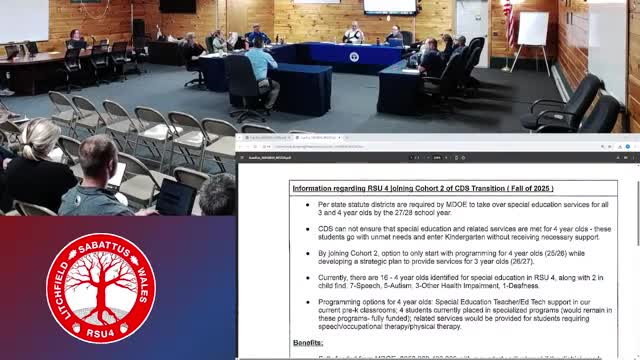
Summary
At its organizational meeting, RSU 04 board heard a detailed proposal to join the Maine Department of Education's cohort 2 to provide special‑education services to 4‑year‑olds for 2025—26 and phase in 3‑year‑olds in 2026—27; staff said the program would be fully state funded and would require new coordinator and related staffing.
At its organizational meeting, the RSU 04 school board heard a presentation on plans to join cohort 2 of the Maine Department of Education's program to shift responsibility for special‑education services for 4‑year‑olds from Child Development Services (CDS) to the district.
The proposal, presented by Justin Kelleher, director of special services, explained that state statute passed in 2024 requires districts to assume special‑education services for all 3‑ and 4‑year‑olds by the 2027—28 school year, and that joining cohort 2 would allow RSU 04 to begin with 4‑year‑olds in 2025—26 and phase in 3‑year‑olds in 2026—27.
Kelleher gave a snapshot of current need in the district: 16 identified 4‑year‑olds in the RSU 04 catchment, plus two students in referral/child‑find. Of those 16, seven are identified with speech needs, five with autism, three with another health impairment (often ADHD), and one who is deaf or hard of hearing. He said programming options include using existing pre‑K classrooms staffed with a special‑education teacher and ed‑techs, continuing placements for students already in specialized programs, and contracting related services such as speech, occupational therapy and physical therapy.
"By joining cohort 2, we have the option to just start with 4 year olds, while working on a more strategic approach to take on the 3 year olds in the 2627 school year," Kelleher said.
Kelleher and superintendent Marco (first name used in the meeting) told the board the state would fully fund the program and that the district should expect quarterly payments tied to the number of students served. Kelleher estimated the district could receive between $350,000 and $400,000 based on current counts and said the state can adjust funding if needs grow. He also said the DOE indicated it would reimburse districts for high outplacement costs if those exceeded initial funding.
"It's fully funded for the foreseeable future unless they change the law," Kelleher said when asked about whether the state funding might expire.
Board members asked several implementation questions. Robbie, a board member, asked whether the state had indicated a sunset or expiration for the extra funding; Kelleher and Marco repeated that funding is expected while the law remains in place and that DOE officials emphasized continued funding in conversations. Shelley, a staff member who checked district enrollment during the meeting, reported there are 46 students total in pre‑K sessions and that session capacity (reported as 14 or 16 per session) indicates the district currently has room to absorb identified students.
Board members probed logistical issues: transportation (for some students transportation on an IEP would be covered), classroom capacity, staffing and screening. Kelleher said the district would initially hire an early childhood special‑education teacher/coordinator and med techs and would contract related‑service providers as needed; he said one position would likely be sufficient to start and additional staff could be added as services expand.
Board members and staff noted potential community benefits from earlier, school‑based intervention. One board member said earlier special‑education intervention in other states had led to better kindergarten outcomes; another observed that local CDS providers had limited capacity since program changes and closures in the area.
No formal board vote to join cohort 2 was recorded in the meeting transcript. The district reported it has already met with the DOE on next steps and that the first state payment is immediate for students served; further details of any formal authorization or application were not specified in the meeting record.
The board did not adopt a binding policy during the meeting; staff said next steps would include hiring/coordinating staffing, finalizing space and transportation planning, and continuing DOE discussions before any formal enrollment or program start dates are posted.