Get Full Government Meeting Transcripts, Videos, & Alerts Forever!
Get email alerts on the Infrastructure Pipeline topic
No spam. Unsubscribe anytime.
Commissioners refer Magellan (1 Oak) jet‑fuel pipeline route back to Planning Commission after staff review request
Summary
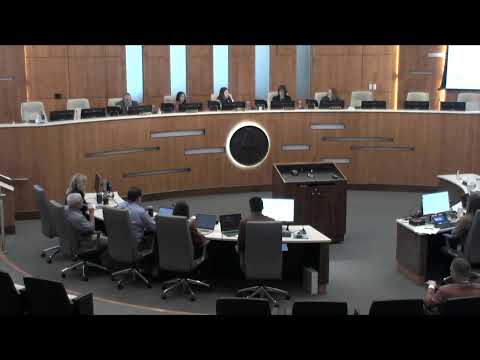
The board voted 5–0 to refer the conditional use permit for the proposed 10‑inch Magellan/1 Oak jet‑fuel pipeline back to Planning Commission so staff can vet a recently revised route and provide additional notice to newly affected property owners in Aurora and Adams County.
The Adams County Board of County Commissioners voted 5–0 on Oct. 7 to refer the conditional use permit application for the 1 Oak (Magellan) pipeline project (RCU2024‑46) back to Planning Commission so county staff can fully vet a recently submitted revised route and issue new public notice to property owners within 1,000 feet of that updated alignment.
County staff told the board last month the applicant had submitted a revised alignment the week of Sept. 25 that shifts roughly one mile west in portions of the route located within the City of Aurora. Staff said the change occurred primarily inside Aurora corporate limits at the request of land owners there and that the pipeline alignment in unincorporated Adams County had not changed. Because the revised route lies inside Aurora and impacts new owners who were not included in the original notices, staff recommended returning the matter to Planning Commission so staff could complete its review and send fresh notice to affected property owners.
The project seeks approval of a conditional use permit, an associated development agreement, and construction approvals for a 10‑inch buried refined‑product pipeline that would run about 235 miles from Scott City, Kan., to Denver International Airport (DEN). The applicant said approximately 12 miles of the overall project lie in Adams County, of which about 5 miles cross unincorporated Adams County. The pipeline would carry gasoline, diesel, jet fuel and renewable fuels; the applicant agreed in the development agreement that crude oil would not be transported unless the county later approves such a change.
Staff highlighted updates the applicant made to the development agreement in response to board questions at prior hearings: 5‑year integrity testing (smart pigging), a SCADA monitoring and remote‑shutdown system, pipeline coating and cathodic protection, pipeline coding and periodic visual inspections, as‑built GIS delivery to the county, and a requirement that the operator identify existing oil and gas infrastructure within the easement area and report any discovered orphan/abandoned flow lines. The agreement also includes language clarifying the process for property owners to request encroachment or utility crossing agreements (for driveways, parking and utilities) so long as those encroachments do not unreasonably interfere with safe operation and maintenance of the pipeline. Staff added that failure to comply with the development agreement could lead to a show‑cause hearing and potential revocation of the conditional use permit.
Denver International Airport, airport tenants and several major carriers (United, Southwest, Frontier, Delta) provided written and verbal support at the meeting, saying the pipeline would add redundancy, reduce truck traffic, and support DEN’s long‑term reliability and potential for sustainable aviation fuel deliveries. DEN planning staff and staff from the airport’s land‑side planning office described logistical constraints inside DEN property (Box Elder Creek, runway and taxiway planning, object‑free areas) and said the revised route is located adjacent to airport property where future connection could be made if DEN or the Colorado Air and Space Port require it.
Property owners and representatives raised questions about routing, potential impacts on future development, compensation, and emergency response. Contractor and pipeline operator representatives (including the selected contractor, Mears/Quanta) described safety programs, training and quality controls; Mears said it expects to use local suppliers and subcontractors and cited an estimated $1,000,000 in local Adams County spending related to construction support services. Union representatives questioned whether work on the pipeline would follow Davis‑Bacon or prevailing wage standards; the contractor said compensation is competitive and the workforce includes both union and non‑union workers and that some specialized transient crews would be brought in during peak construction phases.
Commissioners asked for clarifications on emergency response and monitoring. Staff and the applicant said first responders (local fire districts) would be initial responders, the operator would have incident response plans, and pipeline incidents are reported to state and federal regulators (PHMSA and the Colorado Department of Public Health and Environment). The applicant agreed to provide regulatory incident filings to the county when they occur and to reimburse county costs for county staff time if the county is called on to respond.
After discussion, Commissioner Mullica moved to refer the conditional use permit and updated route to Planning Commission for review and to allow staff to issue new notices to property owners and occupants within 1,000 feet of the revised alignment; Commissioner Henson seconded. The motion carried 5–0.