Get Full Government Meeting Transcripts, Videos, & Alerts Forever!
Get email alerts on the Water Operational Data And Rates topic
No spam. Unsubscribe anytime.
Punta Gorda utility advisers hear data showing water demand outpacing population; council chose 5% water-rate increase
Summary
At the Sept. 22 Utility Advisory Board meeting, Utilities Director Tom Spencer presented water and wastewater operational data showing demand rising faster than population growth. Staff reported that City Council chose a 5% across-the-board water rate increase; consultants advised larger increases to fully cover projected costs.
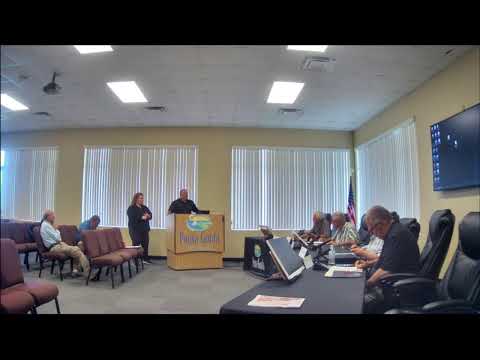
PUNTA GORDA, Fla. — At a Sept. 22 meeting of the Punta Gorda City Utility Advisory Board, Utilities Director Tom Spencer told board members that water demand in the city's service area has risen substantially faster than population, and staff reported that City Council has chosen a 5% across-the-board increase for water rates.
Spencer said the service-area population grew from about 39,900 residents in 2020 to roughly 41,600 today — an increase of about 4% — while peak day water demand rose from just over 8 million gallons in 2020 to more than 9.5 million gallons in 2023, an 18% increase. "We have the numbers to back it up," Spencer told the board.
Why it matters: city staff and the board said demand growth — driven in part by hotter, drier weather and increased irrigation — is pressuring the water system while state withdrawal limits reduce the city's flexibility. The consultant advised larger rate increases and a multi-year plan; staff said City Council opted to adopt a 5% increase for water at this time.
Key operational figures and context presented by staff: - Average daily water to town: 4,750,000 gallons; peak day to town: 6,300,000 gallons. - Total water to town during the reporting period: 147,192,000 gallons (about 780,000 gallons less than July). - Treatment capacity in service (Block 3): 11,730,000 gallons permitted production capacity. - Reservoir level: 5.47 feet on Sept. 1 and 5.5 feet at the meeting. - July rainfall: 6.99 inches; long-term average (since May 1966): 7.48 inches; drought.gov shows mixed records for monthly and year-to-date dryness. - Wastewater average daily flow: 3,360,000 gallons; 3-month rolling average: 3,170,000 gallons; peak: 4,930,000 gallons.
Regulatory and performance thresholds: staff noted the Southwest Florida Water Management District (SWFWMD) uses a gallons-per-capita-per-day (gpcd) threshold of 150; if a utility exceeds 150 gpcd it must submit a report explaining causes and conservation steps. Punta Gorda historically has run in the low 130s gpcd (staff cited figures near 130–132 gpcd), rising at times above 150; recent reporting brought the city to about 149 gpcd in the year-before-last report and around 142 gpcd in the most recent filing cited at the meeting.
Drivers of higher per-capita use discussed at the meeting included: - Climate trends: staff and board members cited higher average temperatures and reduced rainfalls that increase irrigation demand. - Demographics: board members noted a shift toward more full-time residents and possibly younger, larger households that use more water year-round compared with a larger seasonal (snowbird) population. - Irrigation and landscaping choices: staff noted turf types such as St. Augustine require substantially more irrigation than alternatives; staff and members discussed education and xeriscaping incentives as conservation tools.
Rate-setting discussion: the consultant presented options including a multi-year path that would better align revenues with projected costs. Staff reported that City Council selected a 5% across-the-board increase for water rates (the board was told the consultant had estimated larger increases would be needed over multiple years to close gaps between sewer/water costs and revenues). Board members expressed that a 5% across-the-board increase may generate necessary revenue but will not directly incentivize conservation the way tiered or targeted increases can.
Board members and staff said the city will continue to consider conservation measures, chapter 17 code revisions (which govern utilities), and potential future adjustments such as indexing to CPI or changing tiers. Spencer noted that impact fees cannot be used for maintenance or repairs and must be tied to capital improvements attributable to growth.
The advisory board requested continued detailed reporting on water meters, per-capita usage, and conservation steps; staff agreed to provide those updates at future meetings and to bring Chapter 17 revisions and related policy proposals before the board for feedback.
Ending: The board discussed timing for a joint workshop with City Council on the Chapter 17 rewrite and related topics, scheduled to be held in October; staff said it will circulate final dates and materials for that session.