Get Full Government Meeting Transcripts, Videos, & Alerts Forever!
Get email alerts on the Municipal Budgeting topic
No spam. Unsubscribe anytime.
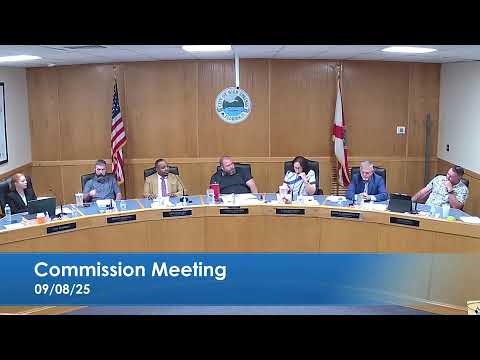
High Springs commission approves tentative millage, adopts FY2025-26 budget and several rate and contract measures
Summary
At its Sept. 8 meeting the High Springs City Commission set a tentative millage rate of 6.99, adopted the FY2025-26 budget, approved a sewer rate increase and other fee changes, and awarded multiple contracts and approvals tied to capital and grant projects.
The High Springs City Commission on Sept. 8 approved a package of budget, tax-rate, utility-rate and contract measures intended to close projected operating gaps and keep federally funded projects moving.
At a public hearing the commission set a tentative millage rate of 6.99 mills for fiscal year 2025–26, up from a rolled-back rate of 6.3438, and later adopted the city’s FY2025–26 budget by ordinance after a first public hearing. The commission also approved a separate resolution implementing sewer-rate and meter-fee changes and a set of contract and project authorizations tied to grants and capital repairs.
The millage decision and the budget vote came after staff presentations showing the city’s revenue and expense drivers: rising property valuations (which produced the rolled-back comparison), a $6.20 sewer shortfall in a prior year, a roughly $103,000 fire budget pressure, higher pension (FRS) costs and a 5% rise in health insurance premiums. Finance Director Diane Wilson described the 6.99 proposed tentative millage and explained the rolled-back calculation during the hearing.
Votes at a glance
- Resolution 2025-K (tentative millage 6.99): Approved (roll call recorded as unanimous). Motion to accept the resolution as read was made and seconded; roll-call votes recorded in the minutes show Mayor Tristan Grunder, Vice Mayor Miller, Commissioner Bloodsworth, Commissioner Howell and Commissioner White voting yes.
- Ordinance 2025-05 (adopt FY2025–26 budget, first hearing held and ordinance read into the record; final reading scheduled Sept. 22): Motion to approve ordinance 2025-05 was made and seconded; roll-call vote recorded as unanimous approval at first reading.
- Resolution 2025-M (utility-rate changes including a $24.25 monthly increase to sewer customers, new hydrant-meter deposit/fees and adjusted water/sewer impact fees): Approved (roll call recorded as unanimous). The measures include a $24.25 monthly increase to sewer customers, a proposed hydrant-meter deposit increase and a $40 monthly hydrant-meter charge with a $3.80 per 1,000-gallon irrigation-style commodity rate for outdoor use; impact fees proposed to change from $250 to $500 for water and from $2,120 to $2,400 for sewer for new connections (staff noted a typo in initial packet and confirmed the $2,400 figure).
- First amendment to the interlocal agreement with Alachua County for fire suppression and EMS/rescue services (mutual-aid payments at $865 per call): Approved (motion seconded and approved by vote).
- Award of Priest Theatre roof and structure repair to Hoffman Construction (per staff recommendation and engineer review): Approved by voice vote; work subject to State Architect review due to historic restrictions.
- Request for qualifications (RFQ) for engineering services tied to a $700,000 CDBG stormwater grant (with $50,000 local match from contingency): Authorized to be released.
- Resolution 2025-O (contract award to KCT Consulting Services for land-development-code rewrite, $90,000 flat fee, one-year term with six-month buffer): Approved (minutes record the motion passing 4–1).
- Waiver of city costs for Operation Douglas Warriors special-event permit and approval of related city support tasks: Approved.
- Temporary suspension of the city’s alcohol-consumption ordinance for the Hot Rodding for Heroes one-day event: Approved.
- Letter to Winn-Dixie corporate urging preservation of the High Springs Winn-Dixie location rather than conversion to Aldi: Approved (commission voted to send the drafted letter).
Why it matters
The package of votes affects recurring revenue and household costs: staff estimated the millage change and the utility/assessment changes together will alter household bills (finance staff gave an illustrative example of roughly $75 per year on an assumed $300,000 home for the millage increase and said the sewer/utility decisions average roughly $2.91 per household per month in a prior calculation). Several votes also authorize spending tied to grants (a CDBG stormwater grant and a state historic preservation grant for the Priest Theatre) that require timetables, state approvals and use-restrictions. Commissioners and staff noted the city’s limited reserves in enterprise funds (sewer, solid waste) and discussed selling city properties as one-time revenue to rebuild reserves.
What commission members said
Finance Director Diane Wilson summarized the technical calculations for the millage and the budget lines and answered commissioners’ questions about enterprise-fund reserves, personnel impacts and grant-related revenues. Commissioners asked for clarification about the use and timing of one-time asset-sale proceeds, the effect of upcoming garbage-contract negotiations on the solid-waste reserve projection, and whether previously approved grants (for wastewater projects) would grandfather older impact-fee rates for applicants; staff said they would check specifics on grandfathering.
The commission set a final budget hearing for Sept. 22, 2025, when it will take a final vote on the millage and adopt the budget ordinance at second reading. In the meantime, line-item changes can still be made by commission vote through routine budget amendments, staff reminded the commission.
Ending
The commission’s votes keep grant-funded projects moving and set the tax and budget framework the city will use for FY2025–26, while staff and commissioners signaled continued follow-up on enterprise reserves, contract negotiations (solid waste, police dispatch/contract issues), and the technical review of the LDC rewrite contract deliverables.