
Canoe Outpost sale proceeds restricted by Wild Spaces Public Places funds, staff say
Get AI-powered insights, summaries, and transcripts
Subscribe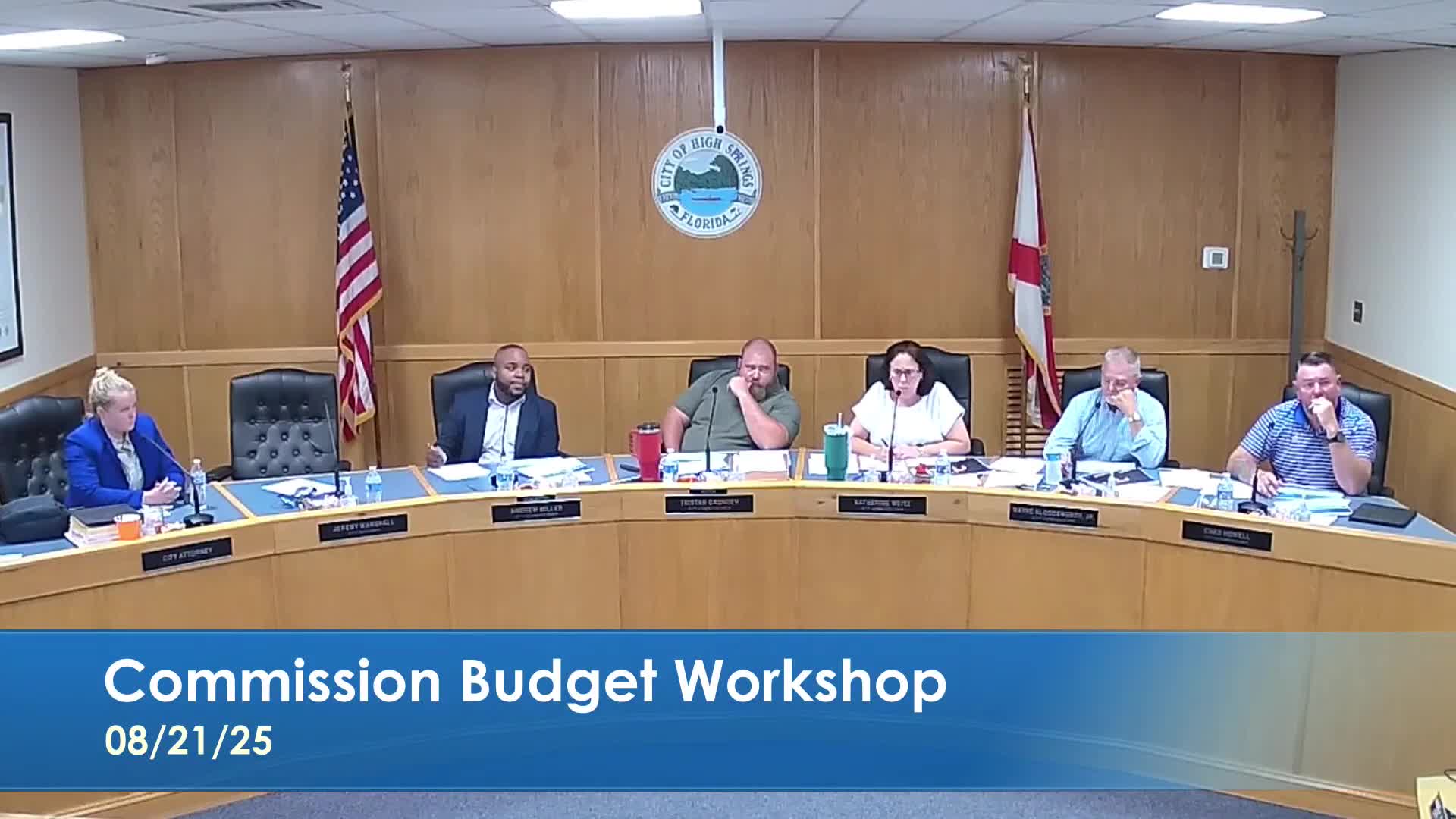
Summary
City and county staff told commissioners that proceeds tied to the Canoe Outpost are constrained by Wild Spaces Public Places funding and a conservation easement, limiting use of sale revenue for the city’s general fund
City and county staff told the High Springs commission during the Aug. 21 budget discussion that the Canoe Outpost site cannot be sold and have its sale proceeds redirected freely to the general fund because the purchase involved Wild Spaces Public Places funds and a conservation easement.
A city staff member identified as Danielle said the Wild Spaces funds must remain in the Wild Spaces Public Places program bucket and that a conservation easement travels with the property and will bind any future owner. "The first and foremost is gonna be those Wild Spaces Public Places funds. Those funds have to go back into the Wild Spaces Public Places bucket," Danielle said during the workshop.
Volunteer firefighter and former staffer Brian Langston, who worked on the initial Canoe Outpost project, told the commission he recalled a 34‑ to 35‑year clause originally intended to keep the property conserved and not available for sale or development. He urged the commission to consider public vendors or state conservation partners if the city wished to change the property’s use.
Why it matters
Marshall and other staff had discussed selling city properties to generate one‑time revenue to replenish reserves; commissioners and residents raised the Canoe Outpost as a candidate for sale. Staff cautioned that proceeds tied to Wild Spaces funding would have statutory or contractual limits on reuse and that the conservation easement would reduce marketability.
Key clarifications from staff and commenters
- Wild Spaces Public Places funds used to acquire the Canoe Outpost must remain in the Wild Spaces program; sale proceeds are not automatically available for general fund use. - The property carries a conservation easement; that easement "travels with that piece of property, and the new owner is going to be bound by the same terms and conditions that we are presently bound by," Danielle said. - A past arrangement included public‑private partners and an anonymous donor; staff reported combined funding that produced a roughly $600,000 total (staff gave differing partial figures in discussion). - Volunteer commenter Brian Langston said the initial agreement included a long restriction to prevent resort‑style development — a 34–35 year clause aimed at conservation.
Options discussed
Commissioners and staff discussed possibilities including approaching the state to consider adding the parcel to state park holdings, pursuing a public vendor to operate the outpost under conservation conditions, or preserving the site and instead selling other unconstrained city parcels to raise one‑time funds.