
High Springs faces $723,000 FY26 shortfall; city manager lays out rate hikes, service cuts and property sales
Get AI-powered insights, summaries, and transcripts
Subscribe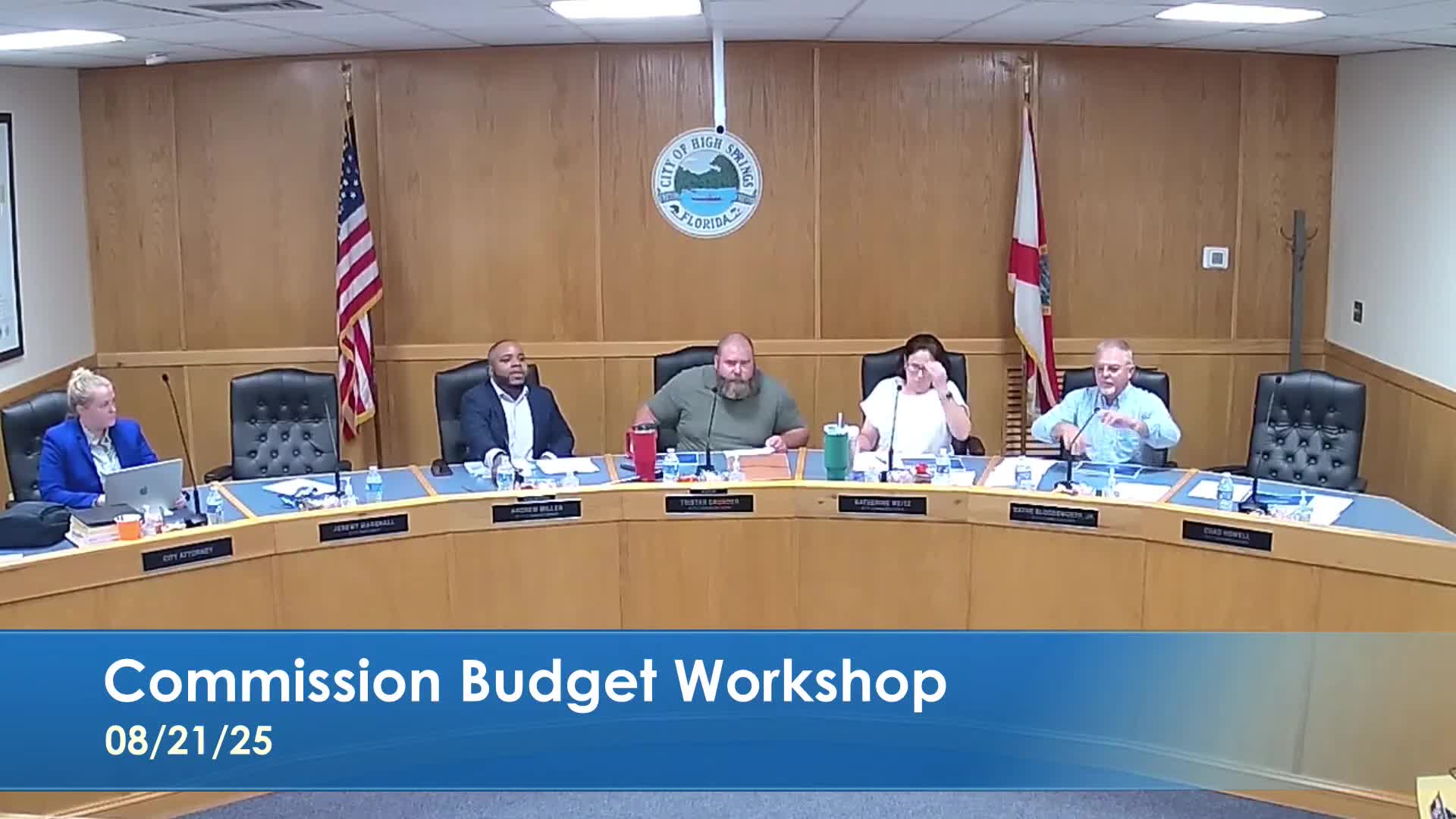
Summary
City Manager Jeremy Marshall told the High Springs Commission at a budget workshop Aug. 21 that the city faces roughly a $723,000 shortfall for fiscal year 2026 driven by reduced county fire funding and higher sewer expenses.
City Manager Jeremy Marshall told the High Springs Commission at a budget workshop Aug. 21 that the city faces roughly a $723,000 shortfall for fiscal year 2026 driven by reduced county fire funding and higher sewer expenses.
Marshall said the city learned it would lose $188,000 of contract revenue from Alachua County Fire Rescue — "That's 51% of the contract that we get from the county" — and that sewer operations are strained after building a second plant, higher hauling costs for biosolids and added staff and utility costs. "To make the budget whole for fiscal year '26, we need to find $723 or $723,000, whether it's raising rates or cutting what we have," Marshall said.
The finance director, Diane Wilson, told commissioners the sewer enterprise fund has a negative cash position and that unrestricted net positions have been drawn down since the last audit. "It has a negative cash position and that means that the cash from the general fund is a placeholder for the — it's like an interfund loan for the sewer system and obviously that's not sustainable," Wilson said. She warned the city lacks reserves to back emergency borrowing.
Why it matters
Marshall and Wilson said enterprise funds (water, sewer, solid waste) have been repeatedly used to supplement the general fund. Marshall showed pie charts for sewer and transportation revenues that, he said, had large transfers out to cover general fund expenses: for example, a $310,000 transfer from sewer and an $1,200,000 historic balance in the local option gas tax that in many years was instead shifted to the general fund for non-transportation uses. "Approximately 60% of your [sewer] expense is out the door before you touch 1 drop of sewage," Marshall said, citing debt service and grinder-pump costs.
Key numbers and constraints
- Total gap to close for FY26: roughly $723,000 (Marshall's figure). - County fire contract reduction: $188,000 (described as 51% of the county contract). - Sewer shortfall component cited repeatedly in the workshop: about $620,000. - Noted annual debt payments in the sewer budget: a USDA loan costing $457,000 a year (until 2043, per presentation), AMI meter debt $84,000, Mowermax-related debt $63,000, and grinder-pump repair/replace costs around $360,000. - Transfer from sewer to general fund: $310,000 (presentation slide). - Cost to replace all grinder pumps (presentation estimate): roughly $2,800,000; individual grinder pumps cited at about $2,000 each with a typical life of roughly 10 years.
Options presented
Marshall presented scenarios commissioners requested or suggested. He emphasized he disliked each option but said the city must act.
- Eliminate the municipal fire department: Marshall said that would remove a $1,000,000 transfer from the general fund and make utilities healthier, but residents would move to county fire assessment rates that staff said are much higher. "If we got rid of the fire department, you will fall underneath the county, and they will get you will fall underneath their fire assessment. Their fire assessment is significantly higher than ours," Marshall said. He used an example of an adjacent county resident paying $768 a year vs. a city residential rate of about $223. He warned loss of local control and likely reduced staffing/response model under county service.
- Reduce fire staffing (several levels): Reducing to a four-person shift (two firefighters and one lieutenant plus one paramedic on shift, per Marshall's scenario) would lower the general-fund transfer from $1,000,000 to around $573,000 and partially close the gap. Reducing to three per shift would cut further but would limit the department to running a single truck. Marshall said cutting staffing would still require a sewer rate increase and a modest fire-assessment bump.
- Raise utility rates and/or millage: Marshall presented rate options including modest recurring increases or a full catch-up. Examples discussed included a sewer increase of about $13.25 per month as a partial step and a larger one-shot increase of about $624.25 (presented as a scenario that would address the sewer deficit in a single adjustment). He also proposed restoring part of a prior millage reduction (an eighth mill) that staff estimated would cost a homeowner with a $300,000 taxable value roughly $331.50 per year.
- No raises and service cuts: Marshall said freezing raises would still require a sewer rate increase and would risk staff retention. He noted police negotiations were ongoing and said the city had prioritized competitive pay for recruitment and retention.
- One-time property sales: Marshall recommended selling surplus city real estate (Priest Theatre and other lots were discussed) and using one-time proceeds to replenish reserves rather than fund recurring operations. He cautioned proceeds would be one-time fixes. He also noted some properties are constrained by outside funding or covenants (see separate item on Canoe Outpost and Wild Spaces Public Places funds).
Other revenue ideas discussed by staff and commissioners
- Trash/solid-waste contract: Commissioners discussed changing or rebidding the town's trash contract; Vice Mayor Miller projected trash at existing rates could generate roughly $200,000 a year if the contract were restructured (see separate article on the solid-waste discussion). - Timber/pine-straw sales on city-owned acreage: staff estimated small revenues (example: $10,000/year for pine-straw sales on 86 acres) — described as "drops in the bucket" relative to the multi-hundred-thousand-dollar deficits. - Leasing or selling low-value lots, unpaid tax-foreclosure parcels and other unused buildings: Marshall said the city pays maintenance and insurance on properties leased to nonprofits for nominal rents and recommended aggressive disposition to build reserves.
Public comments and political context
Dozens of residents spoke during the workshop and at the later commission meeting. Multiple speakers urged preserving the city’s fire and police services. Volunteer and retired firefighters described community programs provided by the department (CPR, car-seat checks, outreach) and argued local control and staffing levels matter for response times. Parents and residents described personal medical emergencies in which local firefighters or paramedics were credited with timely lifesaving care.
Several residents suggested new revenue ideas — local events, a marathon, fundraising for the fire department, annexation of nearby pockets of county property to broaden the tax base, and stricter enforcement of utility collections — and urged the commission to minimize harm to fixed-income residents.
Where the process goes next
Marshall said the presentation was intended to show raw data and options and asked the commission to adopt a path forward. Commissioners paused the workshop to conduct a regularly scheduled commission meeting and indicated public comment on the topic would continue when the workshop was reconvened.
Ending note
Marshall repeatedly framed the choice as recurring revenue versus recurring cuts: "Either you raise the rates or you cut the cut it. That's or cut the service. That's how you're gonna get out of this." He urged the commission to avoid relying on one-time sales as a permanent solution and to replenish utility reserves if one-time proceeds are obtained.