
Commission selects revenue-only budget fix; approves sewer rate increase and other measures after hours-long debate
Get AI-powered insights, summaries, and transcripts
Subscribe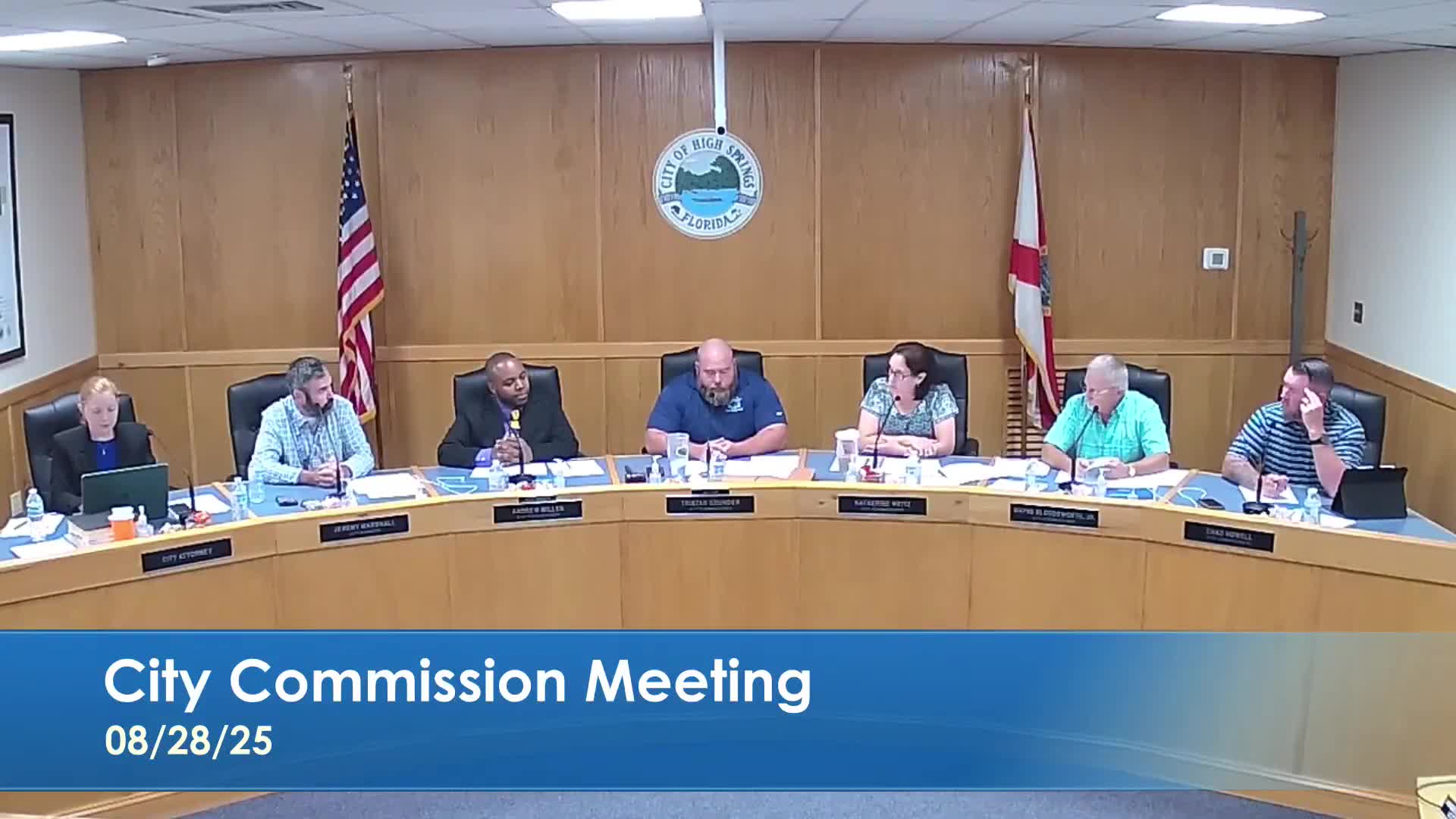
Summary
After lengthy discussion of a $620,000 sewer deficit, a $103,000 fire deficit, grinder-pump costs and utility transfers, the commission approved a revenue-focused budget scenario that raises utility rates and millage; commissioners also approved a 25% reduction to commission pay.
After a more than three-hour budget discussion, the High Springs City Commission approved a revenue-focused budget package Aug. 28 designed to address multiple deficits and shortfalls, including a projected $620,000 shortfall in the sewer fund and a roughly $103,000 shortfall in the fire fund.
City staff presented several scenarios in advance of the Sept. 8 and Sept. 22 budget hearings. The scenario the commission adopted (referred to in staff materials as Scenario 1) relies primarily on rate and tax increases to avoid service cuts. Under staff's presentation, Scenario 1 would require an increase in the sewer customer charge of about $24.25 per month (staff presented this as $24.25 per month in sewer-only charges) and a quarter-mill increase in the city's millage rate to cover general fund needs. Staff estimated the combined household impact of the revenue-first option as about $402 per year for a representative $300,000 taxable-value home. Commissioners were repeatedly told that the increase would make the city whole for the coming year but would not, by itself, fully resolve longer-term structural problems such as enterprise fund transfers to the general fund and a lack of utility reserves.
Other options presented during the meeting included (a) smaller rate increases plus cuts to personnel and (b) deeper operational changes such as reducing fire-shift staffing from five to four personnel per shift and negotiating with Alachua County for county fire response. Staff warned that cutting personnel in fire and police would reduce service levels and could increase response times or require county support. At length, commissioners discussed the trade-offs among preserving public safety staffing, giving city employees raises, and spreading costs to utility customers and property-tax payers.
Commissioners also debated several related items: continuing the city's historical practice of repairing and replacing grinder pumps on properties forced onto the city sewer system, the use and limits of impact fees, and the timing of contracts for garbage collection where the city could achieve savings by renegotiating or piggybacking on another municipality's contract.
On the grinder pump issue, commissioners and staff discussed options including (1) continuing city repairs as pumps fail, (2) moving to a maintenance-fee model paid by all wastewater customers or specifically by grinder-pump customers, or (3) shifting ownership/cost responsibility to property owners after a transition period. Staff said a nominal $2 monthly maintenance fee applied across 1,900 wastewater customers would yield about $45,600 annually, while a fee large enough to fund full pump replacement would be significantly higher (staff noted a hypothetical $34 per month over five years would be required to fully fund replacements). Commissioners asked for an exemption for residents who demonstrate financial hardship if the city moves to more cost-sharing for grinder pumps; staff said a hardship exemption could be administered but that details must be defined.
After public comment and extended deliberations, a commissioner moved to adopt Scenario 1 (the revenue-first plan). That motion was seconded and carried by voice vote. Commissioners then approved an amendment that reduces the commission's own salaries by 25% for the budget year; that amendment also passed by voice vote. The commission instructed staff to incorporate the adopted changes into the budget materials for the Sept. 8 budget hearing so the required advertising could be prepared.
City staff warned repeatedly that Scenario 1 is primarily a one-year fix: the city would still need to address long-term enterprise fund transfers, underfunded reserves and the potential year-to-year impacts of inflation and rising costs. Staff also urged the commission to finalize any contract negotiations and fee changes quickly because there are only a few working days to incorporate changes into the published budget materials for the first hearing.
The commission's approval sets interim direction: staff will produce revised budget documents reflecting the rate and millage increases and the commission pay cut and will return those documents for the public hearings required in September.