
Livonia council to place Flock license-plate readers on Oct. 6 consent agenda
Get AI-powered insights, summaries, and transcripts
Subscribe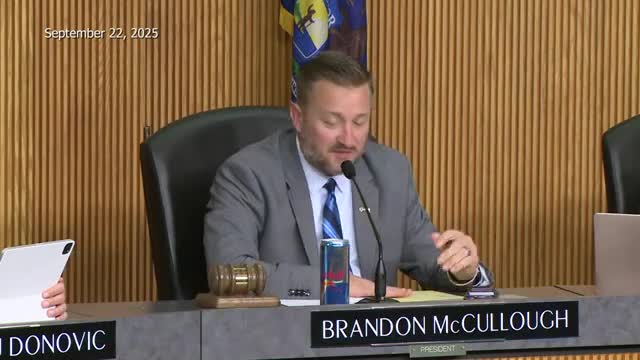
Summary
At a Sept. 20 Livonia study session, the police department presented a plan to lease Flock Safety license-plate reader cameras; councilmembers agreed to place the purchase on the Oct. 6 regular meeting consent agenda. The system will be paid in part by a state Auto Theft Prevention Authority grant and by forfeiture funds, officials said.
At a Sept. 20 study session, the Livonia Police Department asked the City Council to waive formal bidding and authorize the purchase and lease of Flock Safety license-plate reader (LPR) cameras and related software; councilmembers agreed to place the item on the Oct. 6 regular meeting consent agenda for formal action.
The request, presented by the police chief, called for an initial installation of about 35 cameras across the city — described as 21 standard flat cameras, about 10 long-range cameras and two dual-solar LPR bundles — and an enhanced LPR software upgrade to share alerts with regional law-enforcement partners. “License plates are public and can be read by anybody and run by anybody including local law enforcement,” the chief said, and added the department had secured a state Auto Theft Prevention Authority grant to cover roughly 37% of the first year’s cost, “which is about $60,000.”
The proposal drew several council members’ backing during the study session. Councilman Morgan offered to place the item on consent, and other members signaled support. The chief told the council the vendor, Flock Safety, would lease and maintain the equipment rather than the city owning and servicing the cameras.
Council members and the chief discussed scope and privacy. The chief said the system focuses on license-plate recognition and vehicle descriptions and “is not facial recognition,” addressing resident privacy concerns raised on social media. He also described regional interoperability, saying the upgraded subscription would allow the department to share plate alerts with neighboring jurisdictions and statewide law enforcement.
Funding and procurement details were discussed but not finally decided at the study session. The chief said the first year carries the highest infrastructure costs and that the purchase would be funded with the grant and law-enforcement forfeiture funds, not from the city’s general fund. One council member referenced a two-year contract figure of $295,000 discussed in the packet; the chief said first-year infrastructure makes the initial year the most expensive and that future-year costs could change.
Supporters highlighted public-safety uses beyond criminal investigations, including locating missing or medically vulnerable residents. The chief recounted regional examples where LPR systems helped locate missing people and suspects.
Opponents and some residents had raised privacy or oversight questions during public comment earlier in the meeting, but no council member moved to block the item at the study session. The council’s agreement to place the purchase on the Oct. 6 consent calendar means the formal vote on the waiver and contract authorization will occur at that regular meeting.
If council approves on Oct. 6, the city would proceed with the Flock Safety lease and software subscription as described; the transcript did not record a formal roll-call vote during the study session.